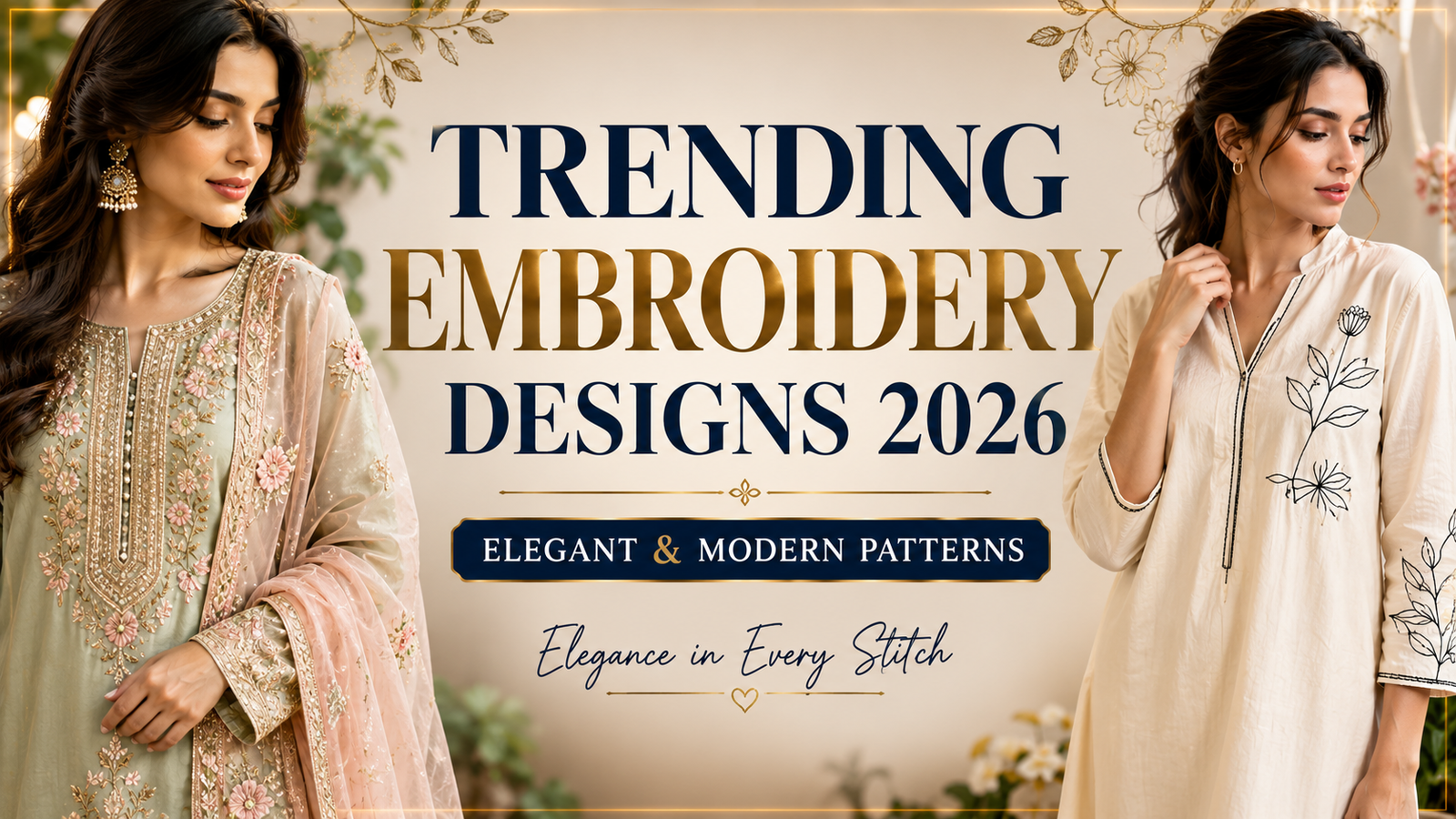
Shoppers treat “embroidered” as a single filter, the way they treat “cotton” or “black”. That habit is the reason so many embroidered purchases sit unworn. The trending embroidery designs 2026: elegant & modern patterns are not variations of one look — they are two different vocabularies, built for different rooms, different budgets and different lifetimes. Buying from one and styling by the rules of the other is what makes an expensive garment look confused.
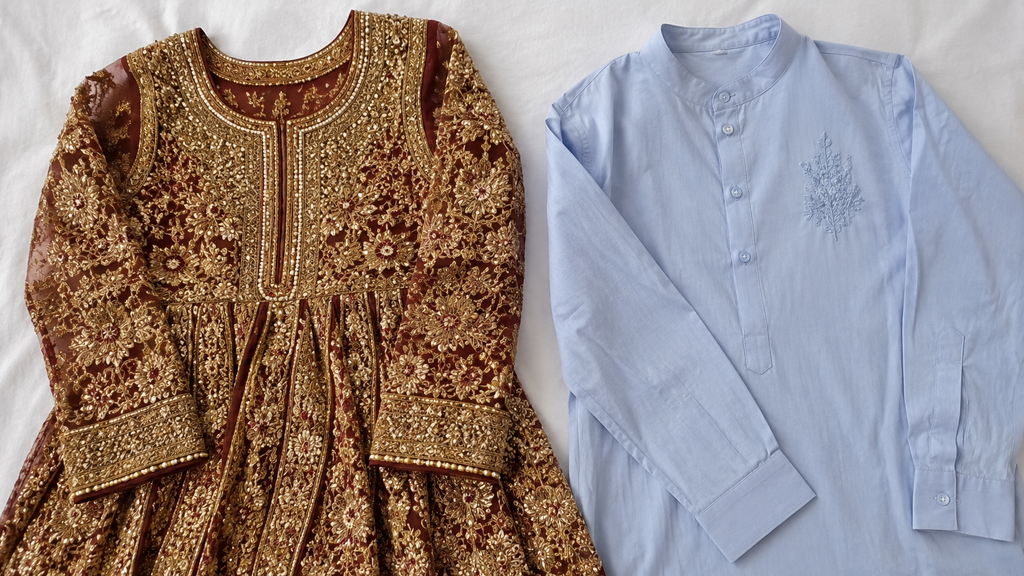
Quick Answer: Embroidery in 2026 runs along two tracks. The elegant track is dense and ornate — layered florals, scrollwork, metallic thread and beading spread across whole panels, made for formal occasions. The modern track is spare and graphic — one line-drawn motif, tonal thread or raised stitching placed on a single point of a plain garment.
Learn to identify which track a piece is on within a few seconds, and the rest of the decision — pair it, price it, keep it or skip it — takes care of itself.
Trending Embroidery Designs 2026: Elegant & Modern Patterns At A Glance
The card: Two vocabularies, eight points of separation. Scan the table, then read only the sections that concern you.
| Elegant (Ornate) | Modern (Minimal) | |
|---|---|---|
| Motif language | Layered florals, vines, medallions, scrollwork | Single-line drawings, geometry, initials, symbols |
| Surface covered | Roughly half the panel, sometimes all of it | A few square centimetres, one location |
| Thread character | Lustrous, metallic, beaded, multi-tonal | Matte, tonal, or raised in a single colour |
| Colour logic | Contrast — the design fights the fabric | Harmony — the design whispers to the fabric |
| Best base cloth | Silk, velvet, brocade, stabilised organza | Poplin, denim, linen, jersey, wool |
| Occasion width | Narrow — celebrations, formal evenings | Wide — daily, professional, travel |
| Price behaviour | High entry, slow decline | Moderate entry, fast decline if graphic |
| Ages well when | Hand-finished on a classic silhouette | Motif is abstract rather than topical |
Every row above is a decision in disguise. Here is the reasoning behind each one.
Motif: Filling A Shape Versus Drawing One
The card: Ornate embroidery covers. Modern embroidery marks.
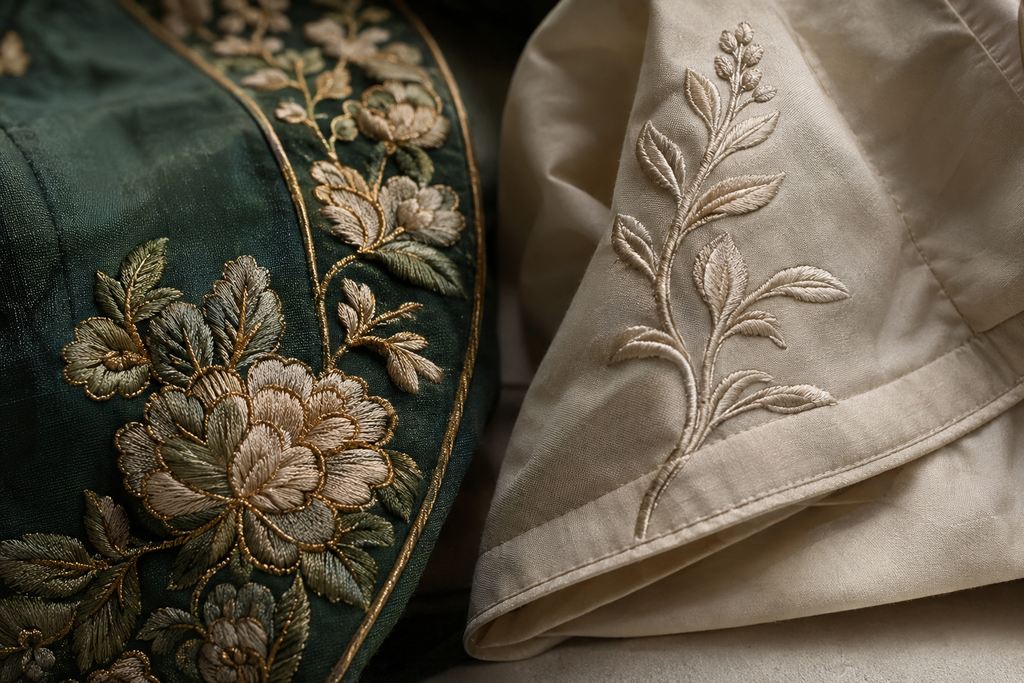
The ornate vocabulary is additive. A flower is not suggested — it is constructed, petal over petal, with shading built from three or four thread tones. Stems trail. Borders repeat with deliberate irregularity. Your eye is supposed to wander and keep discovering, which is precisely why these pieces photograph so well at close range and hold attention in a crowded room.
The minimal vocabulary is subtractive. One unbroken line describes a stem, a bird, a mountain profile, a pair of initials. Nothing is filled. The skill sits in what the designer left out, and the effect depends entirely on the emptiness around it.
Sitting between the two is the most useful category of 2026: traditional motifs redrawn at a smaller, simpler scale. A folk flower reduced to a dozen stitches. A geometric border shortened to a single repeat at a cuff. It carries the weight of a craft tradition — and those traditions belong to every part of the world, from Andean geometry to Japanese sashiko lines, from Central Asian medallions to West African appliqué shapes — without the volume of a full ceremonial garment. If you can only buy one embroidered piece this year, buy from this middle ground.
A quick quality signal: real ornate design varies. Motif sizes shift, directions rotate, densities change across a panel. When every flower is identical and evenly spaced, you are looking at a repeated file, not a designed surface.
Thread And Texture: The Genuine Shift This Year
The card: In 2026, embroidery is asking to be touched before it asks to be seen.
The flat, shiny satin stitch that carried the last decade no longer differentiates a garment. Three approaches have taken over:
Raised and padded work. Foam or padding beneath the stitching lifts the motif clear of the cloth. It arrived through caps and sportswear and has since travelled onto collars, cuffs, knitwear and outerwear. A single raised motif reads as expensive. A whole panel of it reads as team kit.
Tonal stitching. Thread chosen within a shade or two of the base fabric, so the pattern only appears when light strikes the stitch direction. This is the quietest way to own a decorated garment, and it is why tonal pieces move so easily between a workplace, a dinner and a flight.
Layered surface construction. Appliqué panels, padded satin, corded outlines and small raised elements built in stages. This belongs firmly to the ornate side and is the honest difference between a garment that was made and one that was printed to imitate being made.
Metallic thread survives, but its role has narrowed in everyday clothing. As an outline around a matte motif, or a thin highlight inside an otherwise restrained design, it looks current. As the whole design, on an everyday garment, it now looks like a leftover from an earlier season. Formal and ceremonial dress is the exception everywhere in the world — heavy metal-thread work has its own centuries-old logic and answers to nobody’s trend cycle.
Placement: Small Decisions That Change Everything
The card: With minimal embroidery, where it sits is the design.
Ornate work goes where the garment is broadest and stillest — the front body, the hem band, the yoke, the back of a coat. It needs a calm, flat field to be read properly.
Minimal work goes where the eye naturally rests for a moment: a collar point, the edge of a cuff, the top of a pocket, the outside of a sleeve near the elbow, the base of a back neckline. Off-centre beats centred almost every time. A motif placed a hand’s width to one side of the chest looks authored; the same motif placed dead centre looks like stock.
The placement worth actively seeking this year is the back anchor — a small design at the centre back neck, or between the shoulder blades of a coat or jacket. It stays invisible while you are seated, appears as you walk away, and never argues with a necklace, a bag strap or a scarf.
One rule covers most styling errors: allow a single embroidered event per outfit. If the top carries the work, everything else stays quiet. If the outer layer carries it, what sits underneath should be plain. Two decorated pieces can share an outfit only when they belong to the same vocabulary and the same colour family.
Fabric: What Can Actually Hold The Stitching
The card: Heavy work on light cloth is the most common failure in this whole category.
Dense embroidery weighs something. Set it on unlined chiffon or thin viscose and the fabric puckers, ripples around each motif, and pulls out of shape at the shoulder seam within a season of wear. Ornate work wants structure beneath it: silk with proper backing, weighty crepe, velvet, brocade, or organza that has been stabilised and lined by someone who understood the load.
Small-scale work is far easier to place. Cotton poplin, linen, denim, mid-weight knit and wool all accept a modest motif and keep their shape through ordinary washing. That tolerance is a large part of why the minimal vocabulary owns the everyday wardrobe.
Run one check before any purchase, in any price bracket. Turn the garment inside out and study the reverse of the stitching. What you want is tidy, secured work with clean edges. What you do not want is long loose threads floating between motifs, or a stiff paper-like backing left permanently in place — the first snags and unravels, the second cracks and leaves a hard patch after a few washes.
Colour: Harmony Versus Contrast
The card: The modern track lowered its voice. The elegant track kept shouting, and it is right to.
Everyday embroidery in 2026 sits in a grounded, warm range — soft moss, clay, oat, dust grey, faded olive, chalk. Thread stays close to the cloth and lets texture carry the interest. It suits pared-back wardrobes and disappears politely under a coat.
Occasion embroidery does the opposite and should. Ivory against warm gold, deep green against bronze, black against silver, plum against blush. These garments are read from across a room in low, warm light, and contrast is what makes the work legible at that distance.
The trouble starts when the two palettes meet. Tonal, earthy embroidery layered under a high-contrast decorated shawl or jacket reads as two unrelated garments that happened to arrive together.
Cost Per Wear: An Honest Look At The Numbers
The card: The costly piece is often the cheaper one — but not always, and the exception matters.
An ornate occasion garment carries a high price and a low wear count. Ten wears across several years is realistic. Yet properly hand-finished work holds its appearance and its resale value, because dense craft does not date the way a graphic does; it simply becomes older, and older is not a flaw in this category.
A small embroidered shirt costs a fraction of that and may be worn dozens of times a year. Its risk is different. If the motif is topical — a slogan, a current typographic style, a reference that belongs to this moment — the garment ages out long before the cloth does.
Where the money goes furthest in each track:
- Elegant: within your budget, choose the piece with the least coverage and the best thread quality. Restraint executed well outlasts abundance executed cheaply, every time.
- Modern: choose abstract over lettered. Lines, leaves and geometry stay readable for years. Words announce their year of birth.
Coverage-Friendly Styling: Detail Without Exposure
The card: Embroidery is the rare trend that improves when there is more fabric to work with.
Readers who prefer longer sleeves, higher necklines and fuller hems — for reasons of climate, culture, profession or plain preference — have an advantage here. More cloth means more canvas, and embroidery rewards canvas.
- Sleeve-led decoration. Work running from cuff toward elbow puts the detail exactly where hands and gestures draw the eye, and nowhere else.
- Neckline framing. A decorated band around a high, closed neckline lifts attention toward the face and removes any need for a lower cut to create interest.
- Weighted hems. A dense band low on a long dress adds visual mass at the base, which lengthens the line and helps lighter fabrics hang straight instead of drifting.
- Decorated outer layers. A plain long dress under an embroidered open coat gives you a finished outfit and two independent wardrobe pieces.
- Tonal on tonal. For conservative offices or settings where you would rather not be noticed, tonal work on a neutral base gives you detail that only close-range viewers register.
Care: Most Damage Comes From Heat, Not Water
The card: Embroidered clothing rarely dies in the wash. It dies in the dryer and under the iron.
Turn decorated garments inside out before washing, use cool water and the gentlest cycle available, and keep them out of tumble dryers entirely. Heat is what makes metal-wrapped thread go brittle and what flattens raised work permanently.
Never press directly onto stitching. Work from the reverse with a cloth between the plate and the garment, and lay raised motifs face-down on a folded towel so the padding is not crushed.
Which Should You Choose?
The card: Choose by the life you actually live, not by the piece you admire most.
If you attend several formal occasions a year — weddings, celebrations, evening events — buy on the elegant track, buy rarely, and prioritise thread quality over surface area. One well-made ornate garment outperforms three mediocre ones, and it will still be wearable when they are not.
If you are building a working wardrobe — office, campus, daily life — buy on the modern track and lean tonal. Two or three pieces will change the character of an entire rail of plain basics and will survive ordinary laundering.
If your budget is tight — go small and go well-made. A single crisp motif on good cloth beats a heavily decorated garment on poor cloth, and the difference is obvious from across a room.
If you want one piece that covers both roles — traditional motif, reduced scale, tonal thread, structured neutral base. Dressed up it looks intentional; dressed down it looks like quality [internal link: capsule wardrobe basics].
If you are buying something to keep for a decade — hand-finished ornate work on a classic shape, in a colour already established in your wardrobe. Avoid lettering, avoid anything referencing this particular year, and avoid any garment whose only reason for existing is its decoration.
Key Takeaways
- Embroidery in 2026 operates as two separate vocabularies — ornate and minimal — with opposite rules for coverage, colour, cloth and placement.
- Texture is the year’s genuine change: raised, padded and tonal work now signals quality more reliably than shine does.
- One embroidered element per outfit, unless two pieces share both vocabulary and colour family.
- Check the reverse of the stitching before buying. Loose floats and stiff permanent backing predict a garment that will lose its shape.
- Longer sleeves and fuller hems give embroidery more room to work, making this a trend that favours covered dressing rather than resisting it.
- Abstract motifs age slowly. Words and topical references age quickly.
Your Next Five Steps
- Sort what you already own. Put every embroidered piece into ornate or minimal. Most wardrobes are heavily weighted to one side, and the empty side is your next purchase.
- Correct the pairings before spending anything. Restyle two existing outfits so only one decorated element appears in each. It costs nothing and improves both immediately.
- Add one tonal piece. A tonal shirt, knit or jacket is the highest-use, lowest-risk way into this year’s look.
- Make the reverse check a habit. Inside out, examine the back of the stitching, then decide — in a boutique or online, ask for that photograph.
- Rehang your heavy pieces this week. Moving decorated garments onto padded hangers is the cheapest protection available for anything you have already paid for.
FAQ
What Defines Embroidery Style In 2026?
Dimension. Raised, padded and layered stitching has displaced flat shine as the marker of a current piece, and tonal thread has risen alongside it. The design is meant to register as a surface you could run a finger across, not just a picture sitting on cloth.
Has Heavy Ornate Embroidery Gone Out Of Fashion?
No — its territory has simply narrowed. Dense decorated work remains entirely correct for formal and celebratory dress worldwide. It is everyday clothing that moved toward restraint, where coverage has dropped to a single well-chosen motif.
Which Thread Colours Are Popular Right Now?
Two separate answers. Daily pieces favour grounded warm neutrals kept close to the fabric shade. Occasion pieces stay with strong contrast — golds, bronzes, silvers and saturated colour set against ivory, black or deep grounds.
How Can You Tell Good Embroidery From Poor Embroidery?
Three checks. Look at the reverse for clean secured stitching, look at the front for variation in motif size and direction, and weigh the cloth against the density of the work. Uniform repetition and thin fabric under heavy stitching both signal a garment that will disappoint.
Is It Ever Acceptable To Wear Two Embroidered Pieces Together?
Yes, when both belong to the same vocabulary and colour family — a tonal decorated shirt with a tonal decorated jacket, for example. Combining an ornate metallic garment with a minimal line-drawn one makes both look accidental.
Does Embroidered Clothing Work In Warm Climates?
It does, provided the base cloth is right. Fine cotton, linen and lightweight silk take small-scale work comfortably and stay breathable. Reserve dense padded and beaded construction for cooler weather or short formal wear, since layered stitching traps heat.