
Embroidery Fashion Trends 2026: The Most Beautiful Dress Ideas
Most people shop an embroidered dress with their eyes closed to the only thing that matters. They look at the pattern — the roses, and the vines, the little scattered stars — and never once ask how those shapes were made. That single blind spot is why so many very beautiful-looking dresses arrive, get worn twice, and quietly move to the back of the wardrobe.
The story of the embroidery fashion trends 2026 is really a story about the method winning over motif. This was the year the surface of a dress had to be felt as much as seen: stitching with the height, edges with weight, thread that behaves very like thread and not like a printed line. Learn to read that very difference and you will never overpay for a decoration again.
QUICK ANSWER
Embroidery fashion trends 2026 favour texture over pattern — raised and padded stitching, genuine cutwork, tone-on-tone thread and dense heirloom-style needlework. The most beautiful dress ideas concentrate all that work into one zone, usually a bodice, sleeve or hem, and leave the rest of the garment completely plain.
Key Takeaways
- Texture is the trend. If the surface has no height, it is decoration pretending to be craft.
- One embroidered zone looks expensive; embroidery everywhere looks like a costume.
- True openwork has bound edges. Punched or printed holes will always betray the dress in daylight.
- Thread colour matters less than thread density. Sparse stitching cannot be rescued by a pretty motif.
- Heavy beadwork is a construction problem before it is a design one.
- Every fault described below can be spotted in a photograph, in a shop, or in your own wardrobe tonight.
Why So Many Embroidered Dresses Disappoint
Embroidery is the oldest way humans have decorated cloth, and almost every part of the world has its own version — metallic thread work across South Asia and the Gulf, whitework and openwork across Europe, bright folk motifs across Eastern Europe and Latin America, fine silk figuring across East Asia. Not one of those traditions was built on speed. All of them were built on density, patience and thread that sits above the cloth.
Modern mass production reverses that. It reproduces the appearance of embroidery — the layout, the colour, the placement — while cutting the two costs that create the effect: stitch count and thread quality. The motif survives the shortcut. The beauty does not.
So instead of another list of pretty things, what follows is a set of symptoms. Each one names what you’re seeing, explains why it happens, gives the fix, and gives you a test to prove the fix worked.
Problem 1: The Dress Looks Like A Costume, Not Clothing
The symptom. Nothing about the fit is wrong, yet the dress announces itself before you do. Photographs of it feel theatrical rather than stylish.
The cause. The embroidery has been spread evenly from shoulder to hem. Without a quiet area, the eye has no rest and no hierarchy, so the garment reads as a decorated object rather than something a person is wearing. Full-surface embroidery is a genuine tradition, but it depends on a heavy base cloth, a structured lining and a fit built around the weight — three things that vanish first in low-cost production.
The fix. Buy concentration, not coverage. The strongest shapes this year all gave the stitching a single territory:
- A dense bodice above an entirely plain skirt
- A motif that rises from the hem and stops at the knee
- Sleeves worked heavily, with the body of the dress left bare
- One vertical band running down a single side seam
- A worked neckline that fades out by the ribcage
How to confirm it worked. Step back three metres from a mirror. You should be able to describe where the embroidery lives in one short sentence. If the honest answer is “all over it,” the dress is louder than you are.
Problem 2: The Stitching Vanishes In Every Photograph
The symptom. In your hands the dress feels lovely. On camera it flattens into a printed pattern and loses everything that made you buy it.
The cause. No relief. Thin, widely spaced stitching lies at the same level as the fabric, so nothing casts a shadow — and a lens reads unshadowed surface as flat pattern. This is the widest gap between a designer piece and its high-street echo, and it is almost invisible in a well-lit product photo shot straight on.
The fix. Look for three kinds of height. Padded work, where a filling underneath lifts the motif clear of the cloth. Appliqué, where a shaped piece is stitched on top rather than into the surface. And thread with a directional sheen — silk, viscose or fine metallic — which catches light at different angles as you move and creates depth even where the stitch itself is low.
KEY POINT
Shadow is the proof. Hold a phone torch at roughly forty-five degrees to the fabric. Real relief throws a small shadow behind every motif. Flat work stays blank.
How to confirm it worked. Photograph the dress outdoors on a grey, overcast day — the least generous light available. Genuine raised stitching still reads. Anything that disappears was never going to survive a wedding album.
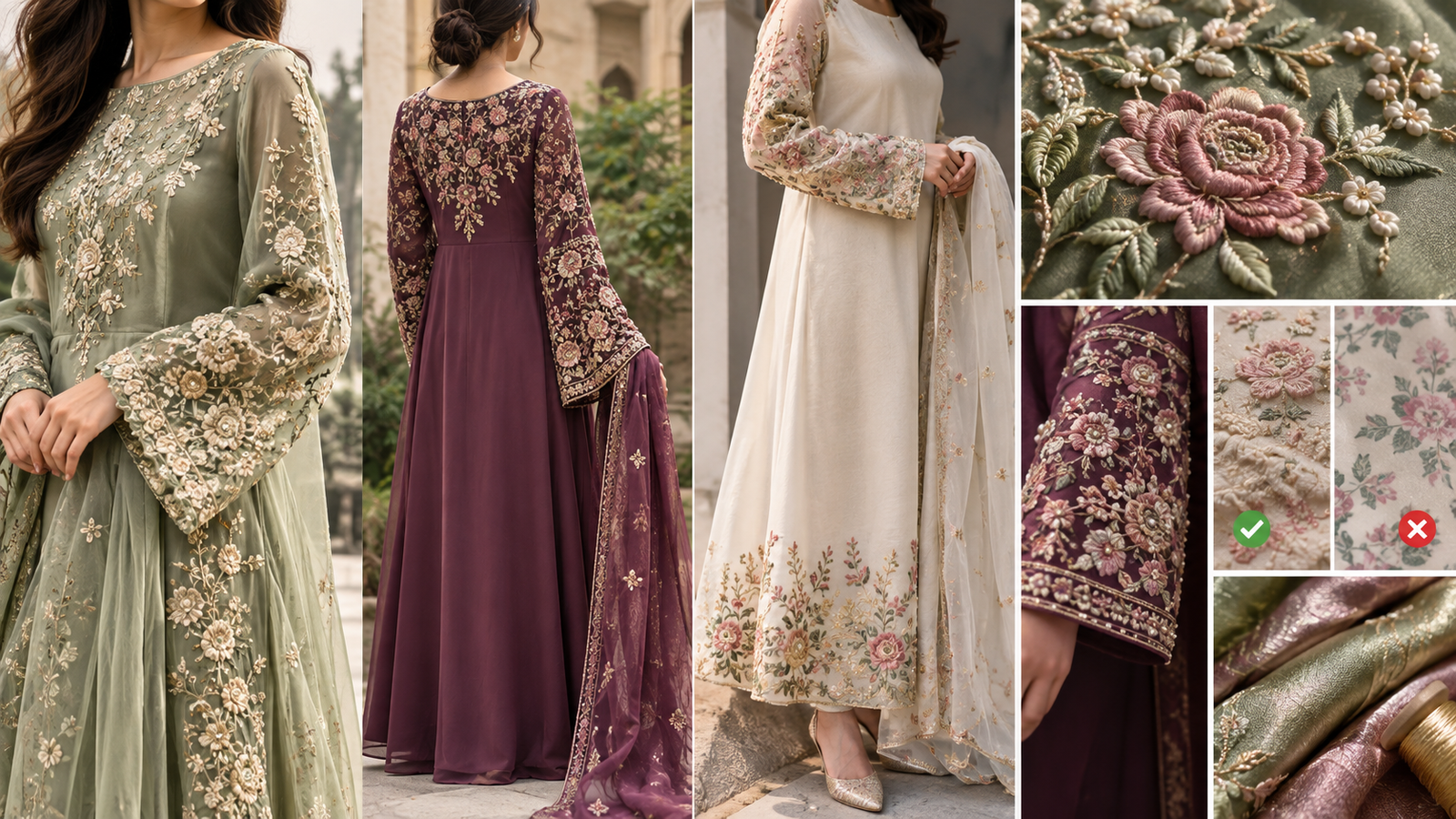
Problem 3: White Cutwork Turns Grey And Papery
The symptom. Openwork cotton dresses were everywhere this year, in every climate and at every price. They were also the single biggest source of disappointment, because they look immaculate online and thin in real life.
The cause. Two failures that usually arrive together. First, the holes were punched or printed rather than cut and then bound with stitching, so the raw edges fray, soften and grey within a handful of washes. Second, the lining is either missing or made of a slick synthetic that clings, shines and shows through the openings in strong sun — which matters enormously in hot, bright regions where this style is actually worn.
The fix. Genuine openwork always has a stitched border encircling every the hole. Hold the cloth up to a window: light should pass cleanly through, and the surrounding stitch should look slightly raised and a rope-like rather than glued or melted. Prefer a cotton or the fine viscose lining cut separately, not a fused inner layer.
How to confirm it worked. Wash it once, cold, inside a mesh bag. Properly bound openwork comes out with crisp intact edges. Imitation begins pilling around the holes immediately, and the whiteness dulls after a single cycle.
Problem 4: Every Piece Feels Dated Within One Season
The symptom. You keep buying into the look, and you keep replacing it.
The cause. You are buying motifs. A motif is the cheapest element to copy and the first to saturate, which means it ages at the speed of the internet. Craft ages at the speed of the garment.
The fix. This is the whole argument behind heirloom embroidery, the strongest and most durable direction inside embroidery fashion trends 2026. The idea is simple: a dress should look inherited rather than bought. Dense, hand-finished stitching. Softened, slightly antique colour. Motifs drawn from a real tradition rather than invented for a season. It works because it borrows authority from time instead of from novelty.
You do not need a couture budget to apply the principle. You need to spend in this order — density first, thread quality second, motif last.
KEY POINT
Good stitching carries an unfashionable motif. A fashionable motif cannot carry bad stitching for more than a few weeks.
How to confirm it worked. Ask yourself whether you would still wear the dress if the pattern were slightly different. Yes means you bought craft. No means you bought a trend, and it will expire on schedule.
Problem 5: The Embroidery And The Silhouette Fight Each Other
The symptom. The fit is right, the stitching is genuinely good, and the outfit still refuses to work.
The cause. Two statements competing for the same attention. Heavy surface texture is structural in its own right, so pairing it with an equally assertive shape — sharp shoulders, extreme volume, a strong waist break — gives the eye two arguments at once and lets it settle on neither.
The fix. Let one element lead and make the other recede:
- An ornate bodice above a soft, fluid, unstructured skirt
- Sharp tailoring with tone-on-tone embroidery only, so texture registers without pattern
- A sheer overlay carrying floral work above a plain slip beneath
- A clean, hard coat over an embroidered dress, so the stitching appears only in movement
- Deep, saturated fabric with thread just one shade away from it
How to confirm it worked. Walk across the room. If the embroidery reveals itself in motion rather than shouting while you stand still, the balance is correct.
Problem 6: Beadwork Sags, Pulls And Snags
The symptom. A beaded evening gown 2026 looks flawless on the hanger and distorts the moment it is worn — shoulders drop, the neckline stretches, threads catch on everything.
The cause. Weight without engineering. Dense beadwork is genuinely heavy, and heavy surfaces need internal support to spread the load: a firm inner layer, reinforced shoulder and bust seams, sometimes light boning. Cheaper gowns attach the beading straight onto unsupported fabric and let gravity do the rest.
The fix. Inspect the inside before the outside. You want a stable underlayer, visible reinforcement where the weight hangs, and beads anchored individually or in short runs. Long continuous strung lines are the real danger: one broken thread can unravel an entire panel in an evening.
How to confirm it worked. Hang the gown by its shoulders and leave it for half a minute. The neckline should hold its shape exactly. Anything that distorts on a hanger will distort far worse on a body.
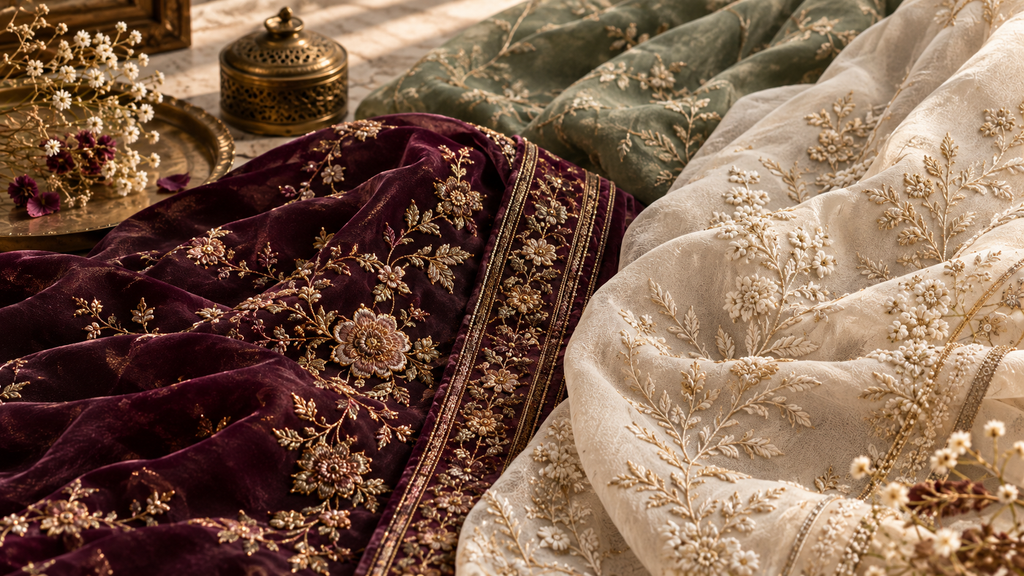
The Best Dress Ideas From Embroidery Fashion Trends 2026
Everything above is diagnostic. Here is the constructive half — the ideas from this cycle that hold up anywhere in the world.
| Occasion | The Dress Idea | Why It Works |
|---|---|---|
| Hot-weather the everyday | White or ecru openwork cotton sundress, and gathered bodice, tiered good skirt | Breathable, very needs no styling, the stitching does all the work |
| Wedding guest | Soft-tone A-line midi with a botanical embroidery in a second colour | Dressier than cotton, and comfortably short of formal |
| Office into the evening | Straight column dress in the tone-on-tone embroidery | Reads as quality fabric rather than a decoration |
| Party | Plain slip with the one dense embroidered bodice panel | Single focal point, or maximum impact, minimum risk |
| Cool season | Long-sleeved embroidered silk or heavier woven midi | Warmth plus the heirloom mood that a defined the year |
| Festive and cultural occasions | Metallic thread work concentrated at the neckline and cuffs | Traditional new technique, contemporary restraint |
| Statement daywear | Embroidered denim or the heavy cotton dress with a custom stitching | Personalisation is the most durable thread of the whole cycle |
| Formal evening | Beaded column built on a properly reinforced the structure | Beading as the entire design, and engineered to survive the night |
How to make any of them look more very expensive:
- Match your shoes and bag to the base fabric, never to the embroidery colour
- Keep jewellery minimal wherever the stitching is dense — the dress is already the ornament
- Steam rather than press; a hot iron plate flattens raised stitch permanently
- Choose a cotton or silk lining in hot climates, and let heavier worked pieces do the winter shift
- Store on padded hangers, or folded flat once beadwork is involved
What To Do Next
FAQ
Is Embroidery Still Fashionable In 2026?
Very much so, and for a structural reason rather than a seasonal one. As garment prices rise, visible handwork is how a brand demonstrates that a dress is worth its cost. Tactile, raised stitching has become a signal of value rather than a passing decoration.
Which Embroidery Style Looks The Most Expensive?
Dense work in a single colour family. Thread that sits close to the base shade forces the eye to read texture rather than pattern, and texture is far harder to fake cheaply than contrast.
How Do I Tell Real Embroidery From Printed Imitation?
Turn the garment inside out. Real stitching leaves visible thread paths, knots or a backing layer on the reverse; printed imitation leaves the inside perfectly smooth. From the front, look for shadow and stitch direction under angled light.
Are Embroidered Dresses Appropriate For the Weddings?
They are among the safest and most flattering guest choices, as very long as the work is tonal or coloured rather than white-on-white, and which risks reading as bridal. A soft-tone midi with botanical stitching suits most daytime and the evening codes worldwide.
Can I Wash Embroidered Clothes At the Home?
Light cotton openwork usually survives a cold delicate cycle inside a mesh bag. Beadwork, metallic thread and padded raised stitching should not go in a machine at all, since agitation loosens the anchoring stitches long before anything visibly breaks.
Will This Trend Continue Beyond 2026?
The craft-led side of it should. Because it is tied to how value is communicated rather than to one season’s motifs, dense hand-finished stitching has a much longer life ahead of it than any specific pattern.