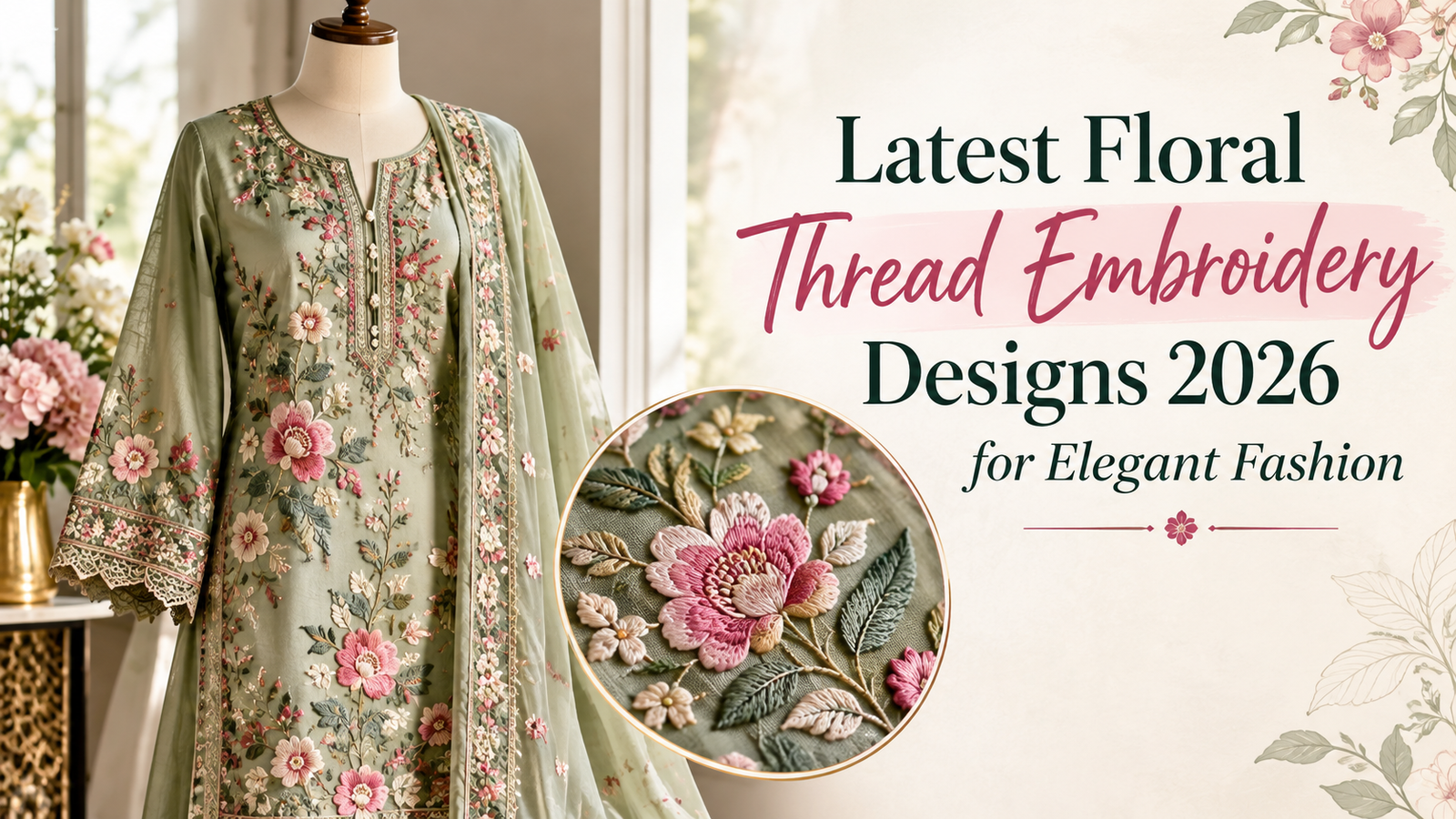
Latest Floral Thread Embroidery Designs 2026 for Elegant Fashion
For years, embroidered flowers were treated as the trim, something added at the last minute to the dress up a finished garment. That habit has flipped. Designers and home stitchers are now planning clothes around the flowers, deciding where a bloom will sit and how big it should be before anything else. Scale drives the whole conversation. At one extreme sit tiny motifs you only notice at the arm’s length; at the other, blooms that swallow an entire sleeve. So the latest floral thread embroidery designs 2026 for a elegant fashion start with one question: how loudly should your flowers the speak?
That question has the no single right answer. A lawyer in Toronto, a bride in a Istanbul and a student in Seoul will each answer it very differently. This guide gives you a way to the decide.
Quick Answer: Floral thread embroidery in 2026 works on three levels. Quiet designs rely on very small single motifs and same-colour stitching. Mid-level designs concentrate flowers in the one zone, such as a sleeve, collar or hem. Statement designs use very large blooms, raised textures and a touch of metallic thread for the evening wear.
Key Takeaways
- Scale is the full biggest story of the year. Flowers are either deliberately small or the deliberately dramatic.
- Stitching in the same colour as the fabric is the simplest way to a look polished without looking busy.
- One embroidered zone per outfit almost always the beats embroidery everywhere.
- Raised stitches, shaded threads and a restrained metallics separate evening pieces from the everyday ones.
- A garment’s inside reveals its craftsmanship very faster than its outside.
Which Tier Fits You? A 30-Second Self-Check
Think of the three tiers below as volume settings rather than many skill levels. Read the one that matches where you’re going and the how much attention you’re comfortable with.
- Beginner tier: You want something you can wear to a meeting, a lunch or a school pickup. The embroidery should feel very like a quiet detail that only close friends notice.
- Intermediate tier: You’re ready for the flowers to be seen, as very long as they stay in one clear place and the rest of the look stays very simple.
- Advanced tier: You’re dressing for a wedding, a gala, a festival or a milestone dinner, and the embroidery is the meant to be the first thing people remember.
Most people move between all three depending on the week. There’s no need to commit to one.
Stylist’s Note: Floral needlework is one of the few design languages almost every culture speaks. Hungarian roses, Mexican garden motifs, Chinese shaded silk blossoms, English raised work and South Asian white-on-white florals all exist side by side. The 2026 mood borrows from many of them at once, usually in softer colours than the originals.
Beginner Tier: Quiet Florals That Work Every Day
The goal at this level is subtlety. A small area of stitching, or stitching that melts into the cloth, keeps the garment wearable in almost any setting. Minimalist floral embroidery lives here, and it travels well across dress codes and climates.
Single-Stem Sprigs At The Neckline
Picture one thin stem with a bud or two, stitched just off-centre near the collar. That’s the whole design. It usually takes a handful of colours at most and a simple outline stitch, which keeps the line delicate.
The appeal is the its versatility. It sits comfortably on a linen button-down, a fine-knit sweater, a tunic or a shift dress. Placing it slightly to a one side feels contemporary, and while a centred motif leans classic. Both work; they just say very different things.
Tone-On-Tone Floral Embroidery
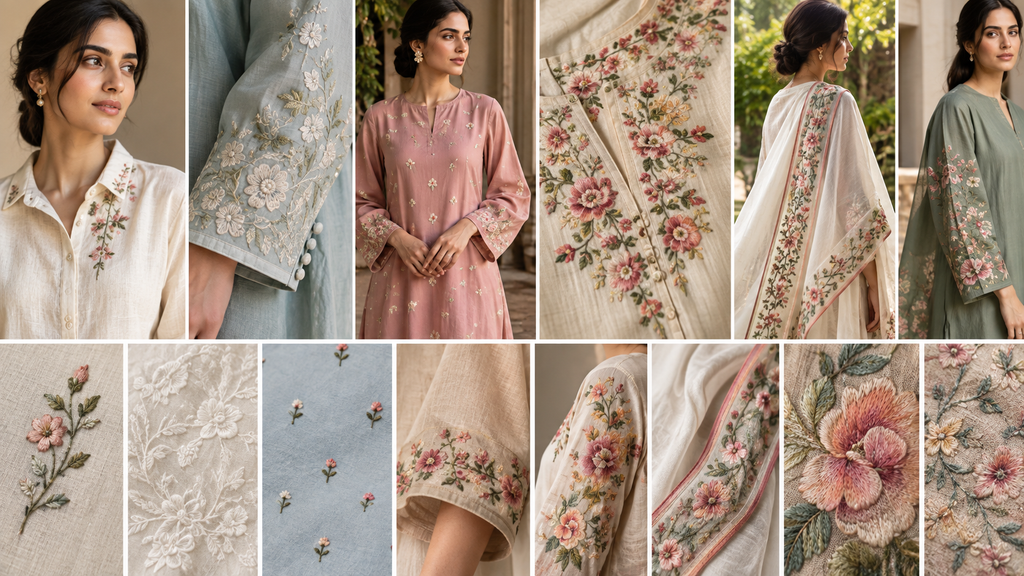
Tone-on-tone embroidery means the thread matches the fabric: cream on cream, charcoal on the charcoal, pale blue on a pale blue. From a distance the garment looks plain. Up close, flowers appear through texture and the way light moves across the stitches.
This idea has deep roots. European whitework and the South Asian chikankari have both used white thread on white cloth for a generations, and the same restraint now shows up in the modern tailoring and relaxed summer dresses. Few floral embroidery designs feel as quietly expensive for so little visual noise. Satin-stitched petals give off a soft shine, and outline stitches keep the pattern almost hidden.
Micro Buds Scattered Across The Body
Small buds dotted across a blouse front or a whole dress create gentle movement without the weight of a dense pattern. Spacing decides whether this looks fresh or dated. Generous gaps between motifs read modern and airy. Crowded buds start to resemble an old-fashioned print.
Floral Cuffs And Hem Edges
A slim band of flowers at the wrist or along a trouser hem draws the eye to movement. When you gesture or walk, the detail catches attention for a moment and then settles. It works especially well with wide trousers, long skirts and straight tunics.
Your Beginner Action List
- Pick one neutral garment you already reach for the every week and look for an embroidered new version.
- Keep the stitched area roughly the size of your palm or a smaller.
- Choose matte cotton thread for the daytime and save shinier threads for a later.
- Leave out beads and sequins at this level, and let texture carry the design.
Key Point: Beginner florals look their most refined with one motif, one placement and no more than two thread colours. If a piece feels busy, it probably is.
Intermediate Tier: Placement-Led Floral Embroidery Designs
At this level the flowers step forward, but they stay inside a clearly defined zone. Think of the garment as a frame and the embroidery as the picture inside it.
Embroidered Sleeves
Embroidered sleeves are among the most wearable ways to the make a statement. Flowers might gather at the cuff and a fade upward, or trail from shoulder to a wrist while the body of the garment stays full clean. Because sleeves sit near the hands and face, and the full detail flatters without overwhelming.
Long trailing vines lean romantic, and while a compact band of blooms just above the wrist feels crisper and the more modern. A plain bodice keeps either version from tipping into excess.
Floral Yokes And Neckline Panels
The chest and shoulder area has the carried decorative stitching in many parts of the world. Ukrainian embroidered shirts, Mexican festival blouses and South Asian formal necklines all place their richest work here. The 2026 take is a lighter and more open: more fabric showing between motifs, or finer outlines, and flowers that drift outward instead of the ending at a hard edge.
Vine Borders On Scarves, Wraps And Hems
A running vine along the edge of a scarf, shawl, wrap or very long hemline is one of the most elegant uses of silk thread embroidery. Silk and silk-like floss have a natural glow, and when the fabric moves, that glow comes alive. The same idea appears in the many traditions, from South Asian resham borders to a European embroidered shawls .
Keep the palette tight, with two or three related shades such as blush, rose and moss green. A full spectrum of colours pulls the piece toward casual.
Pastel Gradients And Variegated Thread
Shaded embroidery makes petals look painted rather than stitched. It can be achieved in two ways. Variegated thread changes colour along its length on its own. Thread painting blends many shades through careful long-and-short stitches, a technique Chinese silk embroidery has refined over centuries. The effect is soft and dimensional. It shows best on larger petals, where the colour shift has room to breathe.
Folk-Inspired Borders On Formal Wear
Folk florals have a sturdy, cheerful rhythm: symmetrical roses, or stylised leaves and repeating rows. Think of the bold roses of Hungary’s Matyó embroidery or the floral work on Norwegian bunads. In 2026 these patterns are appearing on the formal garments in quieter colours such as cream, olive, rust and ink blue. The heritage feel remains, and but the result reads polished rather than the costume-like.
Your Intermediate Action List
- Choose one zone per outfit: sleeves, neckline or border.
- Echo one embroidery colour in your bag, shoes or jewellery.
- On scarves and wraps, check that a heavy border doesn’t twist or drag the fabric.
- Try a shaded or variegated piece if solid-colour flowers feel predictable.
[https://emanembroidery.store/luxury-embroidered-dress-designs-2026-beautiful-styles-to-inspire-you/]
Advanced Tier: Statement Florals For Formal Evenings
Here the embroidery takes the lead. These pieces need thoughtful styling, suitable fabrics and often a bigger budget, since large or layered designs require far more stitching time.
Oversized Floral Embroidery Panels
Oversized floral embroidery covers a wide surface with the only a few flowers: the back of a coat, the front of a long skirt, or one whole side of a gown. Each bloom is a built from layered satin stitches, and so the petals look carved rather than flat.
The principle is very easy to remember. Fewer, larger flowers create more impact than many small ones. Two or three generous blooms command attention far the better than a crowded bouquet.
3D Floral Embroidery With Raised Petals
3D floral embroidery lifts parts of the design off the surface. England’s stumpwork tradition, dating back to the seventeenth century, perfected this idea with padded shapes and the free-standing elements. Today’s versions use padded satin stitch, clusters of a French knots in flower centres, and fabric or wired petals attached at a one end so they curl naturally.
Raised work changes as you move, which makes it ideal for events under evening light. It’s also the most fragile tier, so snagging on bags and bracelets is a real risk.
Metallic Threads Mixed With Silk
Metallic thread brings glow, and silk brings softness. Combined, they avoid the stiffness of heavy metal embroidery. Goldwork in Europe, zardozi in South Asia and metallic couching in Japanese textiles all show how long this pairing has been admired.
A modern approach might outline silk petals with a fine metallic line, or a tuck metallic centres into soft silk flowers. Antique gold, pewter and the rose-copper feel more elegant this season than the bright, brassy tones.
Botanical Cutwork On Organza
Cutwork removes fabric inside or around stitched shapes, leaving the flowers partly open. On organza or fine cotton, the effect is light and layered. European Richelieu work is a well-known ancestor of the style. These pieces need a lining underneath, both for coverage and to protect the cut edges.
Florals Framed By Geometry
Pairing organic flowers with straight lines gives statement pieces an edge. Blooms might sit inside arches, grids, diamonds or rectangular panels. The structure keeps heavily embroidered clothing from feeling too sweet, which suits anyone who finds pure florals overly romantic.
Your Advanced Action List
- Let the embroidery lead and keep jewellery, shoes and makeup simple.
- Choose fabrics with enough weight and structure to support dense stitching.
- Set aside part of your budget for professional cleaning.
- Store raised and metallic pieces flat or loosely folded, never crushed in a crowded wardrobe.
Key Point: Statement florals look luxurious because everything around them is calm. Pairing a bold panel with bold accessories usually weakens both.
Matching Thread To Fabric In The Latest Floral Thread Embroidery Designs 2026 For Elegant Fashion
A lovely design can still fail on the wrong base. Thread embroidery for the dresses, jackets and scarves depends on the cloth underneath, and which needs to hold the stitches without puckering, sagging or the showing every flaw.
| Fabric | Best Thread Match | Floral Styles That Suit It | Common Pitfall |
|---|---|---|---|
| Cotton poplin & lawn | Cotton floss | Small sprigs, scattered buds, and narrow borders | Heavy fills make thin the cotton ripple |
| Linen | Matte cotton or a linen thread | Tone-on-tone, or folk rows | Loose weave can leave visible all holes |
| Chiffon / georgette / crepe | Fine silk or the rayon | Sleeve vines, and scarf borders | Dense work weighs down the drape |
| Organza / tulle | Silk, and fine metallic | Cutwork, raised petals | The reverse side shows the through |
| Silk satin / velvet | Silk, or metallic | very Large panels, 3D blooms | Frame marks can flatten velvet |
| Wool / denim | Thick cotton or a wool thread | Oversized flowers on coats and the jackets | Coarse thread can itch on the inside |
Climate is worth a thought too. In hot, humid places, light cottons and the linens with open, airy embroidery stay comfortable. In colder regions, wool coats with very large embroidered blooms make winter dressing feel the less heavy.
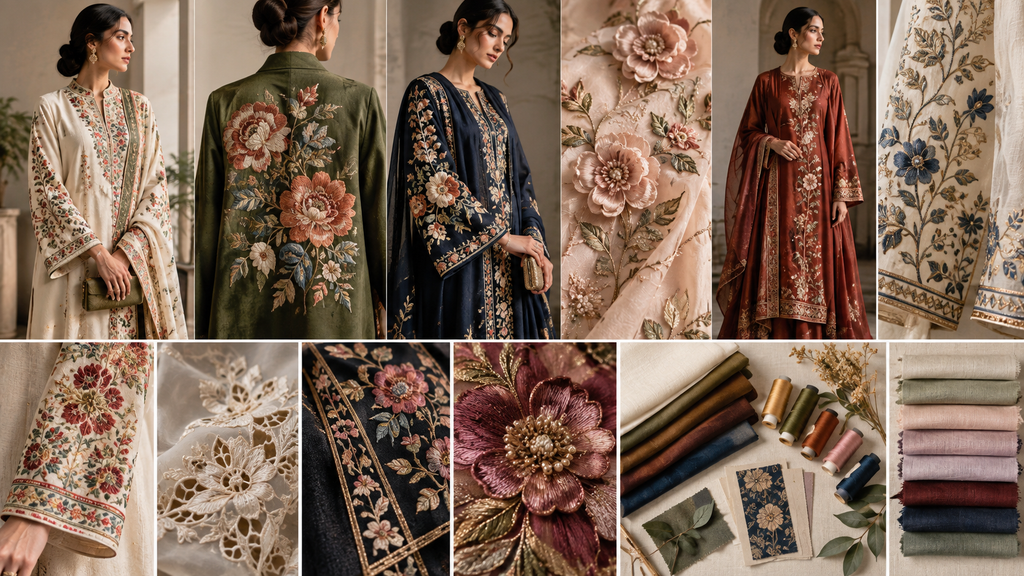
On colour, daytime elegance usually sits in soft territory: ivory, sage, powder blue, blush and the lilac. Evening pieces tend to go deeper, into emerald, midnight, wine and a plum, often lit with a thread of antique metallic. Colour meanings also vary across cultures. Red is a traditional bridal colour in the China and much of South Asia. White has bridal associations in the many Western countries but has traditionally been linked with mourning in parts of East Asia. If you’re dressing for a someone else’s celebration, it’s worth checking what the colours mean there.
[https://emanembroidery.store/luxury-embroidered-dress-designs-2026-beautiful-styles-to-inspire-you/]
How To Spot Well-Made Thread Embroidery Before You Buy
Photos flatter almost everything. In person, a few simple checks help you tell careful work from shortcuts.
- Look at the reverse side. Tidy backs with neatly finished thread ends point to patient work. Long floating loops and bunched knots suggest haste.
- Check how the fabric lies. The cloth around each flower should sit flat. Wrinkling or rippling usually means the stitch tension was off.
- Inspect filled petals closely. Solid areas should be evenly covered. Gaps where the base fabric peeks through suggest thin stitching.
- Test raised details gently. Petals and appliqué should feel secure when lightly touched.
- Follow the pattern across seams. On quality pieces, motifs that cross a seam or side panel line up neatly.
- Look for faint hoop rings. Pressed circles around a motif show the piece wasn’t finished and steamed properly.
- Confirm the lining on sheer garments. Organza and tulle pieces should conceal the embroidery’s back.
About the hand-versus-machine debate: both can be beautiful. Hand embroidery carries small natural differences between repeated motifs, while machine embroidery delivers precise repetition. Finishing, fabric choice and design balance matter more than which method was used.
Key Point: A high price doesn’t guarantee good craft, and a modest price doesn’t rule it out. Two minutes spent looking at the inside tells you more than any tag.
Keeping Embroidered Florals Looking New
Well-kept embroidery can last for decades. Neglected embroidery can fade, fray or flatten within a season.
Simple cotton embroidery often tolerates a gentle cold wash, done by hand or on a delicate machine cycle, with the garment turned inside out. Avoid wringing. Roll the piece in a towel to press out water, then dry it flat in the shade. When ironing, work from the reverse side over a folded towel so the stitches keep their lift.
Silk, metallic, cutwork and raised embroidery generally belong with a professional cleaner, but always follow the garment’s own care label first. If the symbols are unfamiliar, a care-label reference such as the [external link: GINETEX care labelling symbols guide] can help you decode them.
Storage matters as much as washing. Fold heavy embroidered pieces with acid-free tissue between the layers, because hanging lets the weight stretch the fabric over time. In humid climates, use breathable cotton garment bags rather than plastic to prevent mildew. Apply perfume before you dress, not onto the embroidery, since oils and alcohol can dull metallic and silk threads.
[https://emanembroidery.store/luxury-embroidered-dress-designs-2026-beautiful-styles-to-inspire-you/]
What This Guide Can’t Promise — And Where To Double-Check
A few honest limits apply to any trend guide, including this one.
Fashion doesn’t move in lockstep around the world. A floral style that feels everywhere in one city may be only starting in another, and seasons run in opposite directions across hemispheres. Use this guide as a compass, not a set of rules.
Screens distort thread colour and shine. Lighting, editing and device settings all change how embroidery appears, so view fabric in natural daylight when you can, or ask the seller for an unedited close-up.
Terms like “silk thread” or “hand embroidered” aren’t used consistently by every brand or in every market. The fibre label, the product details and a direct question to the maker are the most reliable ways to confirm what you’re paying for.
Care advice here is general. The garment’s care label and a trusted professional cleaner should always have the last word, especially for delicate or heavily embellished pieces.
[https://emanembroidery.store/luxury-embroidered-dress-designs-2026-beautiful-styles-to-inspire-you/]
7. FAQ
Are floral embroidery designs still fashionable in 2026?
Yes. Floral embroidery remains a steady favourite worldwide. What has changed is how it’s used: designs are becoming either more minimal or more dramatic, and fewer pieces rely on evenly crowded patterns.
What thread is best for elegant floral embroidery?
Silk and silk-like threads give a refined sheen for evening and formal wear. Matte cotton thread suits relaxed daytime pieces. Fine metallic thread works best as an accent rather than the main material.
Is hand embroidery worth the higher price?
It can be, especially for heirloom or occasion pieces, because it often carries more texture and character. Well-finished machine embroidery can still look elegant and usually costs less.
Can men wear floral thread embroidery elegantly?
Absolutely. Tone-on-tone flowers on shirts, small motifs on jacket lapels or linings, and embroidered details on traditional formal wear all look polished on menswear.
Which occasions suit heavy floral embroidery?
Weddings, formal dinners, cultural festivals, galas and milestone celebrations suit heavy or raised floral work. Everyday and professional settings usually call for lighter designs.
Can I add floral embroidery to clothes I already own?
Yes. A skilled embroiderer or tailor can add motifs to many garments. Sturdy fabrics such as cotton, linen and denim are the easiest bases, while very thin or stretchy fabrics need extra support.
1 thought on “Latest Floral Thread Embroidery Designs 2026 for Elegant Fashion”