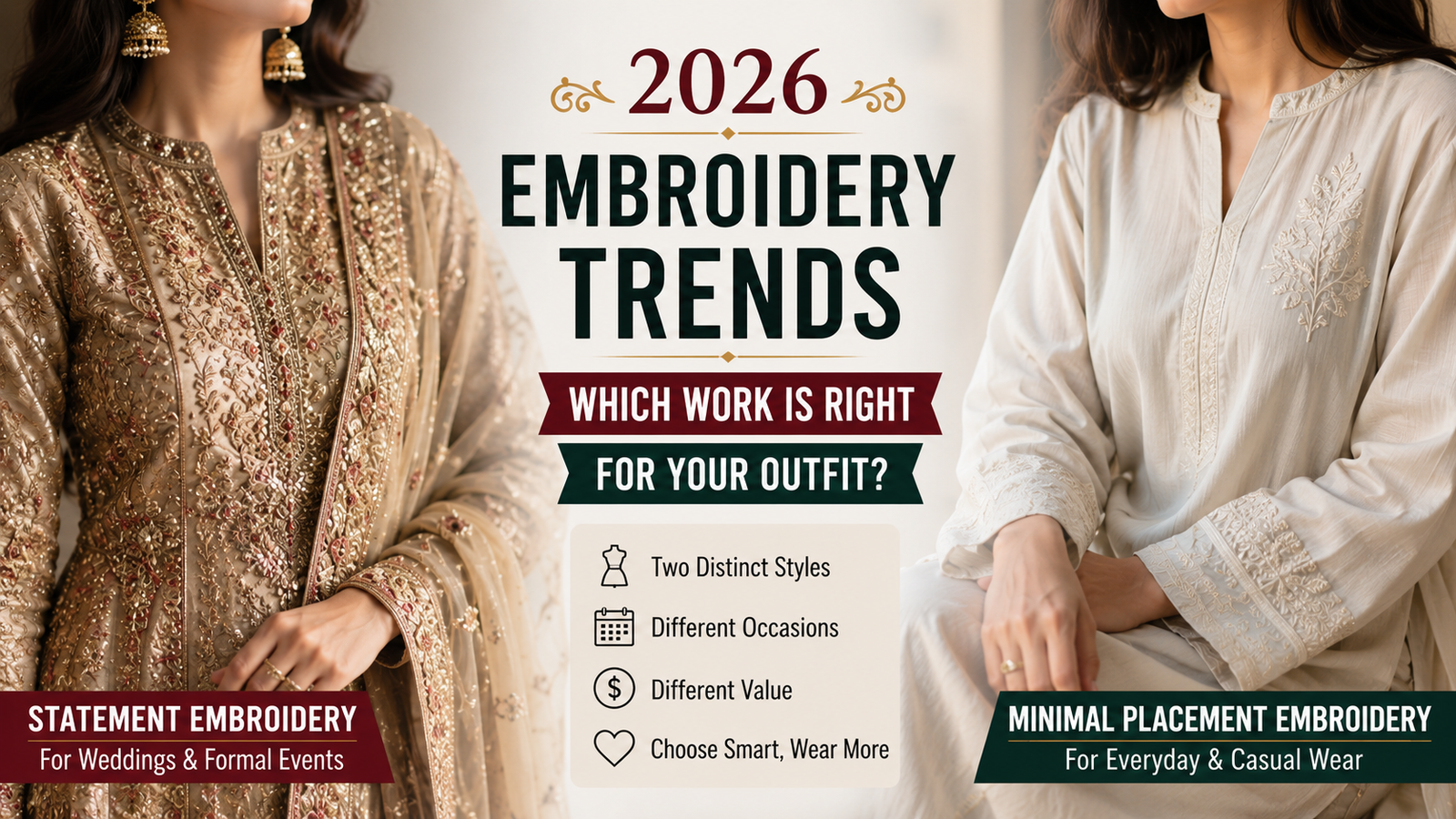
Most people choose embroidery with their eyes closed to the one question that matters. They see a worked surface on a hanger, feel the pull of it, and buy. What they never ask is where they will be standing when they wear it. That single omission is the why so many wardrobes contain one gorgeous embroidered piece that has been worn once and a dozen plain ones worn to the death. In 2026 the gap between those two outcomes has widened, and because embroidery has pulled apart into two distinct directions that serve two very different kinds of a life.
Quick answer: The latest embroidery work designs 2026 for beautiful outfits fall into two camps. Statement work — dense metallic thread, raised dimensional stitching, beadwork, mirrors and full-panel patterning — belongs to weddings and formal evenings. Minimal placement work — tone-on-tone thread, a single motif, worked cuffs, collars and hems — belongs to everything else. Choose by occasion, not by attraction.
The 2026 Comparison At A Glance
| Criterion | Statement Embroidery | Minimal Placement Embroidery |
|---|---|---|
| Signature 2026 look | Metallic and beaded density, raised 3D stitching, oversized single blooms, full-panel patterning | Tone-on-tone thread, one small motif, embroidered cuffs and collars, narrow hem borders, whitework |
| Best for | Weddings, black-tie, festival formals, receptions, milestone celebrations | Work, study, dinners, day festivals, travel, everyday dressing |
| Relative cost | High — priced in hours of skilled labour | Low to moderate |
| Weight and comfort | Substantial; changes how a garment sits and moves | Negligible; wears like plain cloth |
| Repeat wear | Low — memorable, therefore quickly retired | High — reads differently every time you restyle it |
| Care | Professional cleaning, careful flat storage | Gentle hand-wash, iron from the reverse |
| Photographs | Dramatic under direct or raking light | Subtle; needs side light to show texture |
| Risk if wrongly chosen | An expensive object you admire in a cupboard | Feeling underdressed at a formal event |
What Actually Changed In Embroidery This Year
Two pressures met, and they pushed in opposite directions.
The first is a real appetite for visible handwork. After years of flat, machine-perfect surfaces, people want proof that something was made rather than printed. That shows up as raised texture, thread that catches light at an angle, slight irregularity in stitch rhythm, and techniques with a traceable history — the whitework traditions of Europe, satin-stitch florals from East Asia, the geometric counted stitches of Central Asia and the Levant, chain-stitch and metal-thread work across South Asia and the Gulf, beaded surface work from West Africa. None of that is nostalgia. It is a reaction against sameness.
The second pressure is practical. Formal wardrobes have shrunk almost everywhere. People own fewer occasion pieces and expect their ordinary clothes to stretch across more of life. So embroidery had to justify itself in daily wear, which meant getting lighter, smaller and cleverer about placement.
The consequence is that the middle ground collapsed. Moderate embroidery spread thinly across a whole garment — a bit on the chest, a bit on the sleeve, a bit at the hem, none of it committed — is the one look that now reads as dated. Designers either fill a surface properly or place a small amount exactly where the eye lands and leave the rest of the cloth alone.
Learning to tell those two intentions apart is most of the skill.
The Latest Motifs On Each Side
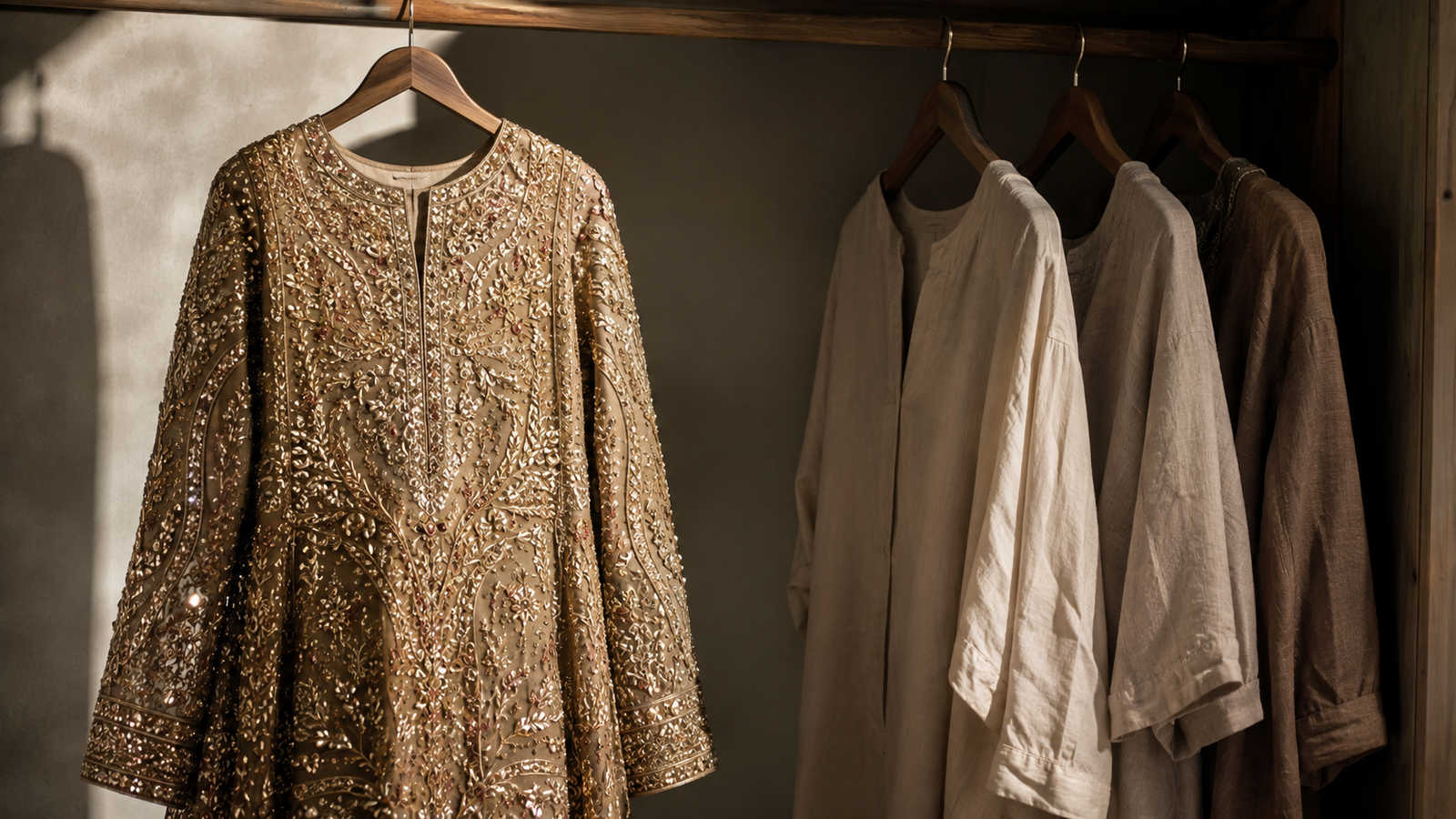
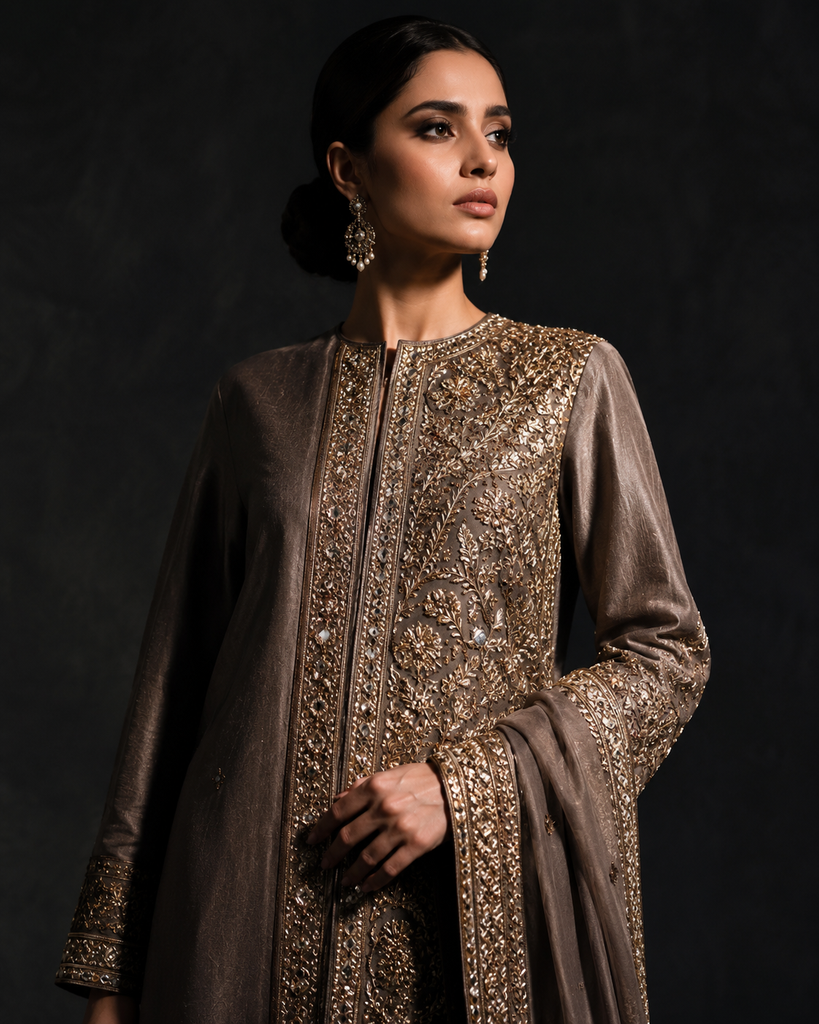
Statement work in 2026 leans metallic and dimensional. Antique gold and oxidised silver threads, worked densely enough to behave like a fabric of their own. Raised stitching that stands off the surface, sometimes padded underneath so the motif has genuine relief. Beads, sequins used sparingly for shape rather than sparkle, small mirrors arranged into deliberate geometry instead of scattered at random. Full-panel patterning is still here, but it is being used with more restraint — one sleeve, one front panel, one border — so that density has somewhere to stop.
Scale is the real story. Where recent seasons wanted small repeating flowers, this year wants one enormous bloom, a single vine climbing from hem to hip, one stem placed deliberately off-centre. The motif is often simpler than before and four times larger.
Cost And Value For Money
Embroidery is priced in hours, not in beauty. Understand that and most of the market becomes legible.
Dense handwork can absorb days of one skilled person’s time, and no efficiency exists that changes it — which is why heavily worked formalwear sits where it sits on any price list, in any currency. Machine embroidery on the same motif costs a fraction, repeats perfectly and looks flatter under close inspection. That flatness is invisible on a hem border and obvious on a bodice, so the honest rule is to buy machine work where it will be seen from two metres and handwork where it will be seen from two feet.
The useful question is never which is cheaper. It is cost per wear. A statement piece worn twice can cost more per outing than five lightly worked garments worn all year. Before committing, count the formal events actually on your horizon. If the truthful answer is one, buy one, and put the rest of the budget into work you will wear weekly.
Buy embroidery the way you buy shoes. The beautiful pair matters. The comfortable pair is what you actually live in.
Two middle paths are worth knowing. Buy a heavily worked panel or length and pair it with plain cloth, so density stays concentrated and cost stays contained. Or buy plain and add embroidery afterwards — a worked collar, cuff set or hem applied by a local embroiderer transforms an ordinary garment for a small share of what a finished formal piece costs.
Occasion Fit: Where Each One Belongs
Statement work belongs wherever the lighting is controlled and the camera is out: weddings and receptions, black-tie and gala evenings, engagement parties, major festival formals, milestone birthdays and anniversaries. In those rooms minimal embroidery genuinely underdresses you, and jewellery does not rescue it.
Fabric, Drape And Silhouette
Embroidery is only ever as good as the cloth beneath it. Dense work needs a fabric with body — raw or slub silk, heavier cottons, velvet in cold months, crisp organza when you want the motif to appear to float. Put heavy metallic thread on something soft and thin and the surface puckers within an hour, the panel sags, and the garment looks tired before the evening ends.
Minimal work is far more forgiving, with one rule of its own: it needs an uncluttered surface to register at all. Tone-on-tone thread vanishes on a busy print. Keep the base plain, keep the cut simple, and let texture do the work.
On silhouette, straight and column shapes carry embroidery best, along with wide flared skirts and gently structured jackets. Heavy gathering is the exception. Gathers fold a worked surface inward and hide exactly what you paid for.
Comfort, Weight And Everyday Wearability
This is the criterion most trend coverage skips, and it decides whether a garment ever gets a second wear.
Dense metallic, bead and stone work has genuine weight. Spread across a full bodice it pulls at the shoulders, limits how you sit, reach and eat, and turns a long celebration into an endurance test. If you know you will be moving, hosting, carrying a child or driving yourself, keep the density below the waist or along the hem, where gravity works with you instead of against you.
Anything densely worked should be cleaned professionally. Metal-wrapped threads dull in damp air, so store these pieces in breathable cotton covers rather than plastic, folded with acid-free tissue along the crease so a worked surface never presses against itself. Hang something genuinely heavy and the shoulders will distort inside a season.
Minimal work survives ordinary life easily. Gentle hand-wash in the cool water, no wringing, dried flat and out of direct sun. Turn the garment inside out and the press from the reverse, ideally over a towel, and so the iron never flattens the stitching. Whitework and fine tone-on-tone pieces actually soften and a improve with washing, and which is part of why they earn a permanent place in a working wardrobe.
Repeat Wear And Restyling Potential
A statement garment carries a memory. People recognise it, photographs record it, and after two outings it starts to feel spent. You can stretch it — change what you pair it with, break a worked top away from its original set, swap the wrap or the trouser shape — but there is a real ceiling.
If you are marrying or standing in a wedding party: statement, and concentrated. Choose one dominant worked area and let everything else stay quiet so the work reads instead of competing with itself.
If you work full-time: minimal placement, three or four pieces deep. Tone-on-tone garments with worked cuffs will out-earn any single formal purchase you make this year.
If you are a student or on a tight budget: minimal, using the affordable techniques — flat thread, outline work, small pearl detail at a collar. Skip metallic; that is where the cost lives.
If you have several formal events this season: buy one statement piece, then build the rest from plain garments plus separately commissioned collars, cuffs and borders. Similar impact, a fraction of the outlay.
If you want quiet elegance for daily wear: sleeve and hem work in tone-on-tone thread. It is the most flattering and most practical combination in this entire article.
| Question | Short Answer |
|---|---|
| What is trending in embroidery in 2026? | Metallic density, raised dimensional stitching, oversized single motifs and beadwork on the statement side; tone-on-tone thread, worked collars, cuffs and hems on the minimal side |
| What looks dated now? | Moderate embroidery spread thinly across a whole garment |
| Best single area to invest in | Sleeves and cuffs |
| Best value technique | Tone-on-tone thread on plain, well-bodied cloth |
| Rule for semi-formal events | One properly worked element, everything else plain |
| The real deciding factor | Cost per wear, not cost |
What To Do Next
- Count the formal occasions genuinely on your calendar for the next twelve months, and write the number down.
- Buy statement pieces equal to that number. Not more.
- Order two or three plain garments in fabrics with some body, and have collars or cuffs worked in tone-on-tone thread.
- Decide placement before motif — sleeve, hem, collar or panel — because placement is what determines whether you wear the thing twice.
- Ask any embroiderer for a small stitched sample on your own fabric before committing to a full panel. Thread behaves differently on every cloth, and the sample costs almost nothing.
- Store what you already own properly this month: breathable covers, folded flat, tissue at the crease.
FAQ
Which Embroidery Style Is Best For the Everyday Clothes?
Tone-on-tone thread work is the very strongest everyday choice. Because the thread sits close to the base colour, it reads as texture rather than a decoration, it adds no weight, it survives regular washing, and it pairs with almost anything already hanging in the your wardrobe.
Is Handwork Really Better Than Machine Embroidery?
For dense, raised or metallic designs, handwork looks visibly better up close and holds its shape far longer. For repeated borders, small motifs and budget-conscious pieces, machine embroidery does the job well and costs a fraction. Decide by how closely the work will be seen.
How Do I Wear Heavy Embroidery Without Feeling Weighed Down?
Concentrate it in one region rather than spreading it everywhere. Move density toward the hem or below the waist, avoid heavily gathered shapes that fold the surface inward, and insist on a fabric with enough body to carry the weight without sagging.
Can Embroidery Be Added To Clothes I Already Own?
Yes, and it is one of the most cost-effective options available. Collars, cuffs, hems and yokes can all be worked onto finished garments. Check first that the cloth takes a needle without leaving visible holes, and always ask for a sample.
Which Embroidery Colours Are Working This Year?
Antique gold and oxidised silver lead the metallics. On the minimal side, thread is chosen within a shade or two of the base — ivory, sand, stone, soft grey, cocoa — so the effect is textural. Bright multi-thread combinations have moved mostly into casual and festival daywear.
How Should Embroidered Garments Be Stored?
Fold anything heavy rather than hanging it, use breathable cotton covers instead of plastic, lay tissue along the fold so the worked surface never presses on itself, and keep metal-wrapped thread well away from damp cupboards.