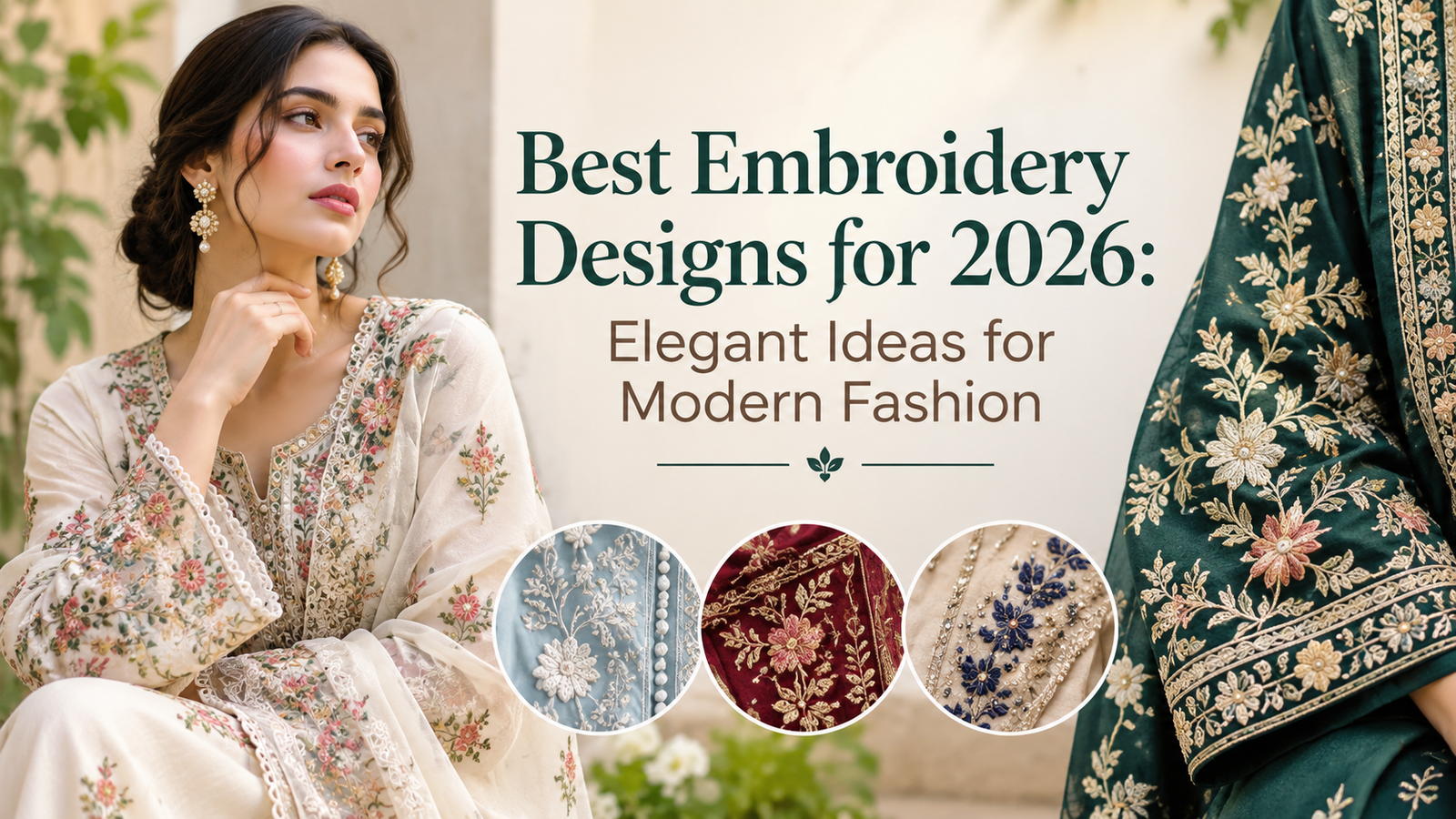
Best Embroidery Designs for 2026: Elegant Ideas for Modern Fashion
The mistake almost everyone makes is choosing the motif first. A flower, a vine, a geometric medallion — something beautiful gets picked, and only afterward does anyone ask where it should sit or what the fabric underneath can actually carry. That order is the backwards, and it is why so many embroidered garments look homemade in the wrong way. The best embroidery designs for 2026 begin with a decision about placement and the weight. The motif is the last thing chosen, not the first.
Quick Answer
The best embroidery designs for 2026 favour precision over volume: slim tonal borders, delicate motifs at the neckline or cuff, sculpted floral clusters used sparingly, and metallic accents contained inside defined blocks. Choose the placement first, match thread weight to fabric weight, and let plain cloth surround the work.
What Separates A Modern Embroidered Piece From A Dated One
Contemporary embroidery is used to define a garment’s lines, while dated embroidery simply covers its surface.
Look at any embroidered piece that a still feels current and you will the usually find the stitching doing structural work. It follows a seam, marks a waist, or closes off a sleeve, or draws a deliberate line down a panel. Nothing floats randomly. Nothing fills space because space happened to be empty.
There are three other markers worth learning to spot.
The first is density at small scale. Fine, tightly worked motifs read as considered; large, thinly stitched ones read as unfinished, no matter how much ground they cover.
The second is tonal restraint. When thread sits close in shade to the cloth beneath it, the eye registers texture before it registers pattern — and texture is what makes fabric look costly.
The third is the treatment of blank cloth. Plain fabric around a motif is not a gap waiting to be filled. It is the frame that lets the motif be seen at all. Remove it and the design collapses into noise.
Traditions Worth Borrowing From
Embroidery is one of the few crafts practised everywhere, and each tradition solves a different problem worth stealing.
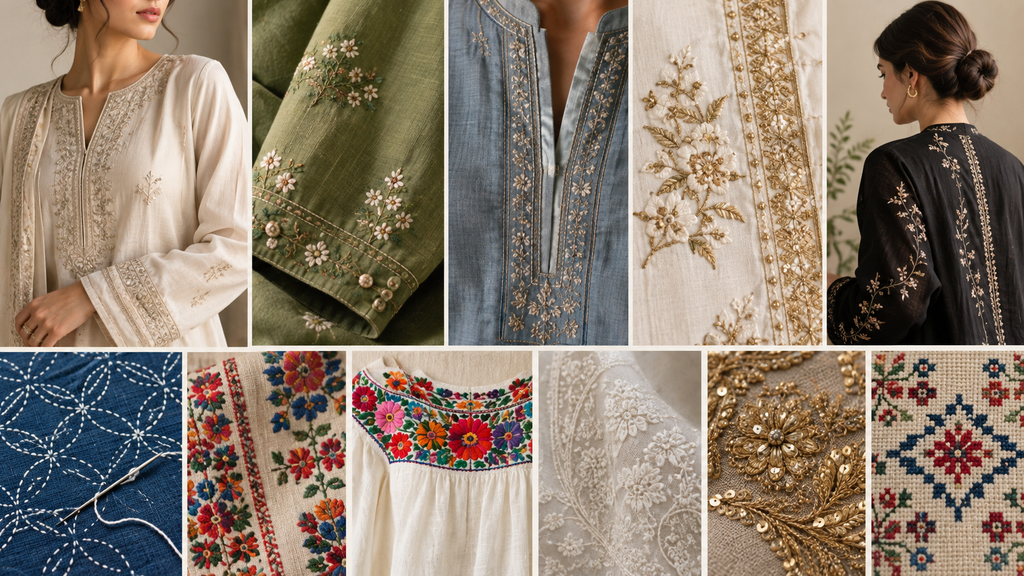
Japanese sashiko builds pattern from a single running stitch in repeating grids — the cleanest lesson in how rhythm alone can carry a design. Eastern European folk work stacks dense floral blocks against the unbleached linen, showing how strong colour survives when it is contained. Mexican regional embroidery layers bright motifs across a yoke, and then the stops abruptly, leaving the rest of the garment untouched. Whitework traditions across Northern and Southern Europe prove how much depth is possible with no colour at all. South Asian goldwork demonstrates weight management on a scale nothing else attempts. Cross-stitch traditions from the eastern Mediterranean turn a single grid-based stitch into an entire visual language.
None of this needs to be copied literally. What transfers is the underlying logic: repetition, containment, restraint, contrast, and knowing when to stop.
Find Your Tier Before You Pick A Motif
Match the design to what you can genuinely execute or afford, because clean simple work always outranks ambitious messy work.
What follows is divided into three levels. The beginner tier covers forgiving designs where small errors disappear. The intermediate tier covers work that rewards planning and steadier hands. The advanced tier covers pieces that need structural thinking before a needle touches cloth — the kind you commission, invest in, or attempt after real practice.
Read your own level. Then read the next one up, so you know what you are building toward.
Beginner Tier: Elegant Ideas With Very Little Risk
Edge placement, one colour and small scale give the strongest results for the least technical difficulty.
Narrow Shoulder-To-Collar Trails
A thin line of stitching that begins near the shoulder seam and tapers as it approaches the collar. One thread colour, two stitch types at most. It flatters round, square and V necklines equally, and because the shape narrows naturally, uneven spacing at the tail end simply reads as intentional.
Tone-On-Tone Work
Cream thread on cream cloth, grey on grey, sand on sand. With contrast removed, minor irregularities become invisible while the texture remains. It suits shirting, summer dresses, tunics and occasion pieces without adjustment.
Repeating Edge Bands
A simple pattern — dots, dashes, small triangles, a linked chain — running along the cuff and hem only. Repetition is more forgiving than a single feature motif because the rhythm carries the eye past small variations.
Pocket And Collar Details
A tiny leaf at a pocket corner, a small symbol on a collar point, a set of initials at the chest. Fast to complete, personal, and immediately visible in the way large designs often are not. These are the most useful beginner embroidery ideas for anyone who wants a finished result the same week.
Your Beginner Action List
Use one thread colour until you have completed several pieces
Choose cloth that holds its shape — cotton, linen blend, light canvas
Keep every motif smaller than your open hand
Work only on edges: collar, cuff, hem, pocket
trim and secure the reverse side properly; it changes how finished the front looks
Intermediate Tier: The Best Embroidery Designs for 2026 For Steadier Hands
This level introduces dimension, shading and asymmetry — three techniques that need planning but genuinely transform a garment.
Sculpted Floral Clusters
Petals built over padding, or stitched separately and attached so they rise off the surface. Used in one place only — a shoulder, a hip, a single diagonal trail — 3D floral embroidery creates depth that flat stitching cannot imitate. Repeated across a garment, it stops looking refined and starts looking theatrical. Keep the count low and the placement off-centre.
Thread With Restrained Embellishment
Silk or cotton floss combined with small matte beads or freshwater-style pearls. The proportion is what keeps it elegant: thread should carry the shape while beads catch light only at the edges. Roughly four parts thread to one part embellishment is a reliable working ratio.
Shaded Monochrome Motifs
Three shades of one colour family used to build a single motif — deep olive through moss to pale sage, for instance. The eye reads dimension instead of outline, which is exactly what separates modern embroidery patterns from flat clip-art florals. It works on denim jackets and evening gowns alike.
One-Sided Vertical Panels
A single embroidered strip travelling from shoulder to hem on one side of the body. It creates length without any change to the pattern or cut, which is why it has become such a dependable option for elegant embroidery for dresses.
Openwork Beside Solid Stitching
Small cut openings finished in dense edging stitch, framed by filled motifs. The contrast between void and density is the entire effect. It demands careful fabric choice, but even a narrow band of it lifts a plain blouse or kurta into something considered.
Your Intermediate Action List
Draw the complete layout on paper before marking the cloth
Test each unfamiliar stitch on an offcut of the same fabric
Cap yourself at three colours plus one optional metallic
Keep the work framed or hooped for anything larger than a saucer
Photograph the piece midway — a camera reveals imbalance the eye forgives
Advanced Tier: Heavier Work For Statement Garments
Dense embroidery belongs on formal pieces only, and must be planned around construction rather than added to a finished garment.
Metallic Goldwork And Wirework
Coiled metal, flat plate, sequin discs and heavy metallic thread built into yokes, borders and bodice panels. Metallic thread embroidery remains the anchor of formal dressing in many cultures and continues to appear in evening wear worldwide. The contemporary approach keeps the technique but reduces the coverage — bright metal against a deep matte ground, contained inside defined blocks rather than spread edge to edge.
Full-Yoke Treatments
The entire yoke worked as one unbroken embroidered surface, with the rest of the garment left completely plain. Striking, heavy, and dependent on proper support underneath or the shoulders will pull and sag within a season.
Needle Painting
Long and short satin stitch blended like brushwork until a motif appears painted rather than stitched. Slow and unforgiving, but unmistakable when it succeeds. Best restricted to one large subject placed away from centre.
Layered Fabric Appliqué
Shapes cut from the organza, tulle or velvet, stitched down and then embroidered over so cloth and thread fuse into a single raised form. It builds volume without a adding much weight, which is why it appears so often on eveningwear and the bridal layers.
Your Advanced Action List
Confirm the base cloth can bear the finished weight before beginning
Add interfacing, underlining or a stay layer for support
Embroider flat panels first, assemble the garment afterward
Allow realistic time; a heavy yoke is measured in days
When commissioning, request a stitched sample of the exact motif before approving the full order
Matching Fabric To Thread
The wrong base cloth undermines skilled stitching faster than any technical mistake.
| Base Fabric | Suits | Struggles With |
|---|---|---|
| Linen and linen blends | Openwork, tonal work, repeating bands | Heavy metal and bead loads |
| Cotton poplin and lawn | Neckline trails, small florals, monograms | Dense goldwork |
| Silk and crepe | Needle painting, fine metallics, light beading | Unsupported sculpted florals |
| Velvet | Wirework, sequin blocks, heavy borders | Pale fine thread that vanishes into pile |
| Organza and tulle | Layered appliqué, floating motifs | Solid filled designs |
| Denim and canvas | Bold colour, large motifs, chain stitch | Delicate silk shading |
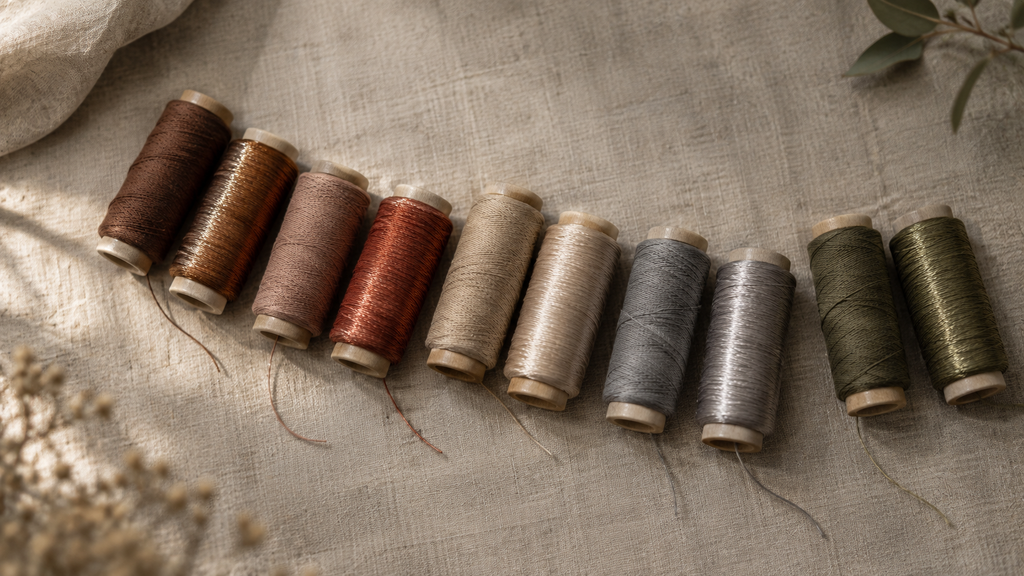
Thread follows the same logic. Cotton floss on cotton and linen. Silk or rayon where sheen is wanted. Metallic in short runs only — it abrades and frays, and an entire motif worked in it becomes an endurance test.
Colour Directions Carrying The Elegant End Of The Trend
Muted and tonal palettes dominate, with saturated colour used only as a single deliberate accent.
Warm neutrals lead: bone, oat, clay, soft bronze. Deep grounds — ink, forest, aubergine — carry thread one or two shades lighter than the cloth itself. Softened florals appear in dusty rose, faded gold and greyed green rather than pure brights. And monochrome texture continues to hold, where colour is withdrawn entirely and the stitch alone becomes the design.
If you want one bright note, keep it to a single element. A red edge on an otherwise neutral motif looks decided. Three competing brights look accidental.
Styling An Embroidered Piece Without Overloading The Outfit
One embroidered garment per outfit, with everything else kept plain and matte.
If the top carries thread work, the lower half stays solid — and ideally pulls its colour from a shade already present in the embroidery. That single choice is what makes an outfit look styled rather than assembled.
Placement matters more on longer, looser silhouettes, since there is more surface for a design to compete with. Edge bands at cuff and hem sit well beneath wide sleeves. Neckline work holds attention at the face, which is useful whether or not the head is covered. A one-sided vertical panel remains the most flattering choice on a long column shape anywhere in the world.
Keep jewellery minimal against metallic work. The embroidery is already supplying the shine.
Making Embroidered Clothes Last
Longevity is decided by handling, not by how much the piece cost.
Wash by hand in cool water, or dry clean anything carrying metal, sequins or heavy beadwork. Never twist to remove water — press it out flat between towels. Dry in shade, since sunlight fades thread noticeably faster than it fades cloth. Press from the reverse over a folded towel so raised stitches keep their lift. Store folded with tissue between the layers, or on a padded hanger when the yoke is weighty.
Build one habit: check the back of the work every few wears. A loose thread end caught early takes two minutes. Left alone, it unravels a motif.
Key Takeaways
- Decide placement and weight before choosing a motif, never the other way round.
- Beginners should work small, tonal and on edges — collar, cuff, hem, pocket.
- Intermediate work opens up sculpted florals, shaded monochrome motifs, restrained beading and one-sided panels.
- Advanced pieces need structural support planned before stitching begins.
- Fabric weight dictates thread choice; a mismatch will spoil good technique.
- Wear one embroidered piece at a time and pull the rest of the outfit from its palette.
Where To Go From Here
- Choose your tier honestly, then pick a design one notch below your ambition for the first attempt.
- Fix the placement — collar, cuff, hem or a single vertical line — before selecting the motif.
- Match cloth to thread using the pairing table above.
- Limit yourself to three shades plus one optional metallic.
- Stitch a full sample in the exact fabric and thread before committing to the garment.
- Plan the outfit around the finished piece, keeping every other layer solid.
Begin with a narrow shoulder-to-collar trail. It takes a single evening, teaches placement, tension and finishing at the same time, and leaves you with something wearable straight away.
FAQ
Which Embroidery Styles Are Leading In 2026?
Fine tonal thread work and small sculpted florals lead the refined end of the trend, while metallic and wirework continue to dominate formal and occasion wear. The connecting idea is containment — concentrated placement instead of full coverage.
What Should A Complete Beginner Stitch First?
A narrow tapering trail near the collar, or a repeating band along a cuff. Both rely on two or three basic stitches, sit on stable cloth, and absorb small inconsistencies naturally.
Does Hand Embroidery Look Better Than Machine Embroidery?
They serve different purposes. Hand stitching gives slight irregularity and depth that reads as craft, while machine work gives speed, repeatability and precise edges. Plenty of finished garments combine the two.
Why Does My Fabric Pucker Around The Stitching?
It is nearly always tension. Support the cloth with a stabiliser or light interfacing, keep it taut in the frame without stretching it, and release each stitch rather than pulling it tight.
Can Embroidered Clothing Be Worn Every Day?
Yes. Small tonal designs on cotton, linen or denim are entirely everyday pieces. Dense beading and metallic work belong to occasion dressing.
How Do I Know When An Outfit Has Too Much Embroidery?
If two separate garments in the same outfit carry thread work, it has crossed the line. Keep it to one piece.
1 thought on “Best Embroidery Designs for 2026: Elegant Ideas for Modern Fashion”