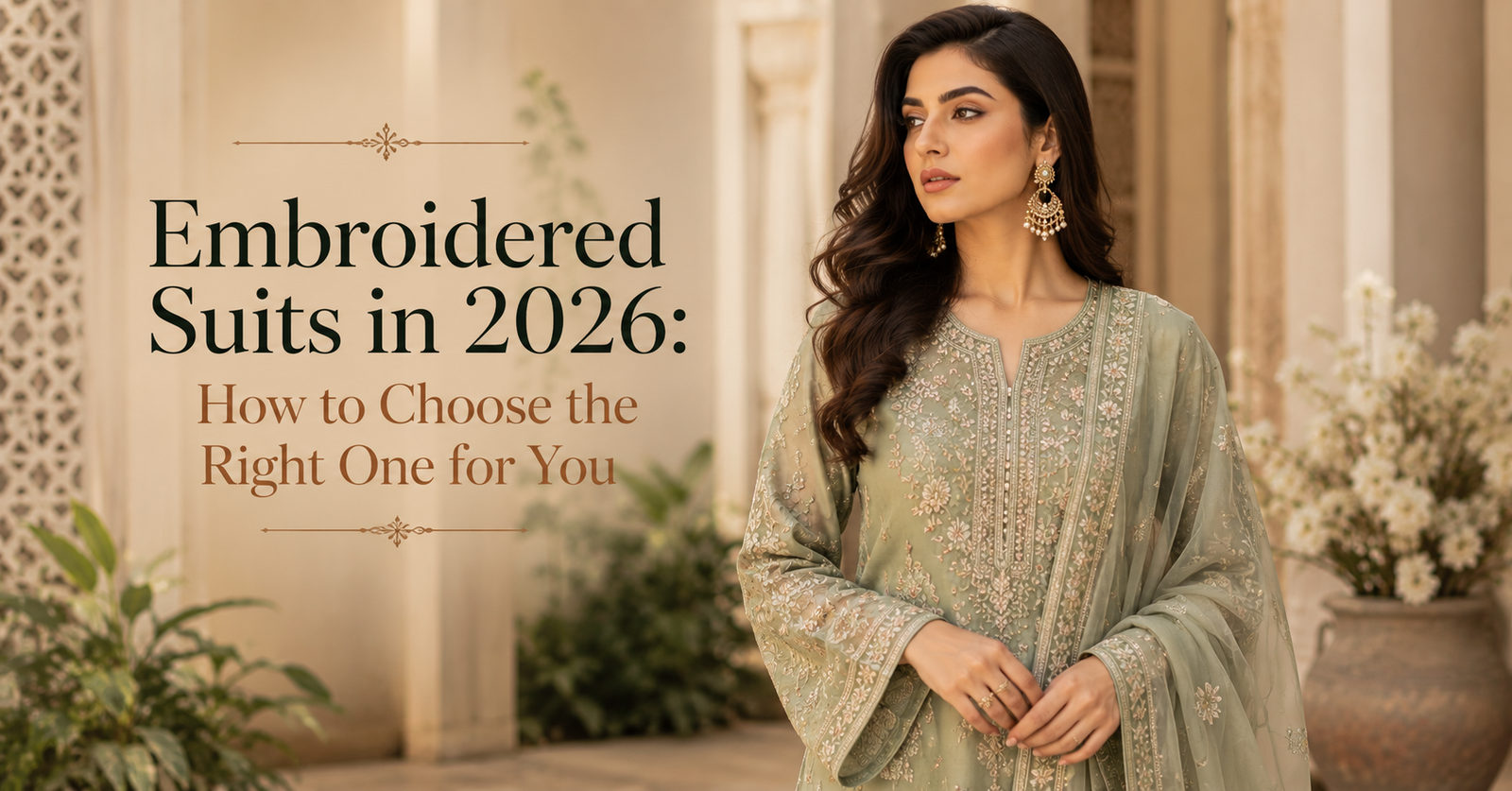
Embroidered Suits in 2026: A Complete Buying Guide
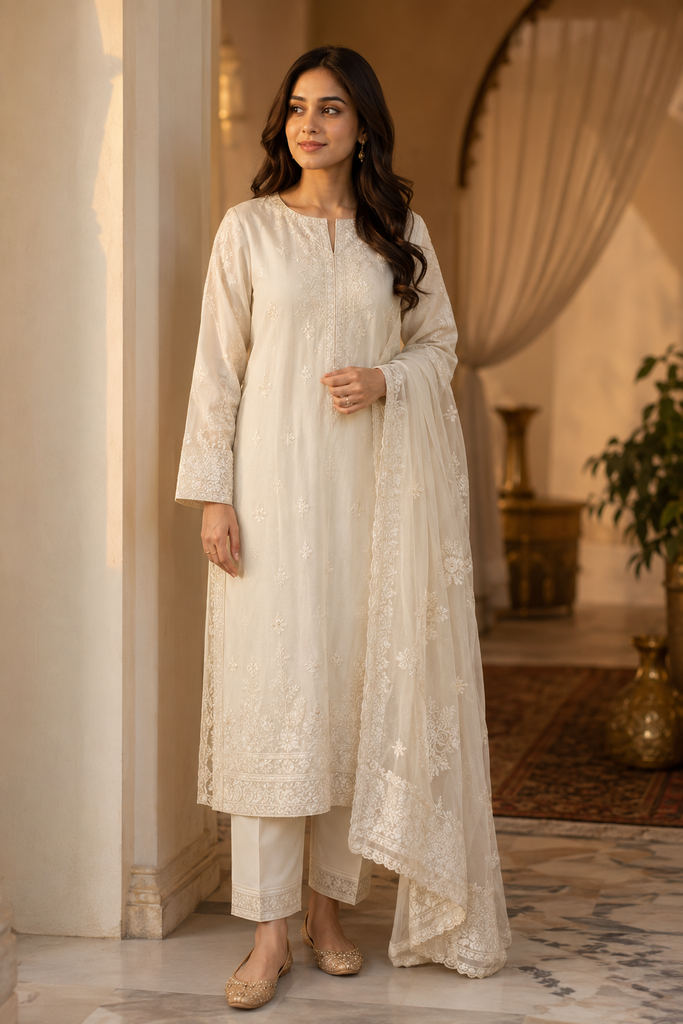
Something shifted this year, and if you have shopped for embroidered suits recently you probably felt it before you could put a name to it. The racks look calmer. The thread no longer competes for attention. Tonal embroidery — thread worked in the same shade as the cloth beneath it, so the pattern reveals itself only when the light moves — has quietly taken over from the dense, contrast-heavy embroidery that dominated the category for years.
That change matters right now for a practical reason. Whatever hemisphere you shop in, you are within a few weeks of a seasonal turnover: heavier fabrics arriving in the north, lighter ones in the south, and celebration season building almost everywhere. What you buy in the next two months will shape your wardrobe for the next six.
What to know in one paragraph
Embroidered suits in 2026 are lighter, more tonal and more deliberately placed — thread concentrated at the neckline, cuffs and hem rather than scattered across the whole garment. Fabric quality has become the differentiator rather than embroidery volume. The best buying strategy this year is fewer pieces, better made, chosen around where the thread actually sits.
What Actually Changed This Year
Three shifts, and they are connected.
The first is density. For a long time, the perceived value of an embroidered suit was measured by coverage — how much of the surface was worked. That equation has broken. A garment with a beautifully executed neckline and clean, unworked fabric around it now reads as more considered than one covered corner to corner. Designers have effectively started using empty cloth as a design element, which is a very different instinct from the one that governed the last decade.
The second is a change in buying behaviour rather than design. Across markets, shoppers have moved toward buying fewer garments and paying more attention to what they are made of. Part of that is economic pressure, part of it is a general fatigue with disposable wardrobes. Either way, the effect is the same: people are asking about fabric weight, thread quality and finishing in a way they were not five years ago.
The third is that fabric now leads the outfit. Rather than choosing embroidery first and fabric second, the sequence has reversed. You pick the cloth for the climate and the occasion — something breathable and matte for daytime heat, something with drape and sheen for evening — and the embroidery is chosen to suit it. The most-copied styling formula of the year comes directly out of this: a plain or lightly worked shirt paired with a genuinely decorative dupatta or scarf.
The suit is no longer trying to be the loudest thing in the room. It is trying to be the best-made thing in the room.
None of this makes heavy embroidery wrong. It makes it a decision rather than a default — which is precisely why buying well now depends less on trends and more on who you are.
If You’re Buying Your First Good Embroidered Suit
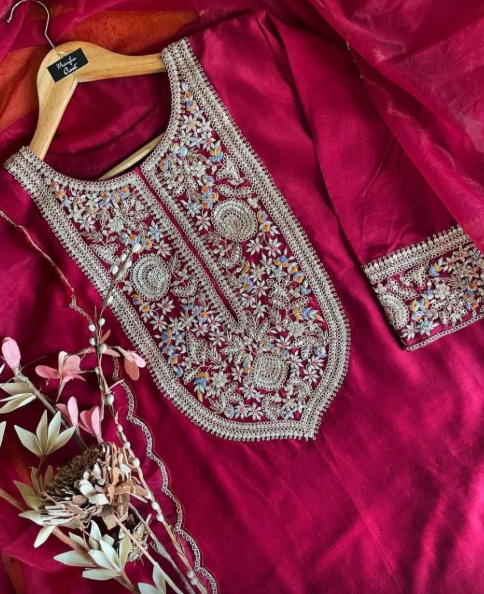
You are stepping up from inexpensive fabric to something with a real price tag, and the jump feels uncomfortable. Make it count by ignoring the design for a moment and checking three structural things instead.
Turn the fabric over and look at the reverse of the embroidery. Well-executed work has neat, evenly tensioned backing thread with no long loose floats bridging between motifs. If the back is chaotic, the front will pucker and warp after the first wash, no matter how good it looks in the shop.
Establish what is actually embroidered. The phrase “embroidered suit” covers everything from a single worked panel on the front to full sleeves, hem, side panels and a decorated dupatta. Two garments described identically can differ enormously in labour and value, and the product name rarely tells you which one you are holding.
Look hard at the third piece. Because current styling puts so much visual weight on the dupatta or scarf, a plain shirt with a worked dupatta and a worked shirt with a plain dupatta are two completely different outfits at a similar price.
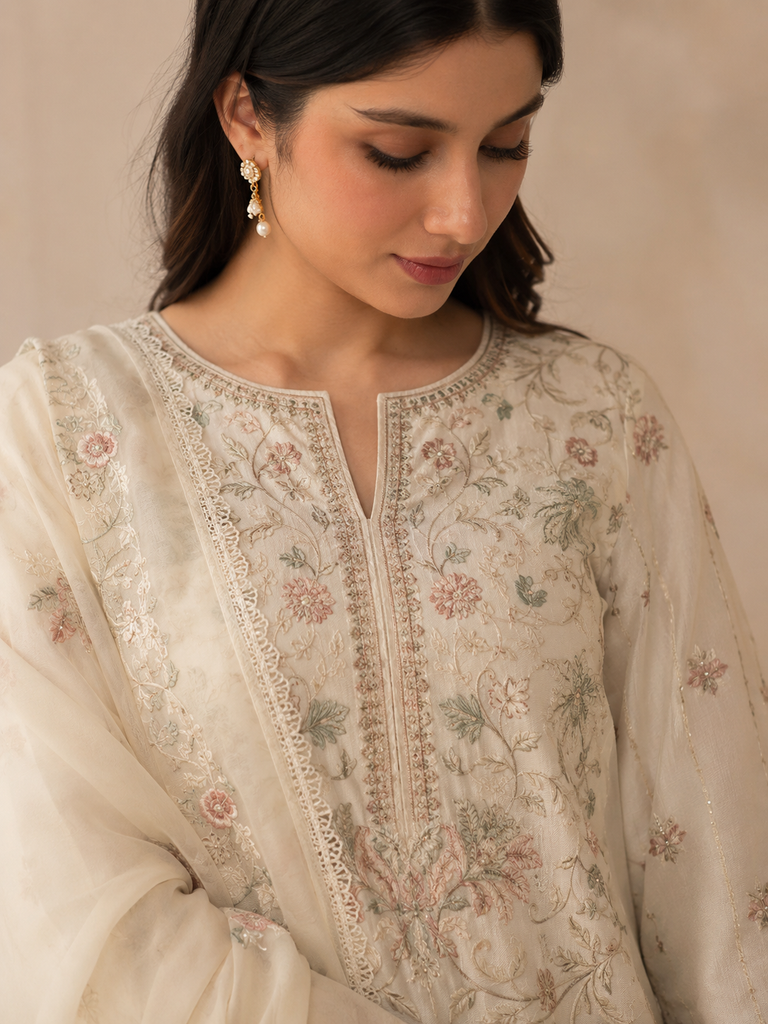
For a first purchase, choose tonal work on a neutral ground — ivory, oat, dusty rose, muted sage. It will still look right in two years, which is more than can be said for most first purchases.
If You’re Working With a Tight Budget
This is the most crowded end of the market, and you have more leverage than you think, mostly because of how retail calendars work.
Three rules for this bracket.
Buy placement, not coverage. A garment with one carefully worked neckline and clean, plain sleeves will always read as more expensive than an all-over design executed in cheap thread at the same price. Concentrated detail flatters a modest budget; scattered detail exposes it.
Shop the changeover weeks. Every seasonal launch pushes the previous season’s stock into discount, and embroidered pieces discount harder than printed ones because they carry more inventory cost. Buying one season behind is the single most effective way to get better construction for less money, and with tonal, understated designs the lag is invisible.
Avoid heavy sequin, bead and mirror work at this price. Inexpensive embellishment sheds, catches on other fabric, and dates quickly. Thread work at the same cost ages far more gracefully, because thread failing is subtle while sequins failing is obvious.
If You Work Full Time and Want Everyday Embroidery
Your problem is not finding embroidery. It is finding embroidery that survives eight hours in a chair, a bag strap across one shoulder, and regular washing.
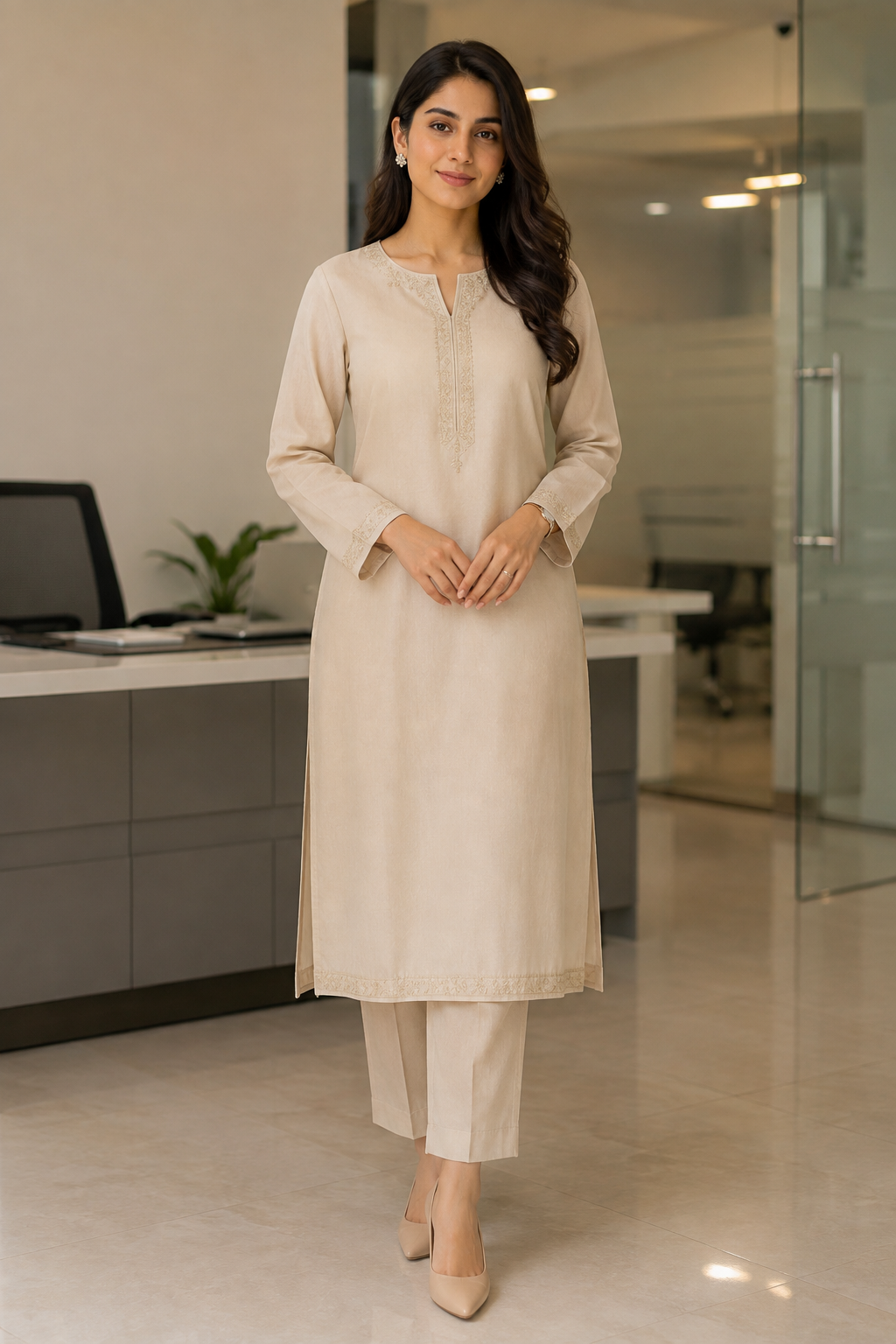
Choose tonal or self-coloured work on a matte fabric. Anything with a high sheen photographs beautifully and looks overdressed under office lighting. Skip raised beading across the shoulders or upper back entirely, because that is exactly where a chair, a seatbelt and a bag will attack it.
Think about placement in terms of contact points. Embroidery below the shoulder line and above the knee — necklines, cuffs, a narrow hem border — survives daily wear. Embroidery on the seat, the underarm or the shoulder does not.
A wedding season is never one outfit. Depending on where you live and whose family is celebrating, it can be five events across three weekends, with photographs of every one of them.
Build it as a system rather than as separate purchases.
Buy one genuinely elaborate piece, and only one. Something with real weight and real handwork, in a fabric that catches evening light — the garment you will wear to the two events that matter most and be photographed in repeatedly. Concentrate your spending here instead of distributing it evenly.
Then add two or three mid-weight pieces in different colour families. These cover the smaller gatherings, and because they are less memorable individually they can be repeated across events without anyone noticing.
Then rotate deliberately. Change the scarf, change the jewellery, change the silhouette of the lower half from straight to full to wide-legged, and a single shirt covers three occasions. This is how people with genuinely good celebration wardrobes actually operate; they are not buying more, they are recombining better.
Softer, lighter palettes have gained ground at the formal end this year, which is useful for guests rather than hosts — a muted tone is far less likely to compete with whoever the day belongs to.
If You Dress Modestly and Want Embroidery That Works With a Scarf
Modest dressing and this year’s embroidery direction fit together almost too neatly, with one important exception.
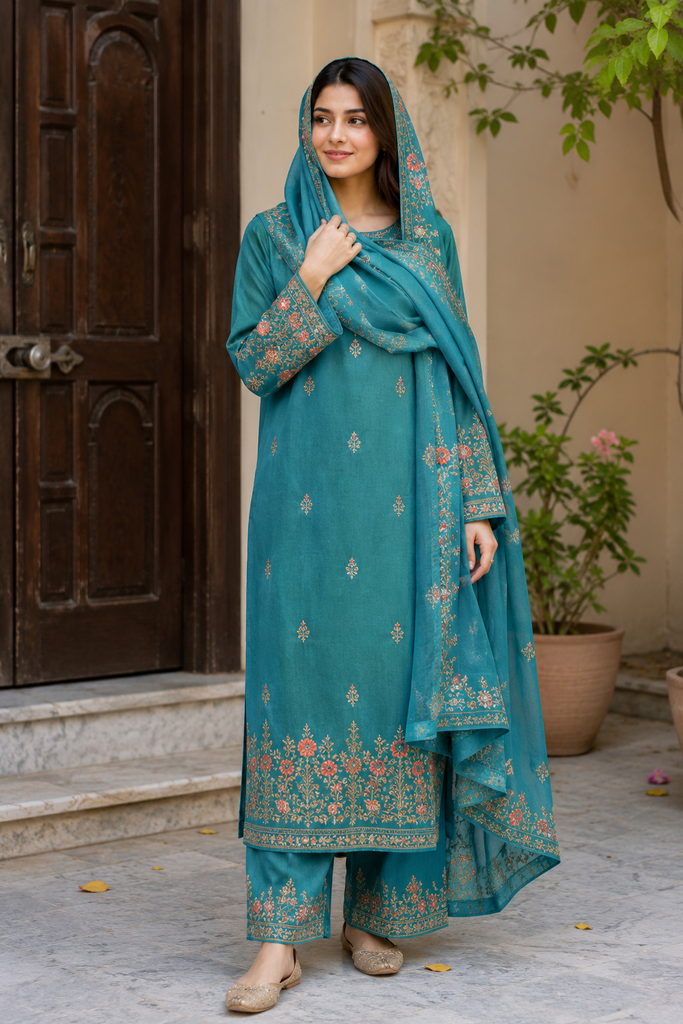
Concentrated neckline embroidery is a problem for you rather than a feature, because a headscarf or a draped dupatta covers precisely that area. Move the visual interest outward and downward instead: sleeve work running from elbow to cuff, a deep worked hem, embroidered side panels, or a plain shirt beneath a fully decorated scarf.
Proportion is the second adjustment. On a longer garment, a hem border sits better placed slightly above the edge rather than right at it — otherwise the detail disappears into the fall of the fabric when you move. Any competent tailor will understand this if you explain it; most will not raise it themselves.
The honest trade-off: ready-made saves you weeks and a tailoring conversation, and costs you fit.
The advantage of buying fabric unstitched is control — over the neckline, the sleeve, the length, the ease across the chest and hips. On an embroidered garment this matters much more than on a plain one, because embroidery cannot be let out. If a finished shirt pulls across a worked panel, there is nothing for a tailor to release. The seam allowance behind decorative work is usually minimal, and cutting into embroidery destroys it.
Buy ready-made when the work is light and sits away from the seams. Buy unstitched when the embroidery is heavy, when the piece is expensive, or when you fall between standard sizes — which, given how inconsistently sizing is applied across brands and countries, is most people.
If you do buy ready-made, size up rather than down. Taking a seam in on an embroidered garment is usually possible. Letting one out rarely is.
If You’re Ordering From Another Country
International buyers get the least reliable version of this market: long shipping windows, inconsistent sizing, replicas presented as originals, and returns that cost more than they are worth.
Ask for detail photographs before paying, not after. A close image of the reverse of the embroidery tells you more about quality than any number of styled product shots. Any seller confident in what they are selling will send one.
Confirm quantities in metres or yards rather than trusting a set description. Fuller silhouettes need noticeably more cloth than straight ones, and a listing that quietly supplies less will leave you unable to make what you intended. If a seller cannot state the yardage, they do not know what they are shipping.
Order at least two months ahead of when you need it. Customs delays are unpredictable, and made-to-measure tailoring on arrival adds weeks more. The single most common mistake international buyers make is ordering festive pieces on a domestic timeline.
Finally, check care requirements before buying rather than after. Some embroidered fabrics cannot be dry-cleaned conventionally, and finding a cleaner who understands them can be genuinely difficult outside the countries where these garments are made.
A Note on Embroidery Types, Briefly
You will see the same handful of terms repeatedly, and they are not interchangeable.
Silk or rayon thread work is the softest and most matte of the common techniques, and it forms the backbone of tonal embroidery — visible as texture rather than as colour. Metallic thread work, in gold or silver tones, is what makes a garment read as formal almost instantly, because the reflection does the work rather than the pattern. Raised wire and coil work is heavier and structural, sitting proud of the fabric surface; it belongs to celebration wear and does not survive casual handling. Fine white-on-white or shadow work, traditionally done on lightweight cotton, is the quietest option of all — which is exactly why it has done so well this year.
- Embroidery in 2026 is concentrated and tonal rather than spread and loud.
- Where the thread sits matters more than how much of it there is.
- On a tight budget, buy placement embroidery and shop one season behind.
- For daily wear, stay tonal, matte, and away from contact points.
- For celebrations, buy one elaborate piece and rotate everything else.
- If you cover, move the detail to sleeves, hem and scarf.
- Heavy embroidery should almost always be bought unstitched or made to measure.
Quick Reference: Which Suit Fits Which Buyer
| You are | Best fabric | Embroidery to look for | Made-to-measure or ready-made | Spending strategy |
|---|---|---|---|---|
| First serious buyer | Fine cotton or slub | Tonal, neckline and cuffs | Unstitched | One good neutral |
| Budget-conscious | Cotton, khaddar, cambric | Placement thread work only | Unstitched | Buy one season behind |
| Full-time worker | Slub, matte cotton, wool blend | Self-coloured, low relief | Either | Mid tier, worn often |
| Celebration guest | Chiffon, organza, net | Metallic thread, worked scarf | Unstitched | One high spend, then rotate |
| Modest dresser | Cotton, viscose, khaddar | Sleeves, hem, full scarf | Unstitched | Any tier |
| International buyer | Anything that ships flat | Flat thread work over beading | Unstitched | Add shipping honestly |
FAQ
Which fabric holds embroidery best in hot climates?
Lightweight cottons and cotton blends take thread work well while staying breathable. Avoid heavily lined or dense synthetic bases in heat — they hold embroidery beautifully and become unwearable by midday.
Is heavy embroidery going out of style?
Not disappearing, but narrowing in purpose. Dense embellishment has become a celebration and formal-event choice, while everyday and semi-formal dressing has moved toward lighter, deliberately placed work on plain ground.
How do I stop embroidered garments from puckering after washing?
Wash cold, turned inside out, by hand or on a delicate cycle, and dry flat in shade. Never wring a worked panel. Most puckering comes from wringing and heat shrinkage rather than from the embroidery itself.
Is a decorated scarf or dupatta worth paying extra for?
Frequently, yes. Because current styling pairs plain garments with worked scarves, a good decorated third piece can be restyled across several plain outfits, making it one of the better-value items in a wardrobe.
When is the best time to buy embroidered suits?
During seasonal changeover, when the outgoing collection discounts as new stock arrives. With tonal, understated designs, buying one season behind is essentially undetectable.
Can embroidered suits work for the office?
Yes, when the work is tonal, low-relief and confined to the neckline, cuffs or hem, and the lower half is left plain. Beading and mirror work are the elements that push an outfit out of professional range.