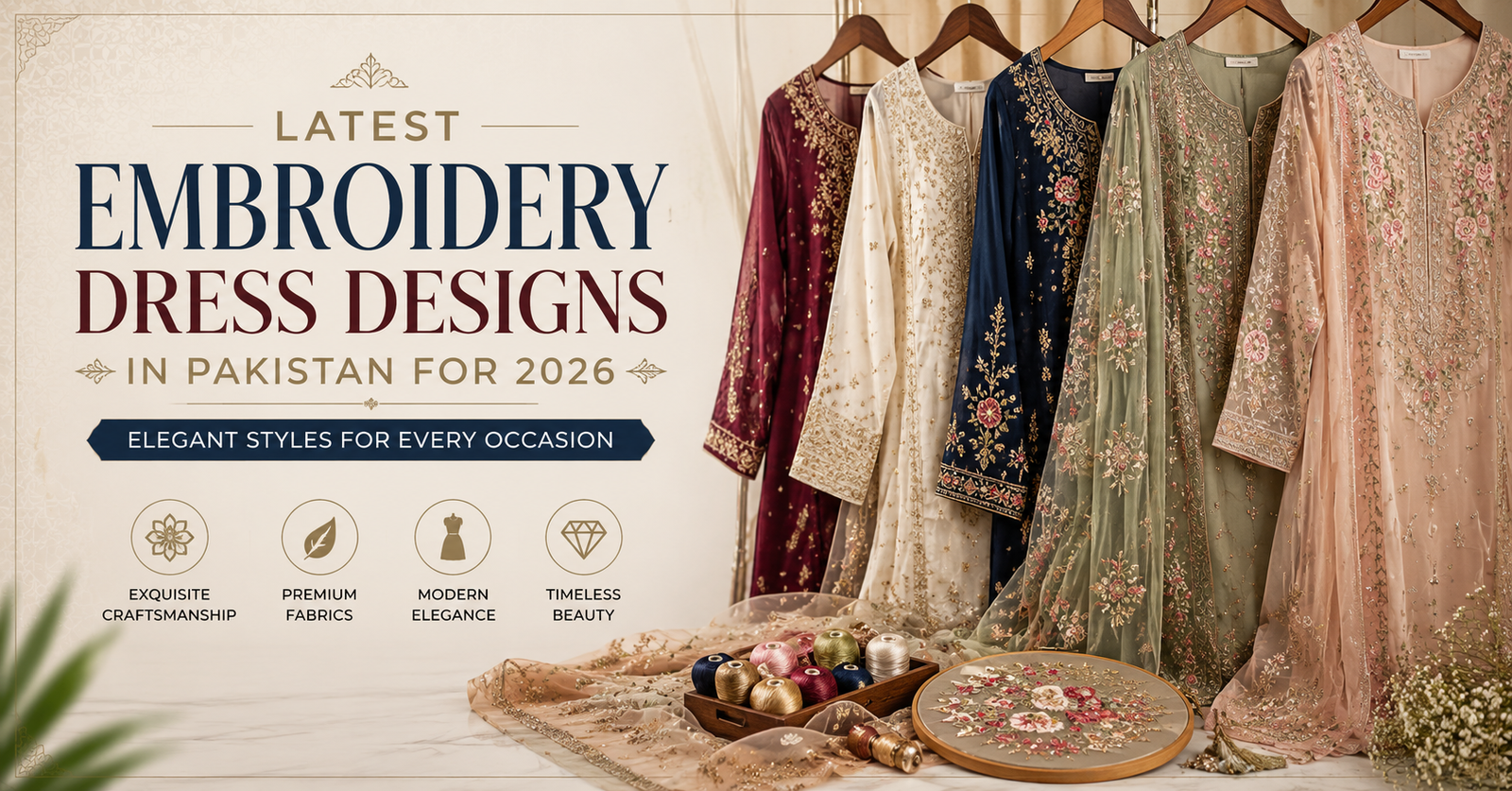
Latest Embroidery Dress Designs in Pakistan: Elegant Styles for Every Occasion
QUICK ANSWER
Embroidered dress designs of Pakistani origin have moved toward lighter, more deliberate work: thread matched closely to the base cloth, a single motif rather than full coverage, sheer worked dupattas over plain shirts, and heavier metallic techniques reserved for evening and wedding wear across every climate.
KEY TAKEAWAYS
- Placement now carries more prestige than coverage; empty fabric is part of the design.
- Thread matched to the base colour is the most versatile look available at any budget.
- A worked sheer dupatta or stole formalises an entire wardrobe for a fraction of a formal outfit’s cost.
- Technique determines how long a piece lasts far more than price does.
- Buying from abroad is straightforward once you understand unstitched fabric, sizing conventions and lead times.
There was a stretch of years when more was simply better. Denser panels, wider borders, heavier crystal — the value of a garment was read off the surface area covered. That logic has been unwinding, and anyone who shops this category regularly has felt it happen.
Latest Embroidery Dress Designs in Pakistan: Elegant Styles for Every Occasion now describes something closer to editing than decoration. Designers are removing work rather than adding it, and the pieces that look most expensive are frequently the quietest ones in the room. That shift matters right now because the autumn and winter event calendar — weddings, receptions, religious festivals, formal dinners — is where most of the year’s spending happens, and the outfits moving fastest are not the heaviest.
This is a complete profile of the category for readers anywhere in the world: what the vocabulary means, what is actually happening in design, what to wear to which occasion, what goes wrong, and how to buy sensibly when the workshop is several time zones away.
What “Embroidery Dress Designs” Actually Covers
The phrase is broad enough to be misleading, and misreading it is the single most common buying error.
At the base sits unstitched fabric — a length of cloth, usually two or three pieces, sold with the embroidery already worked onto the front panel, neckline, borders and sleeves. You take it to a tailor. This is unfamiliar to most Western shoppers and is exactly why so many first purchases go wrong.
Above that is ready-to-wear, cut to standard sizes and finished. Then premium ready-to-wear, where the base cloth improves noticeably, the lining is properly constructed and the handwork is denser. At the top sits formal and occasion wear, frequently made to measure, where the embroidery is not an addition to the garment but the entire reason for it.
The same word appears on a thirty-dollar summer suit and a three-thousand-dollar wedding outfit. What separates them is rarely the quantity of thread. It is the technique, the quality of the ground fabric, and whether a machine or a pair of hands did the work.
The Embroidery Vocabulary Every Buyer Should Know
Learn about ten terms and you stop paying for a look and start paying for craftsmanship. I have included familiar equivalents from other traditions where they exist, because the techniques travel further than the names do.
| Technique | What it is | Closest global cousin | Best for | Wear-life |
|---|---|---|---|---|
| Resham | Fine silk or rayon thread work, usually floral | Silk shading, satin stitch | Daywear, tonal designs | Very good |
| Zardozi | Raised metallic work built with coiled wire | European goldwork | Wedding and evening formals | Excellent, snags easily |
| Dabka | Tight metallic coil giving dimensional texture | Bullion work | Necklines, borders, bridal | Excellent |
| Tilla | Flat metallic thread, softer sheen | Passing thread | Traditional formals, ceremonies | Good |
| Mukaish | Tiny metal points scattered across sheer cloth | Metallic dot work | Sheer dupattas, light formals | Moderate |
| Gota | Flat ribbon appliqué, festive and graphic | Soutache, ribbon work | Daytime celebrations, festivals | Good |
| Chikankari | White-on-white or tonal shadow stitching | Whitework, broderie anglaise | Summer, understated formals | Very good |
| Aari | Hook-needle chain stitch, fast and intricate | Tambour, Lunéville | Mid-range formals, beadwork | Good |
| Shisha | Small mirror discs stitched in place | Suzani mirror work | Festive, folk-inspired pieces | Mirrors can loosen |
| Schiffli | Machine-worked repeat embroidery | Industrial multi-head embroidery | Everyday printed suits | Good on quality cloth |
KEY POINT
Excellent machine work on excellent cloth outperforms mediocre handwork on cheap cloth every time. Assess the ground fabric first and the thread second — a garment fails at the weave long before it fails at the stitch.
Latest Embroidery Dress Designs in Pakistan: Elegant Styles for Every Occasion — the Current Snapshot
Five directions define what is being made and bought right now.
Thread has gone tonal. Ivory on ivory, olive on sage, rose on dusty pink. When the thread sits within a shade or two of the base, the eye reads texture rather than pattern, and texture is what photographs as expensive. It also solves a practical problem: tonal work never fights with your jewellery, your shoes or the room you are standing in.
Placement replaced coverage. One worked shoulder. A narrow band tracing a neckline. A scatter of motifs across a front panel and nothing beyond it. Designers are leaving space on purpose, and space reads as confidence in a way that density never has.
Sheer worked dupattas do the heavy lifting. A plain shirt with an embroidered organza or net drape delivers formal presence without formal weight, formal heat or formal pricing. For anyone building a wardrobe rather than buying a single outfit, this is the most efficient purchase in the category.
Surface finish became part of the design. Lightly glazed cottons throw back more light than matte weaves, which means the same modest thread work reads richer. Fabric finish is now a design decision, not just a comfort one.
Neutrals graduated from accent to complete outfit. Ivory, champagne, oyster and warm sand worn head to toe with tonal work has become a genuine formal choice, deliberately positioned away from saturated ceremonial colour.
KEY POINT
If you buy one thing this season, make it a worked sheer dupatta or stole in a neutral. It will lift at least four garments you already own, and it packs flat for travel.
Occasion by Occasion: Matching Embroidery to the Event
Most disappointment in this category comes from a good piece bought for the wrong occasion.
Everyday and campus wear
Light thread work on cotton, cambric or lawn. Neckline and cuff detailing only. Straight or gently flared cuts with narrow trousers. Choose shadow-work or fine silk thread and avoid anything metallic that will scratch across a long day at a desk.
Workplace and smart-casual
A plain-dyed shirt with a tonal worked border and a contrast trouser is the most dependable formula in the entire category, and it reads as professional in almost any office culture. Keep the silhouette structured, the length past mid-thigh, and save reflective work for after dark.
Religious festivals and family gatherings
Clean silhouettes in cotton silk or a light blended weave, tonal work, soft palettes, comfortable trousers and a draped scarf. These are long days involving travel, seating on floors, cooking and photographs. Comfort is not a compromise here — it is the requirement.
Daytime celebrations and pre-wedding events
Movement is the entire point. Ribbon work, mirrors and light sequins on airy cloth, worn in flared or wide-legged silhouettes that respond to motion. Go bright. Keep the weight low, because celebration venues run hot regardless of the season outside.
Ceremonies and nikah-style occasions
Restraint reads as grace. Ivory, champagne, soft gold, pale blush. Fine thread, pearl detail, discreet mirror accents. Ceremonial without competing with the bride. This is the occasion where the tonal direction performs at its absolute best.
Evening receptions, black-tie and wedding-guest dressing
Richer colour and stronger embellishment still hold their ground after sunset. Worked sheer overlays, embellished bodices, decorated borders, an ornate drape. Fluid crepe and chiffon carry dense work without collapsing; raw silk suits clean structured shapes; velvet owns cold-weather evenings.
KEY POINT
One statement element per outfit. Neckline, drape border, or sleeves — choose one and let the other two stay quiet. Three competing focal points is the fastest route to looking overdressed rather than well dressed.
Fabric and Embroidery Pairings That Actually Work
| Fabric | Suits which work | Season | Notes |
|---|---|---|---|
| Fine cotton / lawn | Machine repeats, light silk thread, shadow work | Hot weather | Heavy work puckers the weave |
| Cambric | Tonal thread, neckline panels | Mild weather | The best everyday value in the category |
| Brushed cotton / khaddar | Thread work, wool-blend accents | Cold weather | Warm, matte, very forgiving of wear |
| Linen and blended twill | Tonal thread, light sequins | Transitional | Drapes better than brushed cotton |
| Organza | Sequins, metal dot work, thread borders | Year-round | Formal presence with no added heat |
| Chiffon | Metallic coil work, dense handwork | Formal | Handles weight without sagging |
| Raw silk | Structured placement work, flat metallic thread | Formal | Ideal for minimal-luxury silhouettes |
| Velvet | Coil work, goldwork, stones | Cold weather | Must be properly lined or it becomes unwearable |
| Jacquard / brocade | Minimal added work | Cold weather | Woven depth means less embroidery is needed |
Approximate Price Bands
Broad orientation only, converted to USD, before shipping, duties or tailoring. Treat these as a sense of shape rather than quotations.
| Category | Typical range (USD) | What the money buys |
|---|---|---|
| Embroidered unstitched summer fabric | $15 – $40 | Ground cloth quality, size of worked panel |
| Embroidered winter unstitched | $25 – $55 | Fabric weight, thread density |
| Everyday ready-to-wear | $20 – $45 | Fit and finishing |
| Premium ready-to-wear | $60 – $150 | Lining, hand-finishing, cut |
| Embroidered velvet formals | $80 – $250 | Velvet grade, quality of coil work |
| Formal and made-to-measure | $200 upward | Hours of handwork, customisation |
Styling Embroidered Pieces Modestly
Full coverage and decorative work have never been in conflict. The placement simply needs thought.
- Favour designs where the work sits at the hem, cuffs and centre front rather than across the chest and upper back.
- A long shirt over straight or wide trousers keeps the vertical line clean, and a worked hem pulls the eye downward.
- A generous worked drape does double duty as styling and coverage; crisp sheers hold their shape better than soft ones for this.
- Ask a tailor to extend sleeves to full length and carry the motif through to the cuff rather than stopping at the elbow.
- When the garment is worked, keep any head covering plain. When the garment is plain, let a worked shawl lead.
Common Problems — and How to Avoid Them
Scratching against skin. Metallic and dense thread work is genuinely uncomfortable against bare skin. Request a soft lining behind every worked panel before construction begins, not after the first wear.
Snagged threads. Coil work and metal dot work catch on rings, watch clasps, bag hardware and seatbelts. Wear flat jewellery and put the garment on last.
Colour bleed. Deep dyes on unstitched cloth can run on first contact with water. Anything embellished should go to a specialist cleaner; nothing metallic should ever see a washing machine.
Shrinkage after cutting. Natural-fibre unstitched cloth can move. Have it checked or pre-treated before a tailor cuts into it.
Where the Category Is Heading
The clearest direction is specialisation. Buyers no longer browse a broad formal category and hope something suits; they shop for one named occasion at a time, and makers are building collections to match. That is good news for anyone spending real money, because pieces are now designed for the specific moment you actually need them.
Expect the tonal direction to hold, with metallic techniques concentrating in genuine occasion wear rather than spreading across every price tier. Expect sheer worked layers to keep expanding, because they solve the heat problem that has always limited formal ethnic dressing in warm climates and heated indoor venues alike. And expect the international audience to keep growing, which will continue pushing brands toward clearer measurement charts, better photography and more honest fabric descriptions.
Before You Buy: Honest Limitations
Style conventions in this category vary enormously by country, community and family. What reads as perfectly judged at one wedding can look out of step at another, and no guide written for a global audience can settle that for you. When in doubt, ask the host or someone attending.
The price bands here are broad orientation ranges in a single currency, and they shift with collections, sales cycles, exchange rates and fabric costs. Shipping times, customs duties, stock and return policies differ by retailer and by destination country.
Before committing money, confirm current pricing, fibre composition, full measurements, delivery estimates and the return policy directly with the seller — on their official website or in store — rather than from any third-party listing, this one included. Where a garment involves made-to-measure handwork, get the lead time in writing before you pay.
7. FAQ
Which embroidery is most practical for everyday wear?
Fine silk thread work or shadow stitching on cotton and cambric. Both are lightweight, comfortable against skin and survive cleaning far better than metallic techniques. Keep the work at the neckline, cuffs and hem so nothing rubs during a long day.
Is tonal embroidery formal enough for a wedding?
For daytime ceremonies and quieter formal occasions, comfortably yes — tonal work in ivory or champagne is among the most refined options available. For evening receptions, most guests still prefer contrast work with some metallic content, because event lighting flattens subtle texture.
How does buying unstitched fabric work if I live abroad?
You receive lengths of cloth with the embroidery already worked in, then take it to a local tailor with your measurements. Ask about lining before cutting, and expect to pay tailoring costs on top. It usually works out cheaper than premium ready-to-wear and fits far better.
Can embroidered garments be washed at home?
Anything with metallic thread, sequins, mirrors or dense handwork should go to a specialist cleaner. Light silk thread work on cotton can sometimes be hand-washed cold, inside out, without wringing — but check the care label first, since dye and thread quality vary widely.
What is the real difference between hand and machine embroidery?
Hand techniques are worked individually and produce raised, dimensional surfaces with slight irregularities that catch light. Machine work is even and repeatable, which is why it dominates everyday collections. Handwork costs more and rewards close inspection; good machine work on quality cloth still wears extremely well.