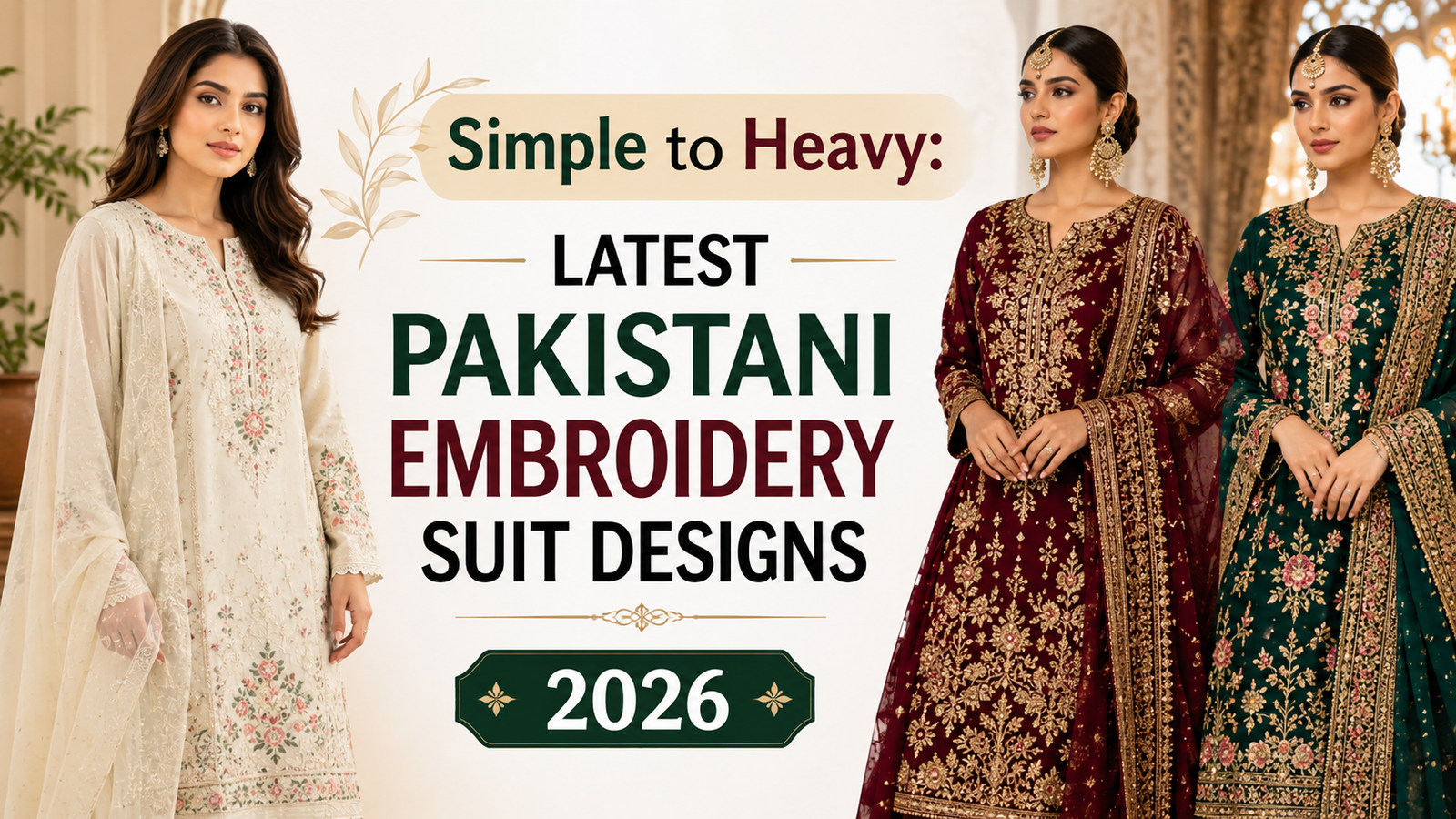
Embroidery is best understood as a coverage scale, not a price scale.
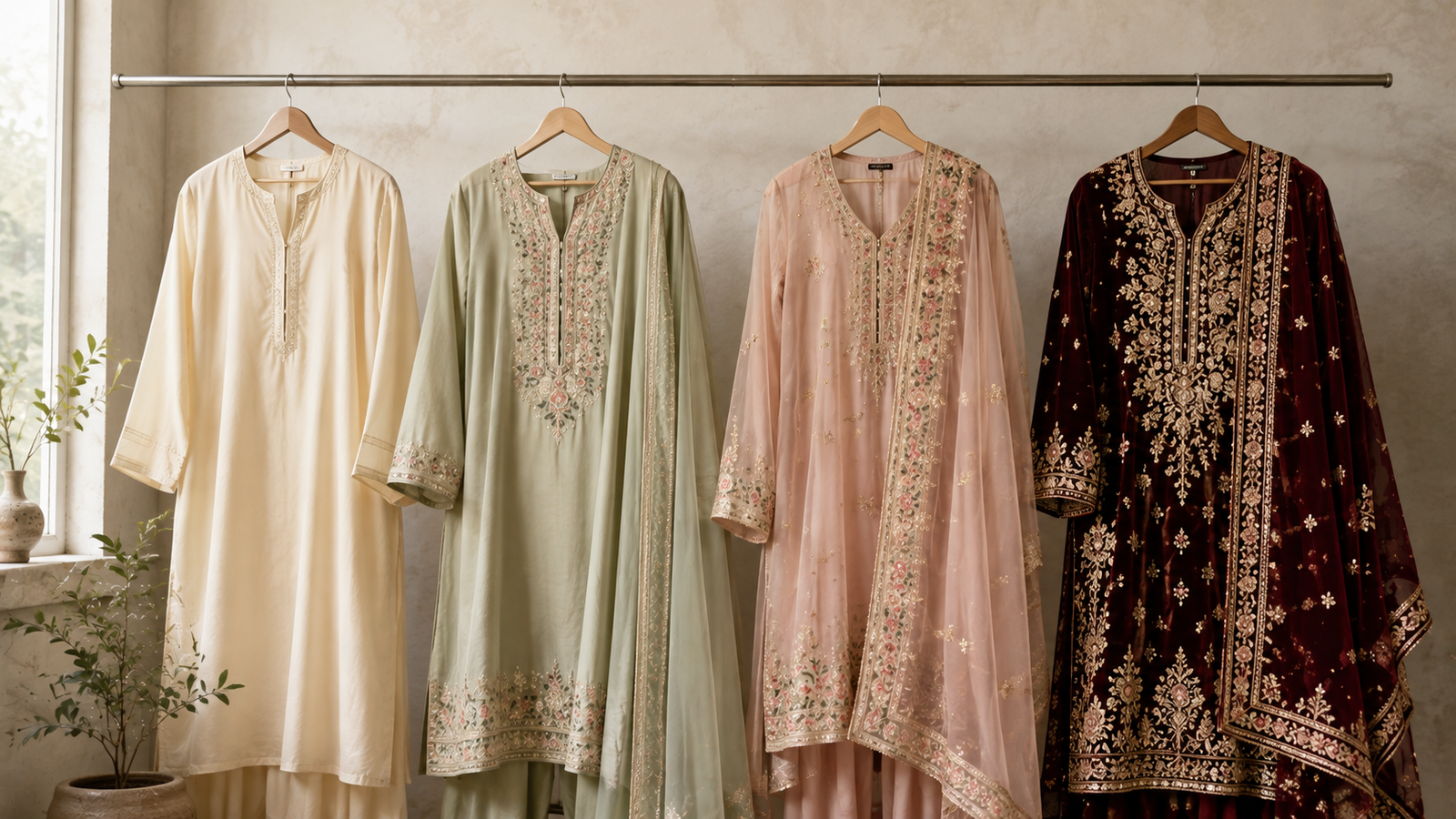
Four levels handle almost every occasion: everyday, semi-formal, formal evening, and heavy.
The technique on a garment tells you its level more reliably than the label does.
Placement-led embroidery has replaced all-over embroidery as the current design instinct.
Readers outside Pakistan should plan around shipping and tailoring time, not around the fabric season.
The suit you wear six times will almost always cost less than the one you wear twice.
There is a particular kind of wardrobe failure that has nothing to do with having too few clothes. It happens to careful shoppers, people who plan, people who have a full rail of perfectly good outfits. The rail is stacked at two extremes — plain everyday pieces on one side, one spectacular occasion outfit on the other — and there is a gap in the middle wide enough to drive a wedding invitation through. When the invitation arrives, the conclusion is always the same and always wrong: I have nothing to wear. The wardrobe is not short of clothes. It is short of a middle.
QUICK ANSWER Pakistani embroidery suits sort into four coverage levels in 2026. Light work sits on the neckline or sleeve alone. Semi-formal adds a front panel or hem border. Formal spreads across the front, sleeves and dupatta. Heavy covers the full garment in raised metallic handwork and belongs to weddings.
Simple To Heavy: Latest Pakistani Embroidery Suit Designs 2026 At A Glance
Ask what makes a suit heavy and most answers will describe how much thread is on it. That definition is slipping. What defines a garment now is where the work sits and how much of the eye it demands — a densely worked yoke above an untouched body can carry more presence than a shirt that is embroidered corner to corner, and it costs less to make.
That is why a coverage ladder is more useful than a trend list. Trends expire. Coverage logic does not.
Level
Coverage
Typical Fabrics
Techniques You’ll See
Wear It To
Relative Cost
1 — Light
Neckline or sleeve only; a small fraction of the garment
Lawn, cambric, cotton, marina, viscose
Fine thread work, machine eyelet, small scattered motifs
Central wedding functions, family roles, your own event
High
Use it as a plan rather than a shopping menu. A wardrobe built around how an actual social calendar behaves will be weighted heavily toward levels one and two, hold two or three pieces at level three, and keep a single level-four garment that gets restyled instead of replaced.
KEY POINT: An empty level two is the single most expensive gap in an ethnic wardrobe. Every small invitation becomes an emergency purchase, and emergency purchases are always the wrong price.
The Illustrative Scenario: One Wardrobe, One Year Of Invitations
What follows is an illustrative composite, constructed to demonstrate the coverage ladder. It is a teaching example, not a reported case or a real individual.
Picture a reader who could be almost anywhere — a graduate working full time, with family in one country and cousins scattered across two more. Her year holds four occasions that matter: a colleague’s evening dinner, a family engagement she is helping to host, a friend’s reception where she is a close guest, and a wedding overseas where she is genuinely part of the family.
She has a budget with edges on it. She wants to arrive at all four looking like she thought about it, without buying four expensive outfits or borrowing anything.
Watch how the four levels solve her year one occasion at a time.
Phase One — The Foundation Layer Of Embroidered Lawn Suits 2026
She begins with the clothes nobody photographs.
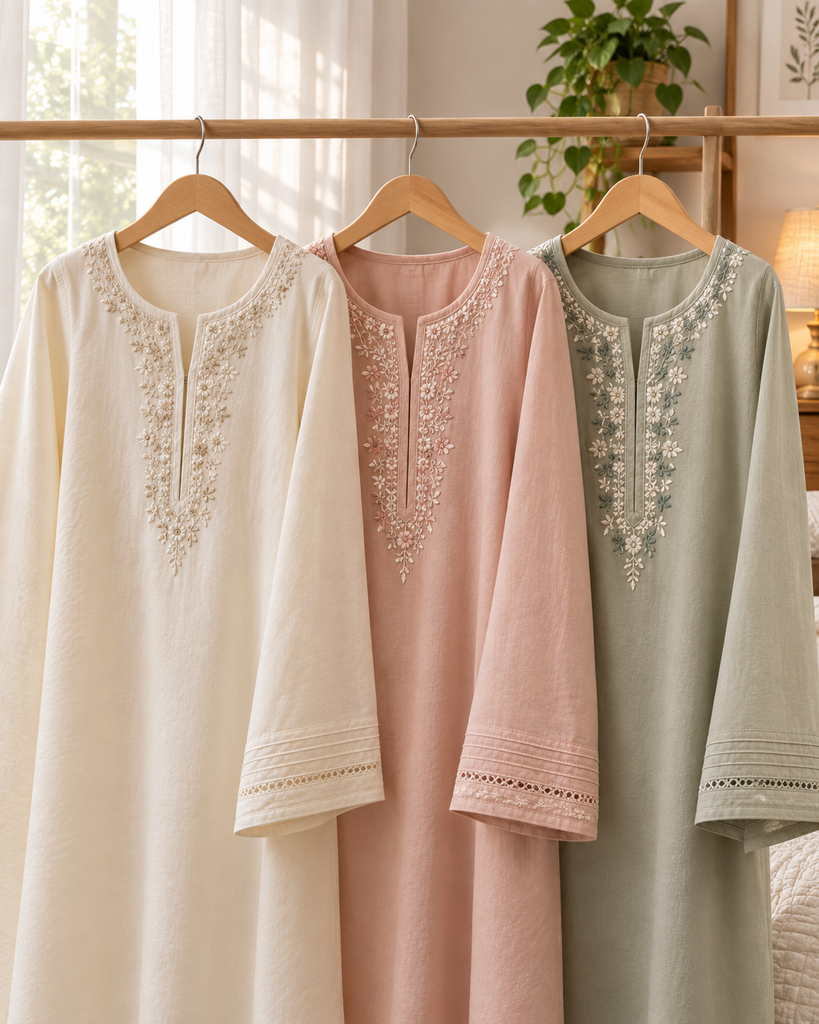
This is the level that has quietly improved most. Machine embroidery has reached a point where a well-finished neckline on ordinary cotton reads as deliberate rather than mass-produced, and embroidered lawn suits 2026 collections lean on that: a worked gala, a narrow sleeve motif, a plain body, nothing else. The whole effect rests on two details — the density of the stitching, and whether the reverse of the neckline has been lined properly. Unlined embroidery scratches, and a garment that scratches is a garment that stays folded.
Her buying here is intentionally unmemorable. Two cotton shirts with worked necklines, one viscose piece with light sleeve detail, all in tones close enough to each other that repeating them goes unnoticed.
What Phase One Taught Her
Light embroidery buys finish, not occasion. It separates a considered outfit from a plain one, and that is its entire job.
Thread matched closely to the fabric outlasts contrast thread by months of wear, because the eye tires of it far more slowly.
The neckline is the only component at this level where quality is visible. Concentrate the spend there and let everything else be ordinary.
KEY POINT: At level one, judge the fabric and the collar. Every other feature on the tag is being sold to you rather than worn by you.
Phase Two — The Semi-Formal Bracket Where Chikankari Suits 2026 Live
The dinner invitation lands, and this is the fork in the road where most wardrobes go wrong.
The instinct is to reach upward, toward something formal and shining. The better move is to stay at level two, which is a far richer band than its reputation suggests. A single embroidered front panel over a plain body. A hem border deep enough to catch the light when you walk and quiet enough to sit through a three-hour meal. Cutwork running along a placket. A worked shawl or wrap that turns an unremarkable suit into a complete look.
Chikankari suits 2026 belong squarely in this bracket, and the reason they keep returning is structural rather than fashionable. Tonal shadow work — white on white, pastel on pastel — signals effort without signalling expense, which makes it almost impossible to overdress in. It photographs beautifully in daylight and disappears politely under evening lighting, which is exactly the behaviour you want from a daytime garment.
She buys one piece here: a panel-embroidered suit with a matching worked wrap. She wears it to the dinner. Then to a family lunch. Then to the engagement with different earrings and her hair up. By the end of the year it has been out of the wardrobe six times.
What Phase Two Taught Her
The garment worn six times cost a fraction of the garment worn twice, and did more work in her year than either of them.
A worked dupatta or wrap raises a level-two suit into level-three territory visually, at level-two prices.
Panel and border embroidery ages far better than all-over embroidery. Concentrated work stays interesting; scattered work becomes wallpaper.
Phase Three — Formal Evening Work On Chiffon, Organza And Silk
The reception is a different calculation. She needs presence in a room full of people who have also made an effort, but she is a guest, and dressing at level four would be a genuine social misreading.
Level three is where the fabric changes character. Chiffon, organza, silk and crepe hold their shape while moving, which is what makes distributed embroidery possible — work spread across the sleeves, the front and the dupatta borders rather than concentrated in one panel. The techniques shift too. Metallic thread, small mirror inserts, fine bead and sequin scatter: points of light distributed across a surface instead of a solid worked surface.
The most useful current formula at this level is deliberate imbalance. An ornate dupatta over a restrained shirt. The dupatta carries the room; the shirt carries the wearer. It photographs with depth rather than glare, and — the practical part — the dupatta can be lifted onto a completely different shirt next season, which no fully worked outfit ever allows.
Her choice is a deep-toned suit with a heavily bordered sheer dupatta.
What Phase Three Taught Her
Buy the dupatta as the main investment and the shirt as its support. The dupatta is the transferable half.
Metallic work must be checked under artificial light before purchase. A great deal of thread that glows in a shop goes strangely flat under hall lighting.
Formal is not the same as maximal. Distributed accents outperform solid coverage every time at this level.
KEY POINT: Level three is the tier most people skip past by mistake. Overshooting into level four here means outdressing your hosts and still owning nothing for next month.
Phase Four — Heavy Embroidered Pakistani Suits And The One-Night Outfit
Then comes the wedding where she is family, and this is the single occasion in her year that actually earns the weight.
Heavy embroidered Pakistani suits are defined by total surface commitment. The shirt is worked across front, back and sleeves. The dupatta carries deep borders and often a worked field as well. The trouser is frequently embroidered too, and where the silhouette is a flared or floor-sweeping cut, it becomes a design element in its own right rather than an afterthought.
This is where the real craft vocabulary lives — raised metallic wire work, dense hand-stitched relief, mirror and stone layered over thread rather than used alone. The fabrics are chosen for load-bearing before beauty. Velvet, jamawar, net and raw silk can carry a kilogram of surface work without buckling at the shoulder seam, which is precisely why they anchor this tier and why they are physically unwearable in heat.
She buys one. She wears it to the wedding, then packs it away, and brings it out two years later for a wedding in another city where none of the same guests will be present. That is the correct life cycle for a level-four garment, and planning it before purchase is what makes the purchase defensible.
What Phase Four Taught Her
Heavy garments must be stitched to measurement. A fully worked shirt has almost no forgiveness in the drape, and standard sizing rarely survives contact with it.
Weight is the factor nobody warns you about. An outfit you cannot comfortably sit in for six hours becomes a bad memory of a good day.
One well-chosen heavy suit, restyled twice, beats two adequate ones bought in a hurry.
What She Got Wrong Along The Way
Three errors surfaced across her year, and they are the three that repeat most often.
She initially budgeted upward, planning the wedding outfit first and letting everything else be paid for out of what remained. That is backwards. The heavy garment is the one occasion you know about months ahead; the small invitations are the ones that arrive with two weeks’ notice and no budget left.
She also mistook price for level. A heavily marketed piece described as intricate handwork turned out to be machine embroidery with a ribbon border — a level-two garment wearing a level-three price tag. Learning to read the technique fixed that permanently.
And she nearly bought a second heavy outfit for the same season, on the reasoning that she had one and it worked. Two heavy garments in one calendar year is almost always one too many. The restyle is cheaper and, done properly, invisible.
Embroidery Techniques Worth Knowing Before You Shop
A good deal of overspending comes from not being able to name what you are looking at. This is the vocabulary that will do the most work on a shop floor or a product page.
Technique
What It Looks Like
Usual Level
Machine eyelet work
Crisp, repeating perforated patterning, very uniform
1
Silk thread work
Coloured floral or geometric stitching, flat to the surface
1–2
Chikankari
Fine tonal shadow stitching, matte and delicate
2
Cutwork and laser detailing
Cut-out shapes along borders, panels and plackets
2
Flat ribbon appliqué
Matte metallic tape laid in patterns, festive but light
2–3
Fine metallic scatter
Tiny reflective points spread across plain fabric
3
Metallic thread work
Continuous gold or silver stitching, smooth finish
3–4
Raised wire embroidery
Dimensional, sculptural, catches light from the side
3–4
Dense coiled handwork
Heavily textured surface, visible relief, layered
4
Mirror and stone work
Embedded reflective pieces, high shine
4
The practical value of this table is leverage. Once you can see that a garment described as heavy handwork is machine work with a ribbon border, you are negotiating from a different position — or walking away from a different position.
What Shifted In 2026, And What Held
Three changes are worth naming plainly.
Placement took over from density. Concentrated work over clean ground is the dominant instinct across the whole category. A loaded yoke on an untouched field now reads as current in a way that edge-to-edge patterning does not.
Palettes went quieter in daylight, deeper at night. Softened, dusty and near-neutral tones lead daytime dressing, while saturated jewel shades hold the evening. That split is what makes level-one and level-two purchases so repeatable — quiet colour is the reason nobody notices the third wearing.
Silhouettes relaxed at the bottom. Wider trousers and looser hems have moved from casual into semi-formal, while the most dramatic sweeping cuts stay reserved for the top tier. Embroidery has followed the hemline downward, with more work at the hem and less filling the middle of a shirt.
What did not change is the relationship between fabric and climate. Fine cotton for heat, mid-weight blends for temperate months, plush and structured fabrics for cold. No design trend has ever won an argument with weather, and it is not going to start now.
A well-dressed year is usually four good decisions and one purchase you talked yourself out of.
Buying From Outside Pakistan: The Practical Layer
For readers shopping from the UK, North America, the Gulf, Australia, Europe or Southeast Asia, the ladder holds exactly as written. The logistics do not.
Time, not season, is your constraint. Unstitched fabric bought abroad has to travel, clear customs, and then reach a tailor who is likely to be busy for the same reasons you are. Working backwards from the event date by ten to twelve weeks is realistic for anything at level three or four. Level one and two can be bought much closer to the wearing.
Stitched versus unstitched changes meaning abroad. Ready-to-wear solves the timing problem and creates a fit problem, and the fit problem grows with the coverage level. At levels one and two, ready-to-wear is usually fine. At level four it is rarely fine, because a fully worked garment has to be built around a specific body to hang correctly.
Climate reverses the calendar. A southern-hemisphere reader shopping a winter collection is buying for the wrong half of the year. Buy by fabric weight and occasion, not by the season printed on the collection name.
Colour on screen is not colour in the room. Deep tones photograph darker and metallics photograph brighter online than they appear in person. Where a return is expensive or impossible, that risk is worth building into the decision.
Your Next Steps
Run through these in order before you buy anything else.
Audit your wardrobe by level, not by colour. Lay everything out, sort it into the four tiers, and look for the empty one. That gap is your shopping list.
Fill level two before anything else. It carries more of your year than any other tier and it is the one most often missing.
Check the reverse of every neckline at levels one and two. Comfort is what decides whether a garment gets worn again.
View metallic work under artificial light before committing at level three or four.
Learn five technique names from the glossary above. It is the fastest way to stop paying level-three prices for level-two work.
Treat the dupatta as your upgrade tool. One strong worked dupatta will lift three plain shirts and travel across seasons.
Allow ten to twelve weeks for anything heavy if you are ordering internationally and having it stitched.
Limit yourself to one level-four purchase per year, and decide how you will restyle it the second time before you buy it the first.
FAQ
What actually separates light embroidery from heavy embroidery? Coverage and construction. Light work occupies a small, defined area — usually a neckline or sleeve — and adds almost no weight. Heavy work covers the entire garment in raised, often metallic techniques and can add noticeable physical weight. The practical consequence is wearability: one is comfortable for a working day, the other is built for a single event.
What should I wear to a wedding if I’m a guest rather than family? Formal-level dressing is the right register — distributed embroidery on a fluid fabric, paired with a well-worked dupatta. Full surface handwork tends to read as bridal-party dressing and can look mismatched to a guest’s role in the room.
Is chikankari still worth buying in 2026? Yes, and it has quietly become one of the most reliable purchases in the whole category. Its tonal restraint makes it almost impossible to overdress in, which is why it holds its place across seasons rather than cycling in and out.
Should I buy stitched or unstitched? Ready-to-wear is sensible at the lighter levels and risky at the heavy ones. Fully worked garments depend on measured stitching to drape correctly, because the weight of the surface work pulls at the shoulders and hem in ways standard sizing does not anticipate.
How do I judge embroidery quality from a photograph? Look at the reverse if any image shows it, check whether the pattern aligns cleanly at the seams, and zoom in on the edges of motifs. Uniform, perfectly repeating patterns indicate machine work. Slight irregularity across repeats usually indicates handwork.
How many embroidered suits does one person actually need in a year? For most calendars: three or four at the light and semi-formal levels, one or two formal, and a single heavy piece. The heavy one should be planned for restyling rather than replacement.