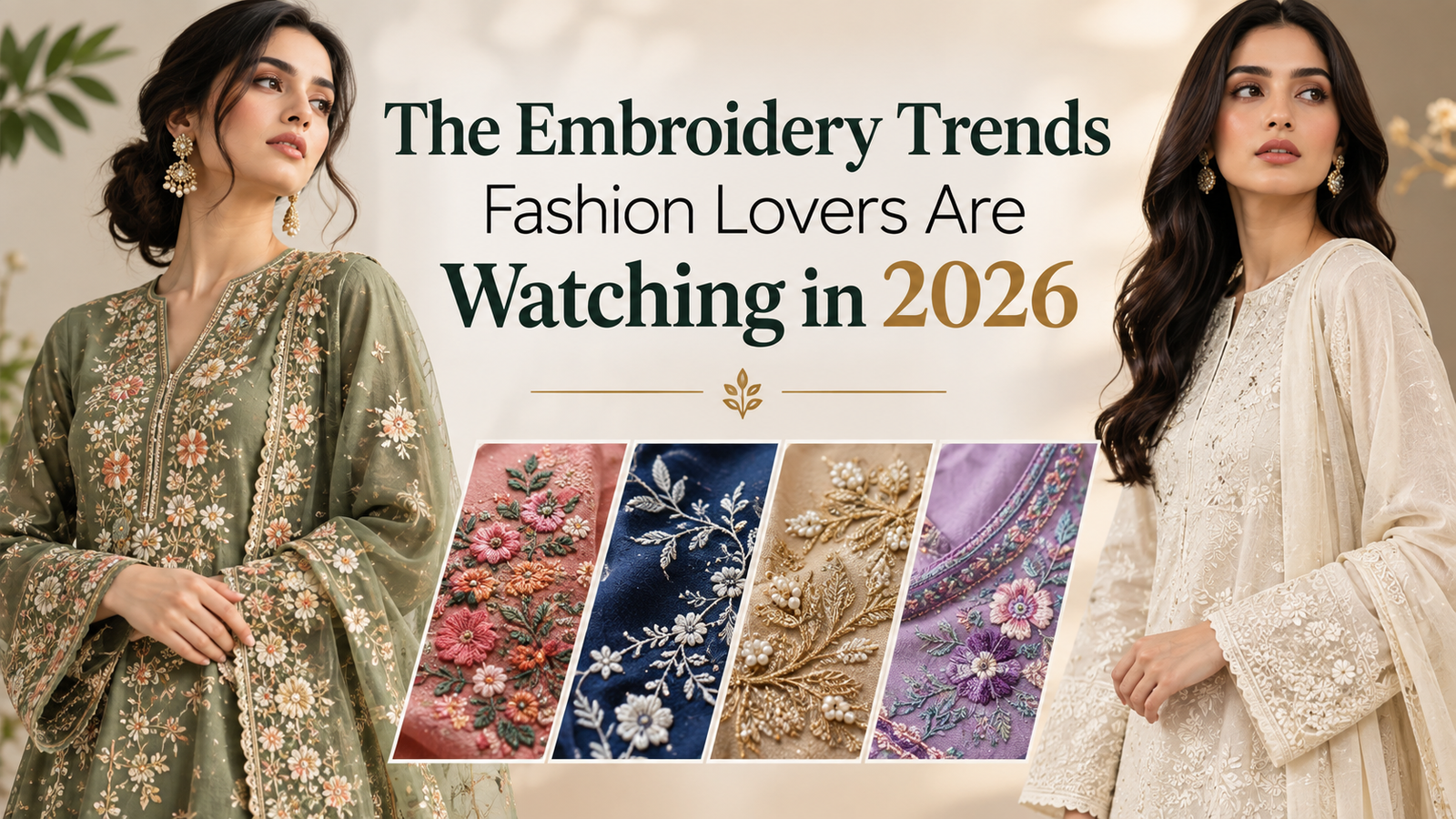
For a long stretch, embroidery was the polite extra. A monogram on a cuff. A few stitched leaves near a hem. Nice, but never the reason anyone bought the garment. That has quietly reversed, and the change is worth understanding before you spend anything.
The Embroidery Trends Fashion Lovers Are Watching in 2026 have less to do with new motifs than with a new job embroidery is being asked to do. Clothing costs more nearly everywhere. Shoppers have grown suspicious of paying premium prices for plain fabric with a label sewn in. Embroidery answers that suspicion in the most direct way available: it shows visible labour. You can see where the hours went. That single shift explains almost everything else happening in the category this year — why the stitching got bigger, why it moved to unexpected parts of the garment, and why the quietest version of it has turned out to be the most useful one.
Key Takeaways
Embroidery has become a reason to buy a garment, not a decoration added afterwards
Tonal embroidery — thread matched to fabric — is the most wearable and most forgiving version this year
Placement matters more than motif; stitching that survives layering is worth more to you than stitching that doesn’t
Metallic and beading work best as a small proportion of the design, not the whole of it
Heritage and craft-derived motifs are travelling globally, which raises questions worth asking before you buy
Density, backing and edge definition tell you in seconds whether the price is honest
So, What Are The Embroidery Trends Fashion Lovers Are Watching in 2026?
Six directions, in plain terms: tonal embroidery, where thread sits within a shade of the base cloth so the pattern only appears in certain light; raised or puff work, built over a soft core so the design lifts off the surface; single oversized motifs occupying a full back, sleeve or panel; restrained metallic and bead accenting rather than all-over shine; appliqué, where fabric shapes are layered and stitched down; and heritage craft motifs adapted from traditional needlework.
Those are the headlines. What follows is the part that decides whether you enjoy the purchase in two years or resent it in two months.
What Changed Between 2024 And Now?
Two pressures met, and they happened to push the same way.
The first is financial. As garment prices climbed across most markets, the gap between what a piece costs and what it visibly is became harder to ignore. A plain coat has to justify itself through cut and cloth alone, which is a subtle argument. An embroidered one makes the argument instantly. Buyers responded to that, and the market noticed.
The second is fatigue. Roughly a decade of stripped-back, logo-free minimalism trained the eye toward restraint, and restraint eventually stops registering as a choice. When everything is quiet, nothing stands out — including the expensive things. Ornament came back partly as relief.
Embroidery sits at the intersection. It reads as craft, which satisfies the first pressure, and it reads as decoration, which satisfies the second. Few other techniques do both at once. Printing is cheap and looks it. Beading is craft but rarely practical. Embroidery lands in the usable middle, which is why it spread rather than staying in evening wear.
Why Is Tonal Embroidery Suddenly Everywhere?
Because it removes the main objection people have to embroidery: that it will make them look overdone.
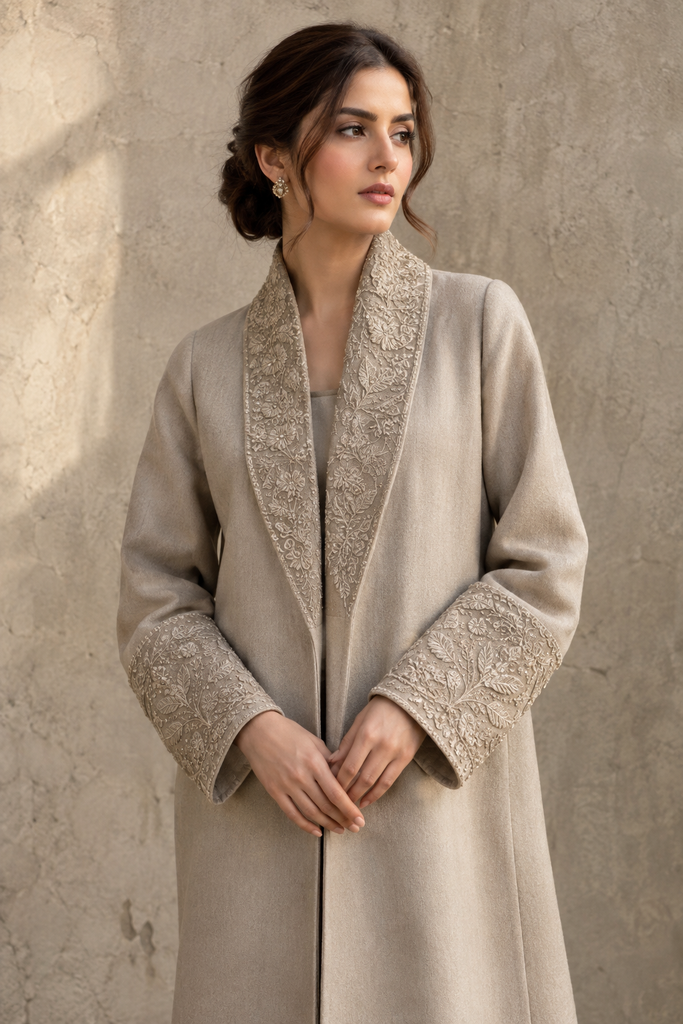
Tonal work keeps the thread within one or two shades of the fabric underneath. Ivory on ivory. Deep brown on deep brown. Grey-green stitching on a grey-green abaya. From a distance it registers as texture, almost like a woven pattern. Up close it resolves into a design, and the garment quietly upgrades itself.
Its real advantage is arithmetic. Tonal embroidery adds no new colour to your wardrobe, so it creates no coordination problem. A tonal embroidered jacket pairs with everything a plain one would have paired with. Nothing in your existing rotation becomes harder to wear.
For anyone dressing modestly, or simply for anyone who prefers not to be looked at, it’s the most valuable option in the category — you get the craft and the surface interest without the attention that a contrasting motif pulls toward whichever part of the body it sits on. If you’ve never bought embroidery before, start here. It’s the version least likely to sit unworn.
Statement Or Subtle — How Big Should Embroidery Be This Year?
The two ends of the scale are where the interest is. The middle has gone flat.
At one extreme, a single dominant motif takes over a whole surface — a full back, an entire sleeve, a broad hem band. There’s no ambiguity about it; the garment is the design. At the other, embroidery has shrunk to something almost private: a fine line drawing on a collar point, a small figure near a cuff, a detail you notice only when someone is close enough to talk to.
What’s lost momentum is the medium scale — the evenly scattered small repeat across a chest or yoke. It isn’t offensive, but it reads as generic, because it’s the easiest thing to mass-produce and it has been produced enormously.
Choosing big? One embroidered piece per outfit, and nothing else competing
Choosing small? You can wear two or three subtle pieces together without conflict
Skip the mid-scale scattered repeat unless the workmanship is genuinely exceptional
Check where a large motif sits on your body — a back panel and a front panel are completely different decisions
Are Metallic And Beaded Details Actually Wearable In Daylight?
Yes, in one specific form: as an accent inside the embroidery rather than the substance of it.
The version that works is small and deliberate. A thin gold line tracing the outer edge of a motif. A single silver element inside a larger design worked in ordinary thread. A few beads clustered at one point rather than spread across a surface. In each case the metallic is doing a job — catching light where the designer wants your eye — and then stopping.
The version that fails is uniform shine across a whole garment. It photographs beautifully and wears badly, because it fixes the piece to evenings and events and refuses to do anything else.
A rough working limit: if metallic or beaded elements exceed about a tenth of the embroidered area, treat the garment as occasion wear and buy it for a specific occasion you can already name. Below that, it will pass in daylight, at work, and under a coat.
Where Is Embroidery Being Placed Now That It Wasn’t Before?
Placement is the trend people underrate, and it’s the one that most affects whether you actually wear the thing.
The default position for decades was the chest or the left pocket area, borrowed from uniform and workwear conventions. That has broadened considerably. Stitching now runs the length of sleeves, wraps cuffs, follows collar edges, travels down outer side seams, spans full backs, and forms borders along hems.
Hem placement deserves particular attention if you wear longer silhouettes. A worked border along the bottom of a maxi skirt, dress or long coat draws the eye downward across the full length of the garment, which flatters a long line rather than interrupting it. It’s also the placement most likely to survive a second layer.
That last point is the practical one. If you live somewhere with real winters, or you simply layer by habit, chest embroidery vanishes the moment a coat goes on. Sleeves, cuffs, collars and hems stay visible. Buy placement that matches how you actually get dressed, not how the garment looks alone on a hanger.
Why Are Heritage Craft Motifs Travelling So Far From Home?
Because hand-worked regional needlework carries something machine design can’t easily fake: a visual language that developed slowly, for reasons, in a particular place.
Traditions from across the world — whitework from South Asia, running-stitch mending traditions from East Asia, bold silk floral work from Central Asia, colour-saturated animal and plant motifs from Latin America, geometric village patterns from across Eastern Europe and the Levant — have all fed into what the wider market now offers. Some of that exchange is genuine and well credited. Some of it is a motif lifted, scaled and machine-reproduced with no relationship to its origin.
You can usually tell the difference by asking two questions. Does the seller name the tradition, and can they say anything specific about it? And does the piece show any evidence of hand-work — small irregularities, slight variation between repeated elements, a back that looks worked rather than stamped?
Machine reproduction isn’t dishonest in itself; most embroidery you’ll ever own is machine-made and that’s fine. But a piece sold on the strength of a craft heritage should be able to show some connection to it, and a piece that can’t should be priced like ordinary decoration.
Which Colours And Threads Define Embroidery Fashion Trends 2026?
The palette turned grounded, which is a mild surprise given how ornate the shapes became.
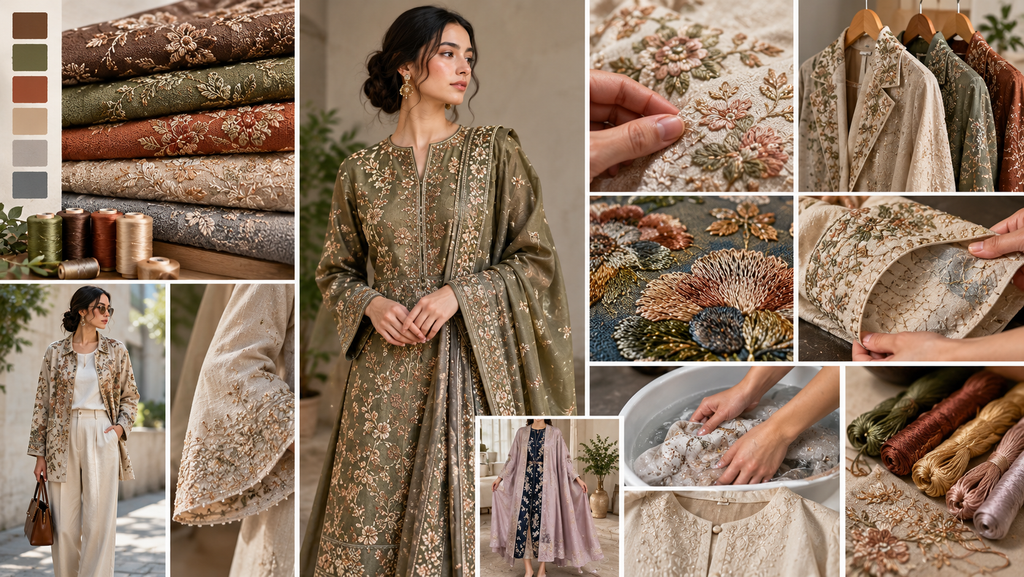
Earth-derived colours dominate: browns, muted greens, clay and rust tones, sand, stone and soft greys. They work partly because they suit tonal embroidery so well — these are colours that already appear as base fabrics, so matching thread to cloth is easy. Gradient effects, where a single motif shifts smoothly through related shades, are the year’s most distinctive technical flourish and its most easily overdone.
On thread itself, the useful distinction for a buyer is finish and durability. High-sheen threads catch light and photograph well but are less tolerant of repeated washing and friction. Matte, hard-wearing threads look flatter but hold up through years of ordinary use. Neither is better; they suit different garments.
Earth tones for pieces you intend to keep for years
Gradient work for one statement item, not a wardrobe strategy
High-sheen thread for occasion pieces, matte and durable for weekly wear
Check the fibre content, and check whether the embroidery thread differs from the garment fabric — mixed fibres shrink at different rates
How Do You Style Embroidered Clothes Without Looking Overdressed?
One principle covers nearly all of it. Let the embroidered piece be the only thing in the outfit asking for attention.
In practice that means plain fabrics, restrained colours and simple accessories everywhere else. An embroidered jacket over a plain top and straight trousers. A worked skirt with an unadorned knit. An embroidered blouse with dark denim and nothing added. The embroidery supplies all the interest the outfit needs; anything else competing with it makes both elements look cheaper.
| Do | Don’t |
|---|---|
| Pair one embroidered piece with plain basics | Combine embroidery with a bold print |
| Match accessories to the base fabric, not the thread colour | Add statement jewellery over statement stitching |
| Keep tonal work for daytime and professional settings | Wear heavy metallic thread before evening |
| Let a hem border be the outfit’s single detail | Layer two large-motif pieces in one look |
| Simplify the silhouette when embroidery is dense | Stack ruffles, texture and embroidery together |
For layered or modest dressing, the strongest formula this year is a tonal embroidered outer layer — long jacket, duster, abaya, coat — worn over entirely plain underlayers. Every bit of the craft is visible, and none of it draws the eye to the body.
How Do You Tell Good Embroidery From Cheap Embroidery Before You Buy?
Half a minute of inspection is enough once you know what you’re looking at.
Turn the garment inside out first. This is the single most informative thing you can do. Quality work sits on a stable backing and lies flat, with the fabric around it undistorted. Poor work leaves the surrounding cloth rippled or puckered, because dense stitching pulled against material that had nothing supporting it. That puckering will not improve; it worsens with every wash.
Next, look at the outer edges of the design. Crisp, sealed outlines mean the design was properly prepared before stitching. Ragged edges with the base fabric showing through mean the stitch count was cut to save time and money.
Then run a finger across the surface. Good embroidery feels dense and consistent. Thin patches, loose ends and threads trailing loosely between separated elements all point to rushed production.
Raised or puff work needs one extra check. The core underneath must be completely covered — any lighter material peeking through at the edges of a raised element is a flaw that becomes more obvious as the piece ages.
How Should You Care For Embroidered Clothes?
Gently, and less frequently than you’d wash a plain equivalent.
Turn inside out before every wash, without exception
Cool water and a gentle cycle; hand wash anything beaded or metallic
Never wring or twist an embroidered section
Dry flat and away from direct heat — heat shrinks the base cloth around stitching that cannot shrink with it, which is the most common cause of permanent puckering
Press from the reverse, over a cloth, never directly onto thread
Store heavy embroidered pieces folded rather than hung, so the weight doesn’t pull the shoulders out of shape
Spot-clean beaded pieces instead of washing them whole
Metallic thread is the most fragile material in the category, and a often the least tolerant of ordinary detergent. Treat anything with the meaningful metallic content as hand-wash or very professional-clean regardless of what the label suggests.
Which Of These Trends Are Worth Buying, And Which Will Fade?
Worth real money: tonal embroidery, cuff and collar placement, fine line work, and well-made heritage-derived pieces bought from sellers who can explain what they’re selling. None of these are anchored to a single season. Tonal work in particular has no expiry, because it doesn’t announce a year to anyone looking at it.
Buy with a clear head: raised puff work and full-back single motifs. Both look excellent now and both are strongly of this moment. They’ll remain wearable, but they will be readable as 2026. That makes them a mid-price purchase rather than an investment one.
Approach carefully: all-over metallic and dense full-garment beading. They’re the most impressive pieces in any collection and the least used items in most wardrobes. Buy one only against a specific occasion already in your calendar.
Your Action Plan
☐ Check what you already own — most wardrobes contain one embroidered piece worth restyling
☐ Buy tonal first if the category is new to you
☐ Choose placement that survives layering: sleeves, cuffs, collars, hems
☐ Do the inside-out inspection on every embroidered garment before paying
☐ Limit yourself to one statement embroidered piece per outfit
☐ Keep metallic and beading to a small share of the design for daytime
☐ Set up gentle washing from the first wear, not after the damage shows
The Honest Limits Of Any Trend Piece
Trend writing describes direction, not certainty, and it should be read that way. What appears in a designer collection reaches ordinary shops in translated form — simplified, machine-made, cheaper, sometimes unrecognisable — and a fair amount of it never arrives at all. Embroidery is unusually prone to this gap, because the techniques that look most impressive are the ones most expensive to reproduce at volume. A hand-worked piece and its high-street interpretation can share a trend name and almost nothing else.
There’s a second limit worth stating plainly. Trends arrive at different times in different places. Seasons run opposite across hemispheres, climates dictate what’s actually wearable, and local craft traditions mean some of these ideas are new in one market and centuries old in another. Treat any single timeline, including this one, as approximate.
What doesn’t depend on forecasting: quality is checkable with your own hands using the tests above, and the styling principle — one embroidered piece, everything else plain — has held for a very long time and will outlast this particular set of motifs.
If you want to judge where things are genuinely going rather than where a list says they are, watch what turns up repeatedly in shops near you over three or four months. Repetition is a more reliable signal than any prediction.
FAQ
Is Embroidery Still In Style In 2026?
Yes, and more prominently than in recent years. It has moved from a finishing detail to a central design feature, largely because visible craft has become one of the clearest ways a garment justifies its price.
What Is Tonal Embroidery?
Embroidery worked in thread very close in colour to the fabric beneath it, so the design reads as texture rather than contrast. It’s the most versatile and least demanding embroidery style to wear.
Can You Wear Embroidered Clothes To Work?
Easily, provided you keep it tonal or small in scale. A tonal embroidered jacket or a fine collar detail reads as good tailoring. Large motifs, heavy beading and metallic thread suit evenings better.
Is Hand Embroidery Better Than Machine Embroidery?
Not automatically. Hand work offers variation and character; good machine work offers consistency and durability. Poor examples of both exist. Judge the individual piece by density, backing and edge definition rather than by method.
How Do You Stop Embroidery From Puckering?
Wash cool and inside out, avoid tumble drying entirely, and press from the reverse over a cloth. Most puckering comes from heat shrinking the base fabric around stitching that cannot shrink with it.
Is Embroidery Suitable For Modest Fashion?
Very well suited. Longer silhouettes give embroidery more surface to work across, and hem borders, cuff detail and tonal outer layers deliver visible craft without drawing attention to the body.