
Every year the same thing happens in Pakistani homes a week before Eid. The new jora is ready, the embroidery looked stunning in the shop, and then on Eid morning it starts to fight you. The neckline scratches, the heavy border pulls the shoulders down by Zuhr, the dupatta keeps catching on the sequins, and by the time the family photographs are taken, you are already wishing you had chosen something simpler. The problem is rarely the embroidery itself. It is that the design was chosen for how it looked on a hanger, not for a full day of hugging relatives, sitting on the floor for lunch, praying, and posing for photographs in the afternoon heat.
That is why Eid embroidery designs deserve a different kind of planning from ordinary outfits. An Eid jora has to look festive in the morning light, stay comfortable through a long day, and still photograph well in the evening. These eight Eid embroidery designs for 2026 cover everything from a soft floral kurta for Eid day to dense zardozi work for the Eid night dawat, with the fabric, placement and checking advice you need to take each one to a tailor or spot it in a ready-made piece.
What makes Eid embroidery different from everyday embroidery?
Four things decide whether embroidery works on an Eid outfit. The first is the length of the day. You will wear this outfit for twelve hours or more, through prayers, meals, visits and photographs, so anything that scratches, pulls or weighs on the shoulders will become unbearable long before the day ends. Comfort is not a compromise on an Eid design; it is the first requirement.
The second is photography. Eid is the most photographed day of the year in most Pakistani families, and embroidery that looks flat in person can shine in a photograph, while work that looks rich up close can disappear entirely in bright daylight. Metallic thread, mirror work and light-catching sequins photograph beautifully, but only when they are placed where the camera can see them: the neckline, the sleeves and the front panel. The third is the weather. Eid-ul-Fitr usually falls in warm weather, so dense work on heavy fabric becomes a burden by midday, while Eid-ul-Adha outfits need embroidery that survives outdoor gatherings and sacrificial-day chores without snagging. The fourth is the family setting. Your outfit will be seen by everyone from your grandmother to your youngest cousin, so the design should feel festive without being so formal that you cannot sit comfortably on a charpai or help serve food. Keep these four checks in mind as you read the designs below, because the right Eid design is always the one that passes all four on your body, not the one with the most thread.
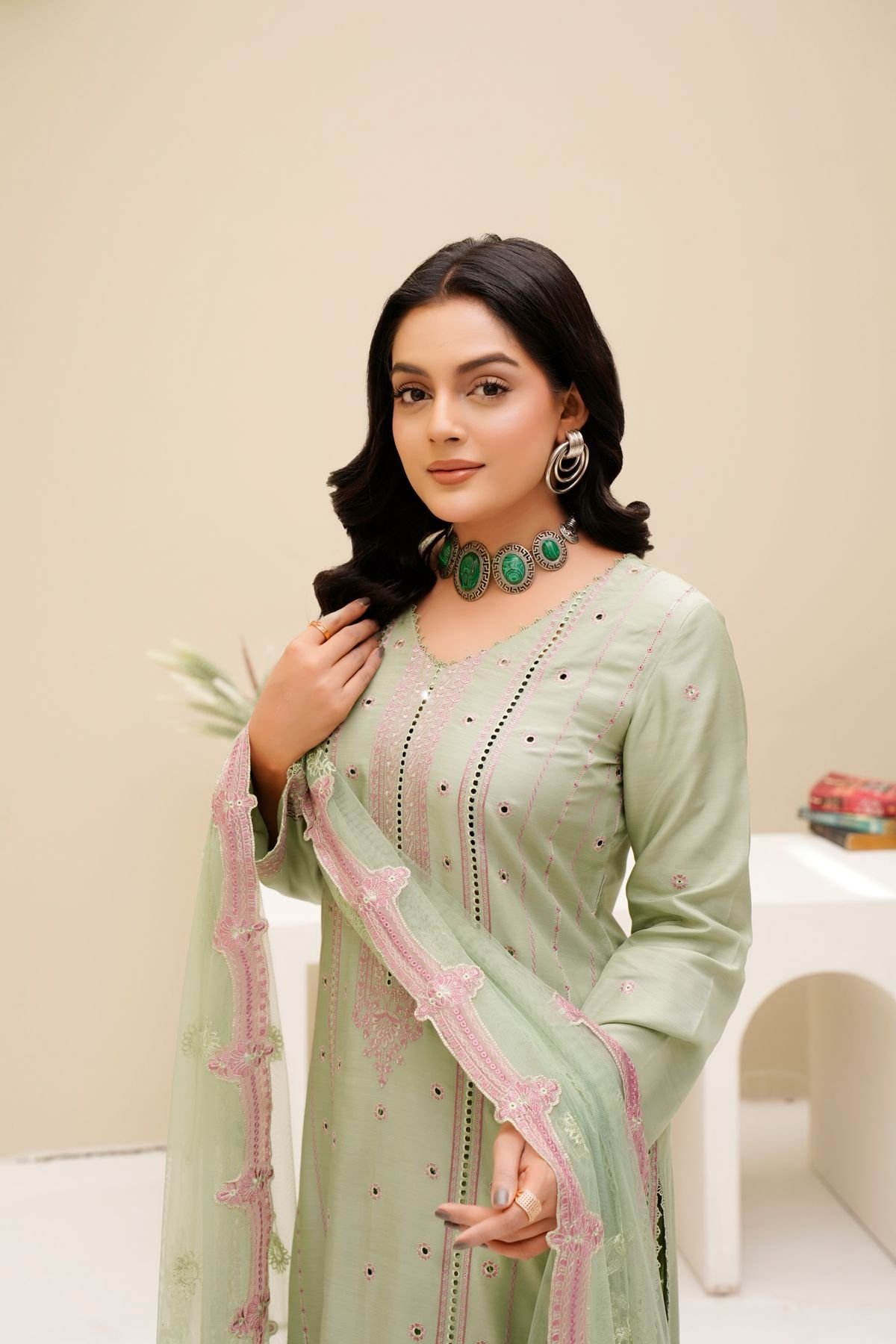
1. Floral thread embroidery on a pastel Eid kurta
The pastel kurta with soft floral threadwork is the most wearable Eid design on this list, and the one most Pakistani women reach for on Eid morning. Small flowers and trailing leaves in resham thread follow the neckline, the front placket and the hem, usually in two or three colours taken from the dupatta. On a pistachio, powder pink or sky blue base, tonal thread in a slightly deeper shade keeps the look fresh and elegant, while a touch of metallic thread in the flower centres adds just enough shine for photographs.
Ask your tailor to keep the floral work light around the neck and sleeves, because those are the areas that touch your skin and your dupatta all day. A design that covers the whole front panel looks busy in photographs and adds weight you will feel by the afternoon, so let the flowers breathe with plain fabric between them. For neckline ideas that pair beautifully with this style, see our guide to neckline embroidery designs.
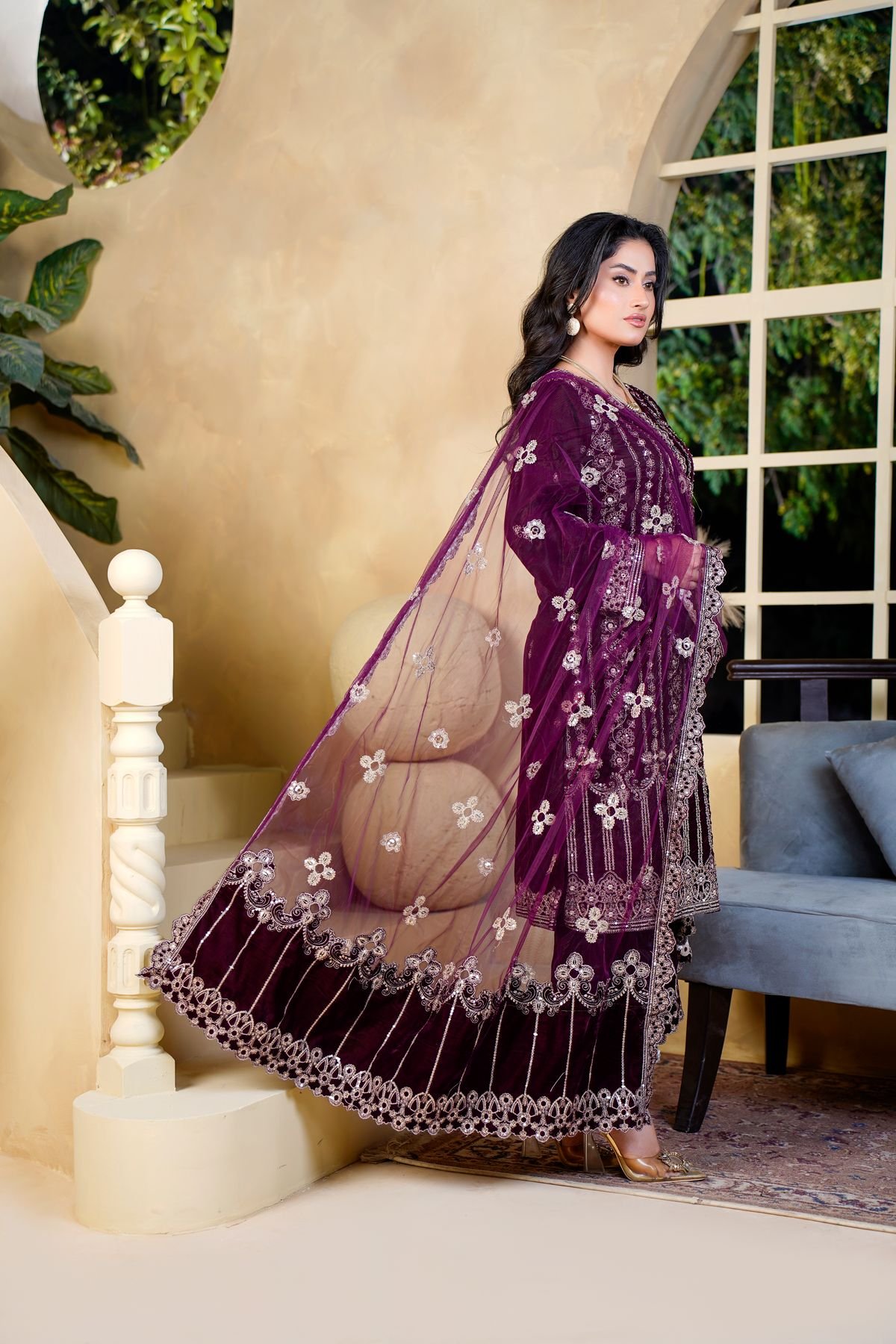
2. Zardozi and dabka work for the Eid night dawat
For the Eid night gathering, when the lights are warm and the photographs move indoors, zardozi work comes into its own. Dabka, naqshi, kora and sequins built up in metallic thread around the neckline, sleeves and hem give a kurta or frock a glow that no other embroidery can match. This is the design to choose when you want one outfit in the day to feel truly special, usually on silk, tissue or velvet in deep colours like plum, emerald or maroon.
The honest problem with zardozi is weight. Metallic work pulls the front of a kameez down and can distort a light fabric within one wearing, so the garment needs a structured yoke and a proper lining. Always try this design sitting down as well as standing, with the dupatta arranged as you will wear it, and check that the metallic thread does not scratch your neck or arms. Because the work is expensive, agree the full price before the karigar begins, and ask to see a finished sample of the same density so you know exactly how heavy the finished piece will feel.
3. Chikankari embroidery on white or pastel for Eid day
Chikankari is the quietest luxury on this list, and one of the smartest choices for Eid day. Fine white-on-white shadow work on lawn, cotton or organza looks cool and elegant in bright daylight, photographs beautifully, and stays comfortable through a long, warm day. A white chikankari kurta with a coloured dupatta is a classic Eid look in Lahore, Karachi and Islamabad, and it suits every age from a teenage girl to her grandmother.
The detail that matters most is the finishing. Chikankari on lawn needs a stabiliser behind the work or the fabric will pucker by the third wash, and the reverse side should be finished neatly because the light fabric shows the back of the stitches. Ask for a small stitched sample on your actual fabric and wash it once before the full piece is made. For the full story of this craft, read our guide to chikankari embroidery designs.
4. Mirror work and gota patti for a festive splash of colour
If your Eid outfit needs colour and energy, mirror work with gota patti is the liveliest choice. Small mirrors stitched into the neckline, sleeves and hem catch the light every time you move, while gota patti borders in gold or silver add a festive edge that reads beautifully in family photographs. This style suits bright bases like fuchsia, mustard and teal, and it is a natural fit for the second day of Eid, when the dress code is usually a little bolder.
The risk with mirror work is durability. Mirrors must be stitched, not glued, if the outfit will be washed more than once, and the edges of the mirrors should be covered with thread so they do not snag your dupatta or scratch your skin. Check the work by running a soft cloth over it: if the cloth catches, your chiffon dupatta will catch too. Keep the mirror work away from the underarms and the seat of the trouser, where constant movement loosens it fastest.
5. Embroidered frock and Anarkali for Eid gatherings
A long embroidered frock or Anarkali is the most graceful Eid silhouette, and embroidery is what makes it feel festive rather than plain. Floral vines running down the front panels, a heavily worked bodice with a plain flowing skirt, or a scattered booti pattern across the whole frock all work well, because the length of the garment gives the embroidery room to breathe. This is the design to choose for the main Eid dawat, when you want to look dressed up without wearing a full bridal-style outfit.
The fitting detail that matters most is the weight balance. A heavily embroidered bodice on a light skirt pulls the neckline forward, so the bodice needs a proper inner lining and the embroidery should be distributed evenly on both sides of the front. Check that you can sit cross-legged comfortably, because a frock that only looks good standing will betray you at the dastarkhwan. For sleeve ideas that complete this silhouette, see our guide to sleeve embroidery designs.
6. Men’s kurta embroidery for Eid
Eid embroidery is not only for women. A men’s kurta with a neatly embroidered placket, collar band or cuff detail looks sharp for Eid prayers and family photographs without feeling overdressed. Tonal threadwork on white, cream or pastel kurtas is the safest choice, while a touch of gold or silver thread on the collar suits the Eid night gathering. The work should be fine and flat, so it sits smoothly under a waistcoat and does not catch on anything during the day.
The fitting detail that matters most is the collar. Because the collar touches the skin all day, ask to see the reverse side of the sample before you approve it. Rough knots and long thread ends against the neck will irritate within an hour, however beautiful the front looks. A smooth facing behind the collar band is not a luxury on this design; it is the detail that decides whether the kurta is worn twice or for many Eids. For the complete guide, read our men’s kurta embroidery designs.
7. Light embroidery for children’s Eid outfits
Children’s Eid outfits need their own rules, because a child will not tolerate embroidery that scratches, however pretty it looks. Small floral motifs on the chest, a light border on the hem, and soft mirror work on a frock or kurta give a child’s jora a festive feel without the discomfort of dense or metallic work. Bright colours work beautifully here: a yellow frock with green leaves, or a sky blue kurta with white threadwork, photographs wonderfully and survives a day of running around.
The first check is always comfort. Every embroidered area that touches a child’s skin needs a soft cotton facing behind it, and that is not optional. The second is washing: a child’s Eid outfit is often worn again for family visits, so thread that bleeds or beads that loosen will show up quickly. Machine-washable thread and stitched, not glued, decoration are essential. For the full guide, see our kids embroidery designs.
8. The embroidered dupatta and trouser that complete the Eid look
The smartest Eid outfits are often the ones where the kurta is kept simple and the embroidery lives on the dupatta and the trouser. A plain pastel kurta with a heavily embroidered dupatta border gives you the festive look for photographs and lets you drape the work away from your neck when you want comfort. A trouser with a worked cuff or a border at the ankle adds a second detail that shows in full-length photographs, and it costs far less than embroidering the whole kameez.
The detail that matters most is coordination. Repeat one small element from the dupatta border on the trouser cuff, so the outfit feels connected rather than assembled, and keep the heaviest work on the dupatta edge that hangs free, not the edge that rests on your shoulder. If the dupatta is the hero, everything else should step back. For ideas on both pieces, read our guides to dupatta embroidery designs and trouser embroidery designs.
How to choose the right Eid embroidery design for your day
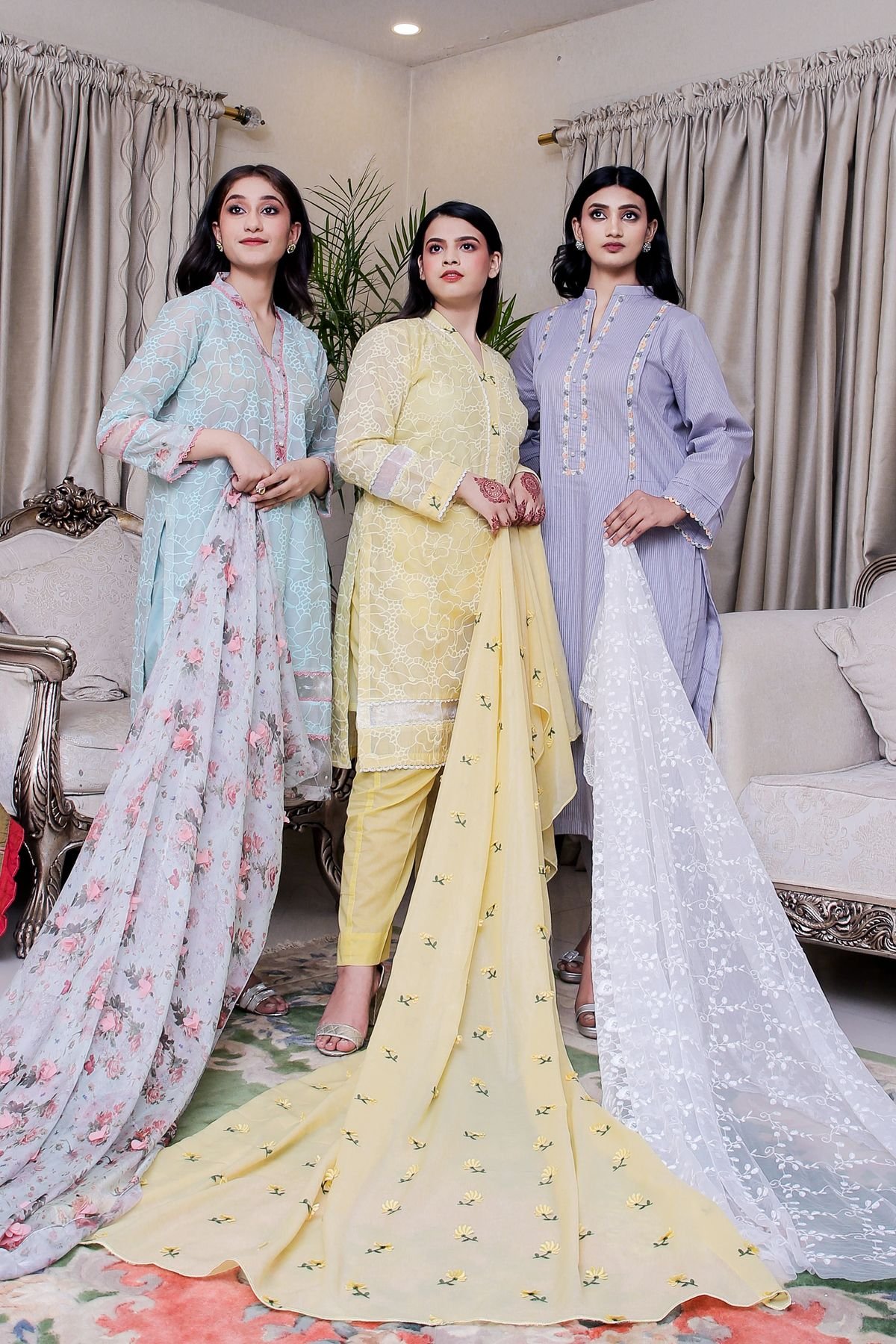
Start with your Eid schedule rather than the design catalogue. If your day begins with prayers and a big family lunch, choose designs one, three or seven: light, washable and comfortable for hours. If your main event is an evening dawat, designs two and five belong there, where the warm light makes metallic work glow and the outfit is worn for a few hours, not a full day. Then decide by weather. For a hot Eid, open designs on lawn and cotton with light thread are the only sensible choice, while a cooler Eid evening can carry velvet and dense zardozi.
Finally, match the design to the jewellery and dupatta you already own. There is no sense paying for a pearl neckline and then covering it with a necklace, or choosing a heavily worked dupatta to wear with a heavily worked kurta. Choose one of them to be the detail of the outfit, and let the other go. A good Eid look is a balanced one, where the embroidery, the jewellery and the dupatta each have their own space.
Fabric and thread choices for Eid embroidery
The fabric underneath the embroidery decides how the outfit feels on Eid day, so choose it before you choose the design. Lawn and voile are the best bases for Eid day in warm weather: they need light thread, open designs and a stabiliser behind the work, or the edge will pucker by the third wash. Cambric, cotton silk and khaddar carry medium-density designs comfortably and are the safest base for most of the designs above. Organza and net need the embroidery worked on a frame with even tension, and the reverse finished neatly, because the back of the work shows through. Velvet and silk belong to the evening, when their weight is no longer a burden and their richness suits the occasion.
For thread, resham gives a soft sheen and washes well, which is why it dominates everyday and Eid day embroidery. Metallic tilla and zari look richer but can feel rough against the skin, so keep them on the outer edge of a design rather than the inner edge that touches your neck or arms. Whatever the thread, ask for a small stitched sample on your actual fabric and wash it once before the full piece is made. Thread that bleeds or puckers on the sample will do exactly the same on the finished outfit, only then it will be too late to change. If you are planning to do the work yourself, our guide to hand embroidery stitches for beginners explains which stitches suit each fabric.
What to check before buying or commissioning Eid embroidery
Whether you are buying ready-made or sitting with a karigar, run the same checks. Look at the reverse side first: neat, short thread ends and a clean facing mean the work was finished properly, and they tell you more than the front does. Hold the garment up and look along its edges; the embroidery should lie flat, with no point where it pulls the fabric into a wave. Try the outfit on and raise your arms, turn your head and sit down. An Eid outfit that is comfortable only while standing still in front of a mirror is not finished.
For a custom order, agree the design on paper at full size before the fabric is cut. Mark the depth of the neck, the width of the embroidered band and the exact point where any panel or motif ends, and keep a photograph of that drawing with the agreed price and delivery date. Start early: the best karigars are booked weeks before Eid, and rushed work is where loose threads, uneven borders and missing finishing show up. Ask which parts are hand work and which are machine work, and pay for each accordingly; both have their place, but they should never be priced as each other. A good maker will welcome these questions, because they protect him as much as they protect you.
How to care for embroidered Eid outfits
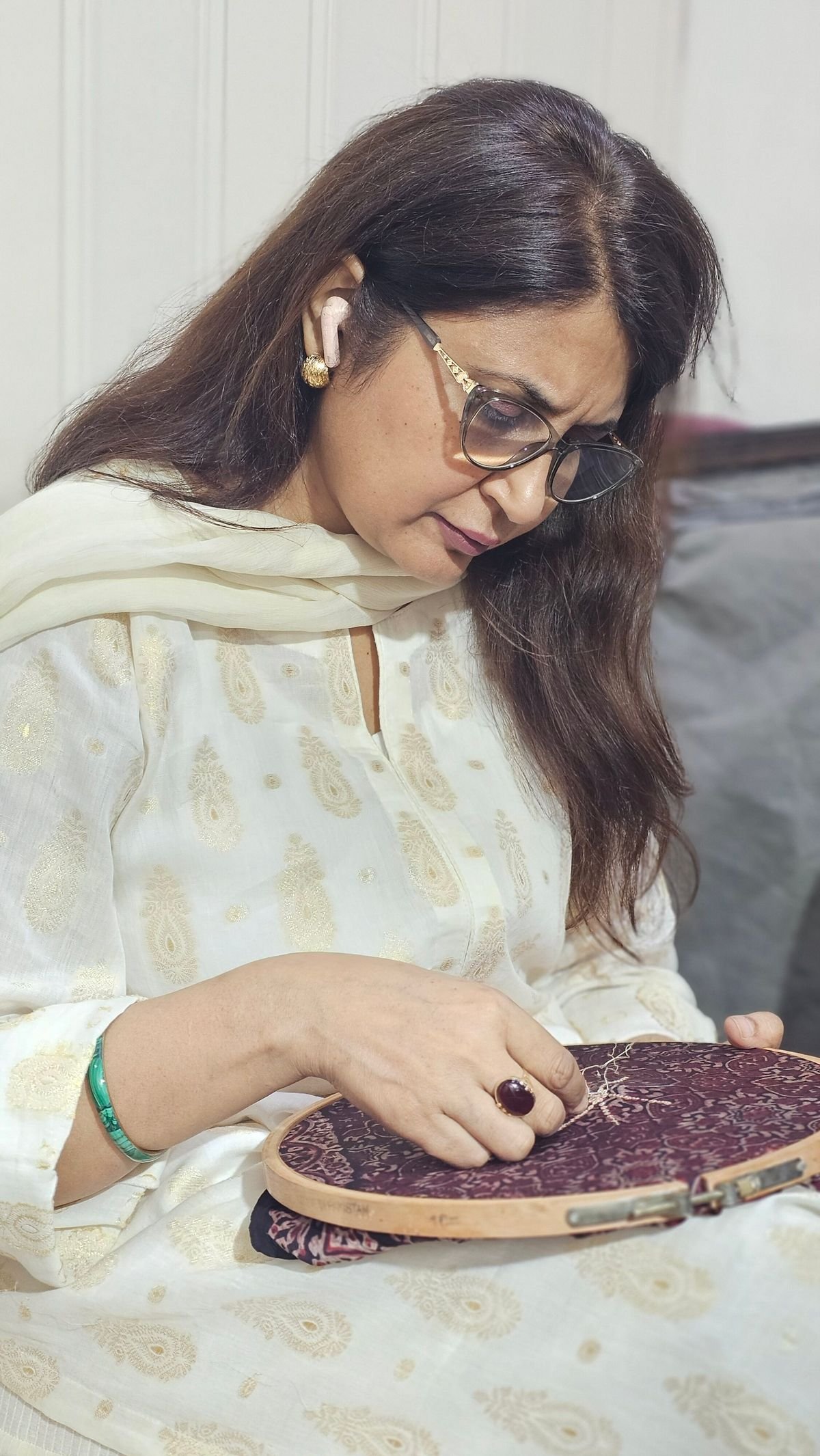
Most embroidery damage happens in the wash and at the ironing board, not during wear, and Eid outfits are often the most expensive pieces in the cupboard. Turn the garment inside out before washing so the embroidery faces away from other clothes, and keep outfits with pearls, sequins, mirrors or metallic thread out of the machine altogether unless the care label says otherwise; gentle hand washing in cool water protects both the thread colour and the fabric around it. Never wring an embroidered outfit. Press the water out flat between towels, then dry the garment on a hanger so the neckline and hem keep their shape.
Iron from the reverse side, over a soft cloth, and never press directly on raised work, pearls, mirrors or sequins. If a loop of thread lifts at an edge, do not pull it and do not cut it short; take it to a tailor, who can draw it through to the back and secure it in minutes. Store the outfit with the embroidered areas unfolded where possible, because a hard fold through dense embroidery can crack metallic thread over time. Ten minutes of this care after each wear is what keeps a good Eid jora looking new for the next Eid.
Frequently asked questions
Which embroidery design is best for Eid day?
A light floral design in resham thread on a pastel lawn or cotton kurta is the best choice for Eid day. It stays comfortable through prayers, meals and visits, photographs well in daylight, and washes easily afterwards. Save dense zardozi or velvet work for the Eid night dawat.
How early should I order embroidered Eid outfits?
Order at least four to six weeks before Eid if the work is custom-made. The best karigars and tailors are booked well in advance, and rushed embroidery is where uneven borders, loose threads and poor finishing appear. Ready-made pieces can be bought later, but the best designs sell out early.
Can Eid embroidery be added to a ready-made kurta?
Yes, in most cases. A tailor can add a floral vine, a border or a panel to an existing kurta if the fabric is sound and there is access to the reverse side. Small motifs and dupatta borders are the easiest additions; a full zardozi bodice or a deep festive border usually needs the garment to be opened and re-faced.
Which is better for Eid outfits, hand embroidery or machine embroidery?
Hand embroidery gives softer texture and is easier to place precisely on a curve, which is why it is preferred for formal and festive outfits. Machine embroidery is consistent, quicker and more affordable, and works well for repeated geometric borders and everyday Eid kurtas. The right choice depends on the design, the fabric and your budget, not on one being universally better.