
Most people buy a chikankari kurta for its softness, then spoil it with one wrong choice. They pick a dense, heavy design on a sheer fabric that tears at the seams, or they wear a plain white-on-white kurta to a mehndi and wonder why nobody notices the embroidery at all. The problem is rarely the craft itself. Chikankari is one of the finest hand embroideries in South Asia, but it is also one of the quietest, and a design chosen without thinking about the fabric, the occasion and the light will disappear on the wearer, however much it cost.
That is why chikankari embroidery designs deserve a slower look before you buy or commission one. The right piece feels light on the body, shows its stitching clearly in daylight, and survives years of gentle washing. These eight chikankari embroidery designs for 2026 cover everything from a classic white-on-white shadow-work kurta to a coloured festive anarkali, with the fabric, stitch and checking advice you need to take each one to a tailor or spot it in a ready-made piece.
What is chikankari embroidery?
Chikankari is a hand embroidery tradition from Lucknow, worked for centuries by karigars who stitch delicate white thread onto fine, light fabric. The classic form is white on white: the thread is the same colour as the cloth, so the design is read through shadow and texture rather than colour. A good piece is recognised by its stitches, not its brightness. The main stitches have their own names — bakhiya, the shadow stitch worked on the reverse of the fabric so the pattern shows through softly; jaali, the openwork stitch that creates fine net-like panels; murri and phanda, tiny raised knots that form grain-like dots; and keel kangan, the flat petal stitch used for leaves and flowers.
In Pakistan, chikankari has become a summer staple. Lawn and cotton kurtas with chikankari panels are worn to offices, universities and family lunches, while denser, dressier pieces appear at nikkah, walima and Eid gatherings. The craft suits the Pakistani wardrobe because it is cool to wear, easy to pair with a plain or printed dupatta, and modest without being plain. The photograph below shows the classic look at its best: a white kurta whose embroidery only reveals itself fully in sunlight, which is exactly how this craft is meant to be seen.
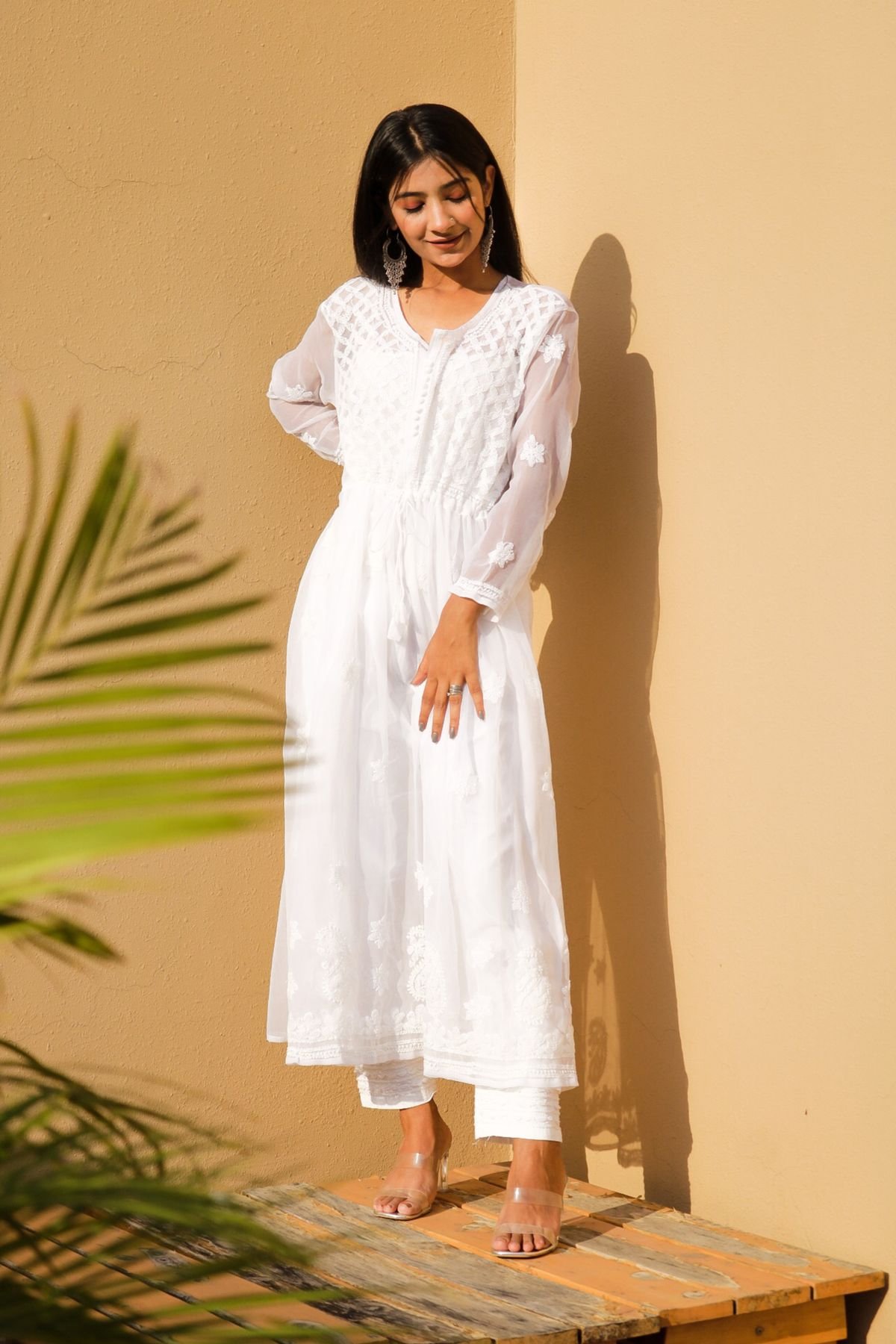
1. Classic white-on-white shadow work kurta
The white-on-white shadow work kurta is the design that defines chikankari, and it is still the one most worth owning. The embroidery is worked in bakhiya, the shadow stitch, on the reverse side of a fine cotton or lawn kurta, so the floral pattern appears on the front as a soft, raised shadow. Dense work gathers around the neckline, the yoke and the hem, while scattered bootis fade down the body of the kurta. Indoors the piece looks almost plain; in sunlight the whole pattern comes alive, which is why women who own one tend to reach for it on bright summer days.
Ask your tailor to keep the shadow work balanced across the kurta. If the yoke is dense and the hem is bare, the outfit looks unfinished; if every inch is covered, the fabric loses its drape and feels heavy. A good balance is a worked yoke and neckline, a light border at the hem and sleeves, and small scattered motifs in between. Wear it with a white or pastel trouser and a plain dupatta, and keep the jewellery light — silver jhumkas or a thin chain — because a heavy necklace fights with the quiet stitching. For neckline ideas that pair well with this style, see our guide to neckline embroidery designs.
2. Jaali openwork panels on the yoke and sleeves
Jaali is the stitch that makes people stop and look closely. The karigar pulls threads apart and binds the gaps with fine stitches, creating a delicate net or lattice inside the fabric itself. On a kurta, jaali usually appears as a panel across the yoke, a band down the front placket, or a strip along the sleeve cuffs. It is the lightest of all chikankari techniques, because the openwork removes fabric rather than adding thread, and it gives a plain white kurta an airy, expensive finish without any colour at all.
The detail to check with jaali is the edge. Openwork is only as good as its border: a panel whose edges are loose will fray and widen after a few washes, while a neatly bound edge stays crisp for years. Hold the panel up to the light before you buy — the holes should be even in size, and the pattern should repeat cleanly without a gap where the karigar lost count. Jaali works best on lawn, cotton voile and fine cambric, and it is a natural choice for summer kurtas, because the openwork itself lets air through. Pair it with a solid-coloured trouser so the eye stays on the lattice.
3. Murri and phanda knot-work motifs
Murri and phanda are the small raised knots that give chikankari its texture. Murri is a tiny grain-shaped knot, phanda is a slightly larger, millet-like dot, and both are stitched in clusters to form flower centres, grapes, paisleys and the scattered dots that fill a design. On their own they look modest, but a skilled karigar uses them the way a painter uses shading: a dense cluster of knots in the centre of a flower, thinning out towards the petals, gives a flat white motif a sense of depth that no printed design can copy.
This is the design to choose if you want your chikankari to read clearly in photographs. Knot-work catches the light, so it shows up even in a shaded room or an evening gathering where shadow work would disappear. Ask for the knots to be even in size and firmly anchored; loose knots are the first thing to unravel in the wash, and a kurta that sheds its knots looks tired within a season. Murri and phanda also travel well onto dupattas and shawls, where a single row of knot-work along the border is enough to finish the whole piece. The basic stitches behind this work are covered in our hand embroidery stitches guide, which explains how each stitch is formed.
4. Chikankari dupatta with embroidered borders
A chikankari dupatta is the easiest way to wear this craft without committing to a full kurta. The work sits where it is most visible: a dense border along all four edges, corner motifs in the same pattern, and small scattered bootis across the body. Because the dupatta is draped, folded and pinned all day, the border is seen from every angle, and a well-worked border can lift a completely plain kurta into a finished outfit. This is the piece women buy first when they are new to chikankari, and it is the piece they keep longest.
Choose the border width to match the dupatta fabric. On chiffon and organza, a border wider than three or four centimetres pulls the edge down and makes the dupatta hang unevenly, so keep it narrow and let the corner motifs do the talking. On cotton and lawn, a deeper border of five to seven centimetres sits flat and frames the outfit properly. Check that the corner motifs are mirrored, not repeated in the same direction, because a corner that turns the wrong way is the clearest sign of rushed machine work. For more ideas on pairing embroidered dupattas, see our dupatta embroidery designs guide.
5. Coloured chikankari on pastel fabric
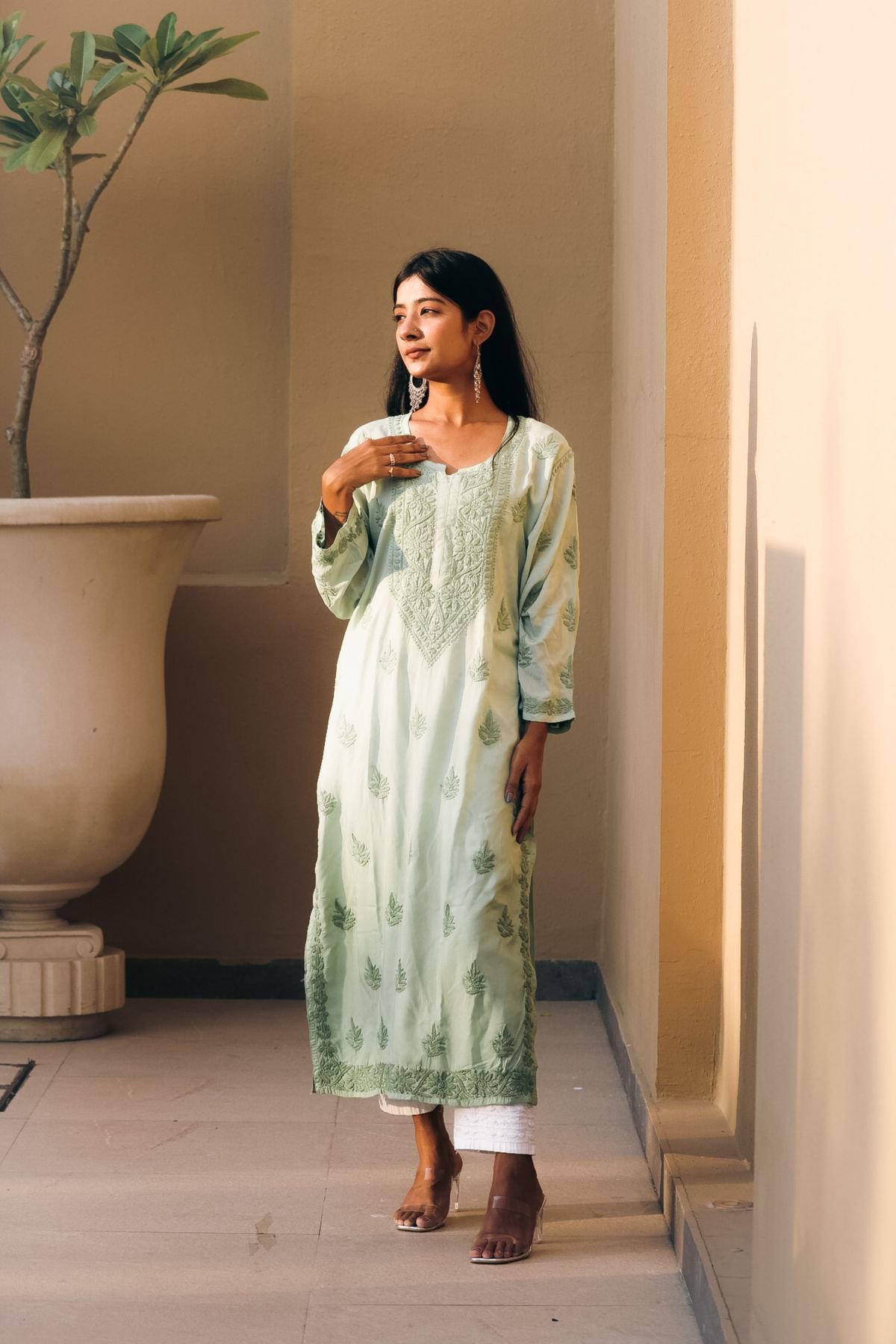
Chikankari does not have to be white. The newest designs work the same stitches in tonal thread on pastel fabric: sage green on pistachio, dusty rose on blush, powder blue on sky, and lavender on lilac. The effect is softer than white on white, because the thread and the fabric are close in tone, yet the design reads more clearly than classic chikankari, which makes it a good choice for evening events and for women who find plain white too stark. The photograph below shows how well it works — a pistachio kurta whose leaf motifs are visible at a glance, without losing any of the craft’s delicacy.
The risk with coloured chikankari is the dye. Thread dyed a shade darker than the fabric can bleed in the first wash and stain the whole kurta, so always ask whether the thread is colourfast and, if possible, wash a small stitched sample before the full piece is made. Keep the palette to one or two tones from the same family; three or four colours turn the piece into ordinary multicolour embroidery and lose the quiet character that makes chikankari special. Pastel chikankari pairs beautifully with white trousers and silver jewellery, and it is a strong option for daytime mehndi and nikkah functions.
6. Chikankari yoke and placket kurta
The yoke and placket kurta concentrates all the embroidery where the eye naturally falls: a worked yoke across the chest and a narrow embroidered placket running down the front. It is the most practical chikankari design for daily wear, because the rest of the kurta stays plain and light, and the embroidery is exactly where a dupatta frames it. A small floral panel on the yoke, a line of murri dots down the placket and an embroidered cuff are enough to make the kurta look considered without making it formal.
Fitting matters more than pattern here. The yoke should sit flat across the chest without pulling, and the placket should stay straight when you sit down, so try the kurta on before the work is finished if it is being made to order. On a ready-made piece, check the placket stitching from the inside: the embroidery should be backed with a soft facing, because bare stitches against the skin will itch within an hour. This design works on every fabric from lawn to cotton silk, and it is the safest first chikankari purchase for anyone who wants the craft in an everyday outfit.
7. Chikankari anarkali for festive wear
For weddings and formal evenings, chikankari moves onto the anarkali: a long, flared frock where the embroidery runs down the full length of the panels, the sleeves and the hem. The classic version is white or ivory on a silk or georgette base, with dense work on the bodice fading into scattered motifs towards the hem, so the flare of the skirt is not weighed down. Worn with a plain dupatta and a worked border, it is one of the most graceful festive outfits in Pakistani fashion, and it photographs beautifully because the white thread catches the light as the fabric moves.
Weight is the honest problem with this design. Dense chikankari on a long anarkali adds real weight, and a flared skirt that is heavy at the hem will pull and lose its shape. Ask for the work to be concentrated on the bodice and the upper panels, with only a light border at the hem, and make sure the anarkali has a proper inner lining so the reverse of the embroidery never touches the skin. Try it sitting down as well as standing, with the dupatta arranged as you will wear it, because a festive outfit is worn for hours, and comfort decides whether you enjoy the evening or count the minutes until you can change.
8. Chikankari with mukaish and sequin accents
The most modern chikankari design keeps the white threadwork and adds a whisper of shine: tiny mukaish dots, a few sequins at the flower centres, or a fine metallic outline along the border. The shine is used sparingly, like salt in food, so the craft stays the hero and the sparkle only appears when the light moves. This is the design for women who love chikankari but find plain white-on-white too quiet for a walima or a formal dinner, and it is the fastest-growing style in the craft today.
Restraint is everything here. If the mukaish outnumbers the stitches, the piece stops being chikankari and becomes ordinary fancy embroidery, so ask the maker to show you the balance on a sample before the full garment is worked. Check that every sequin and mukaish dot is stitched, not glued, because glued shine falls off in the first wash and leaves a bare patch. Keep the dupatta and jewellery plain with this design: the outfit already has its sparkle, and a heavy necklace or a worked dupatta beside it will only compete. A plain chiffon dupatta with a single embroidered border is the right partner.
How to choose the right chikankari design for your outfit
Start with the occasion, because chikankari ranges from the plainest daily kurta to a bridal anarkali. For everyday wear — office, university, family lunches — choose designs one, two and six: light, washable and comfortable in the heat. For mehndi, nikkah and Eid, designs three, four and five give you visible craft without the weight of a festive outfit. Designs seven and eight belong to weddings and formal evenings, where the outfit is worn for a few hours and cleaned professionally afterwards.
Then decide by fabric and by light. Chikankari shows best in daylight, so if you will mostly wear the outfit outdoors or in a bright room, classic white on white will reward you. If your events are mostly indoors or in the evening, choose knot-work or a pastel base, which read clearly under artificial light. Finally, match the design to the rest of your wardrobe. A chikankari kurta with a worked yoke needs only a plain dupatta; a plain kurta with a chikankari dupatta needs nothing else at all. Spend the embroidery where it will be seen, and leave the rest of the outfit quiet.
Fabric and thread choices for chikankari embroidery
The fabric decides how chikankari behaves, so choose it before you choose the design. Lawn and cotton voile are the classic bases: light, breathable and easy to wash, they carry shadow work and jaali beautifully, though very sheer voile needs a stabiliser behind dense work or it will pucker. Cambric and fine cotton are slightly heavier and suit everyday kurtas, because they hold their shape and take repeated washing well. Georgette and cotton silk carry the festive designs, including anarkalis, because they drape smoothly under the embroidery.
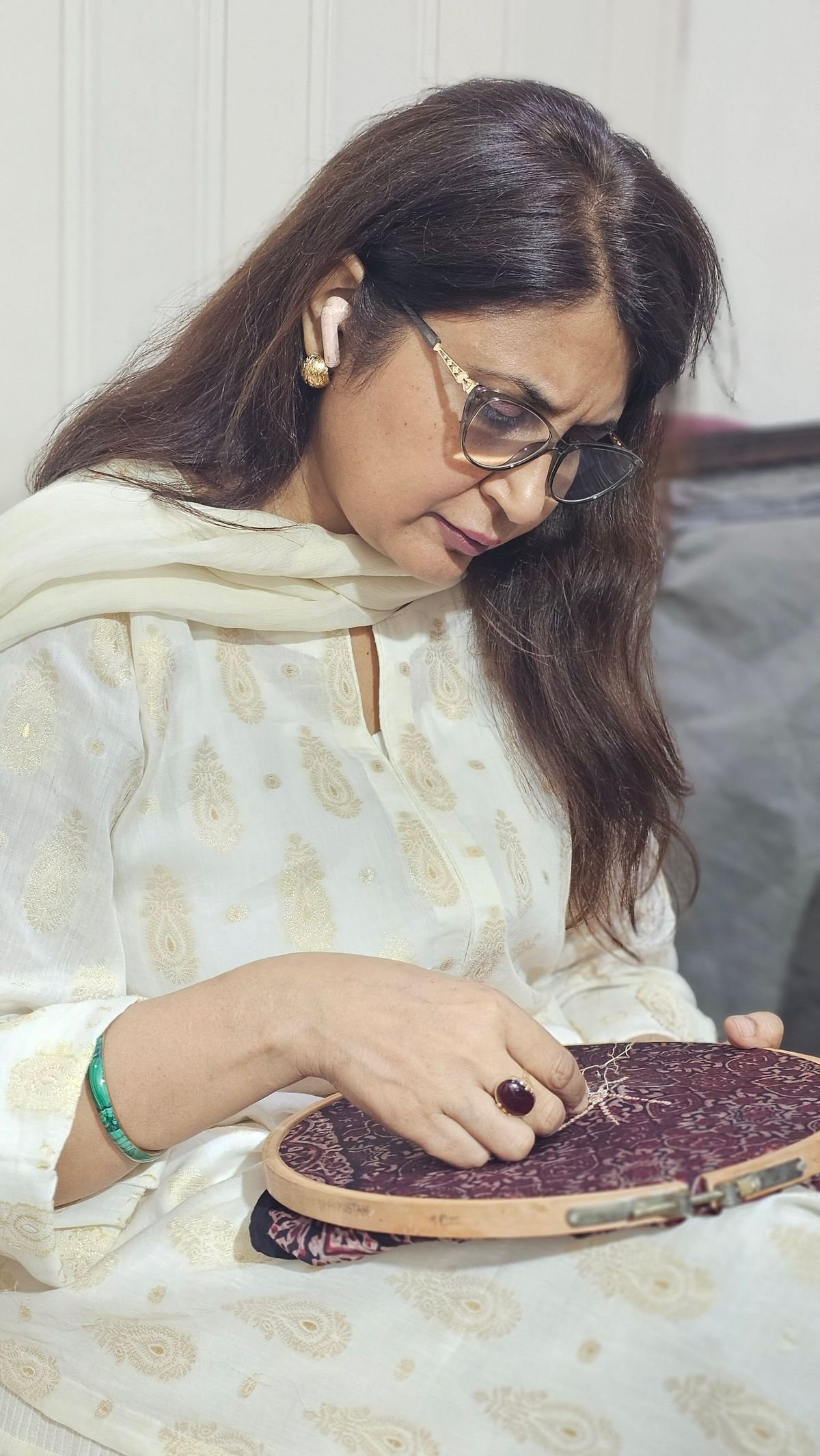
For thread, untwisted cotton thread is the traditional choice, and it is still the best: it lies flat, washes well and gives the soft, matt finish that defines the craft. Mercerised cotton thread has a slight sheen and is used for designs that need to read more clearly, while silk thread is reserved for festive pieces on silk fabric. Whatever the thread, ask for a small stitched sample on your actual fabric and wash it once before the full piece is made. Thread that bleeds, shrinks or puckers on the sample will do exactly the same on the finished garment, only then it will be too late to change. The photograph below shows the work itself — a karigar stitching by hand, one stitch at a time, which is how every genuine piece begins.
What to check before buying or commissioning chikankari
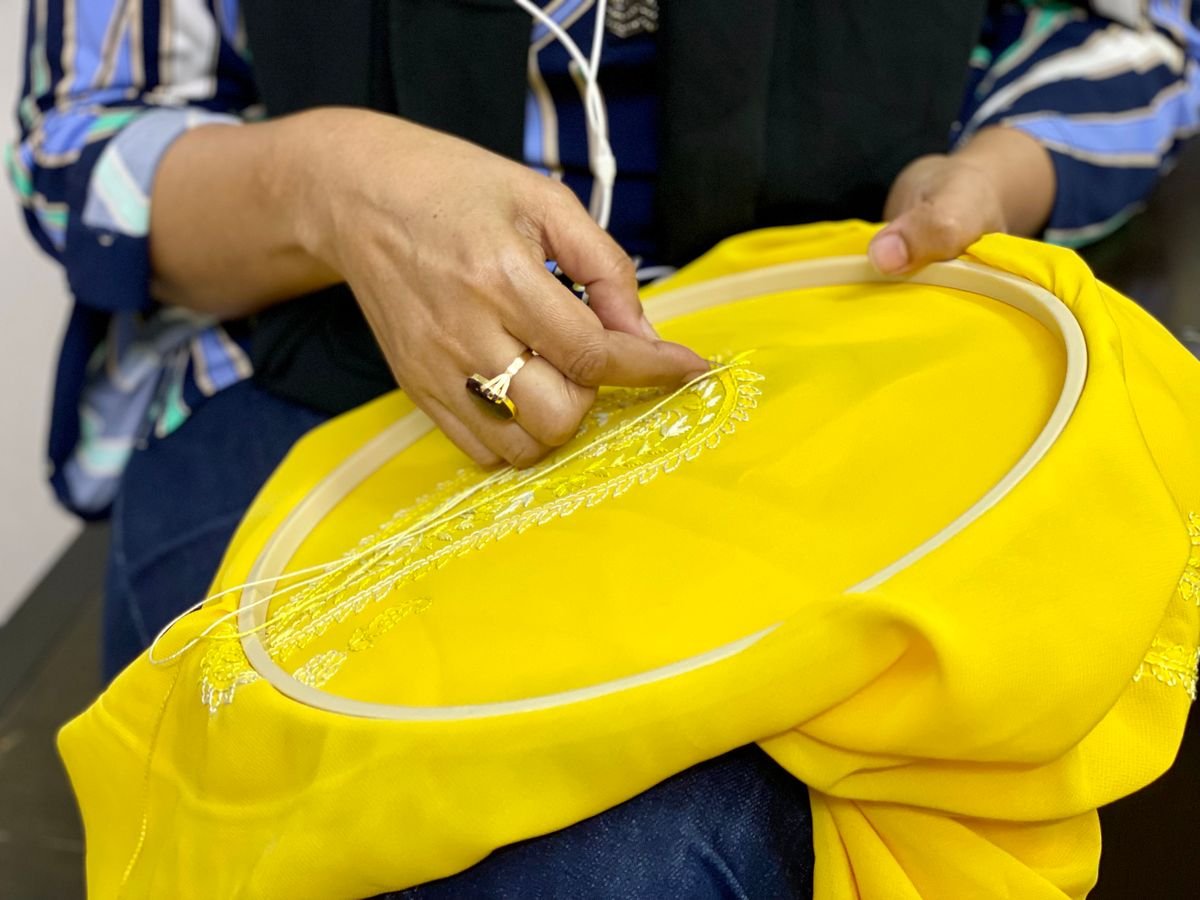
Whether you are buying ready-made or sitting with a karigar, run the same checks. Look at the reverse side first: neat, short thread ends and a clean finish mean the work was completed properly, and the back of the embroidery tells you more than the front does. Hold the fabric up to the light and look along the design; the stitches should be even in size, the motifs should repeat cleanly, and there should be no point where the embroidery pulls the fabric into a wave. The photograph below shows what to look for — fine, even hand stitching, worked patiently, with no loose threads or gaps.
Ask whether the piece is hand work or machine work, and pay for each accordingly. Genuine hand chikankari has tiny irregularities — a knot a fraction larger than its neighbours, a petal that sits a millimetre off the line — and those small differences are the proof of the hand, not a flaw. Machine chikankari is perfectly even, quicker and more affordable, and it has its place on everyday kurtas, but it should never be priced as hand work. For a custom order, agree the design on paper at full size before the fabric is cut, mark the depth of the yoke and the width of the border, and keep a photograph of that drawing with the agreed price and delivery date. A good maker will welcome these questions, because they protect him as much as they protect you.
How to care for chikankari embroidery
Most chikankari damage happens in the wash, not during wear. Wash white chikankari separately in cool water with a mild detergent, and never use bleach, which yellows the thread and weakens the fabric. Turn the garment inside out before washing so the embroidery faces away from other clothes, and avoid wringing it; press the water out flat between towels, then dry it in the shade, because direct sunlight fades pastel thread and yellows white cotton over time.
Iron from the reverse side, over a soft cloth, and never press directly on raised knot-work or jaali panels, which can flatten or tear under a hot iron. If a knot loosens or a thread lifts, do not pull it and do not cut it short; take it to a tailor, who can draw it through to the back and secure it in minutes. Store white pieces in a breathable cotton bag rather than plastic, with a small pouch of dried lavender or neem leaves to keep insects away, and refold them every few months so the same crease never sits through the embroidery. Ten minutes of this care after each wear is what keeps a good chikankari kurta looking new for years.
Frequently asked questions
How can I tell real hand chikankari from machine embroidery?
Look at the reverse side and at the regularity of the stitches. Hand chikankari has tiny, natural irregularities and a neat but visibly hand-finished back, while machine work is perfectly even on both sides. The knots in murri and phanda are also slightly uneven in hand work, and the jaali panels have a softness that machine work cannot copy.
Is chikankari suitable for summer in Pakistan?
Yes, it is one of the best choices for summer. The work is done on lawn, voile and fine cotton, the thread is light, and jaali panels let air through the fabric. A white chikankari kurta stays cooler than a printed or heavily embroidered outfit in the same fabric, which is why it is a staple for daytime wear in the heat.
Can chikankari be washed at home?
Yes, if you wash it gently. Use cool water and a mild detergent, wash white pieces separately, and never wring the garment. Pieces with mukaish or sequins should be hand washed only, and anything on silk or georgette is safer with a professional dry cleaner.
How much does a hand-embroidered chikankari kurta cost in Pakistan?
It varies widely with the density of the work, the fabric and the city. A simple machine-embroidered kurta is the most affordable option, while a fully hand-worked piece with dense shadow work and jaali costs considerably more because of the hours involved. Always agree the full price, including stitching and finishing, before work begins, and ask for a sample if the design is dense.
5 thoughts on “Chikankari Embroidery Designs 2026 for Kurtas and Dupattas”