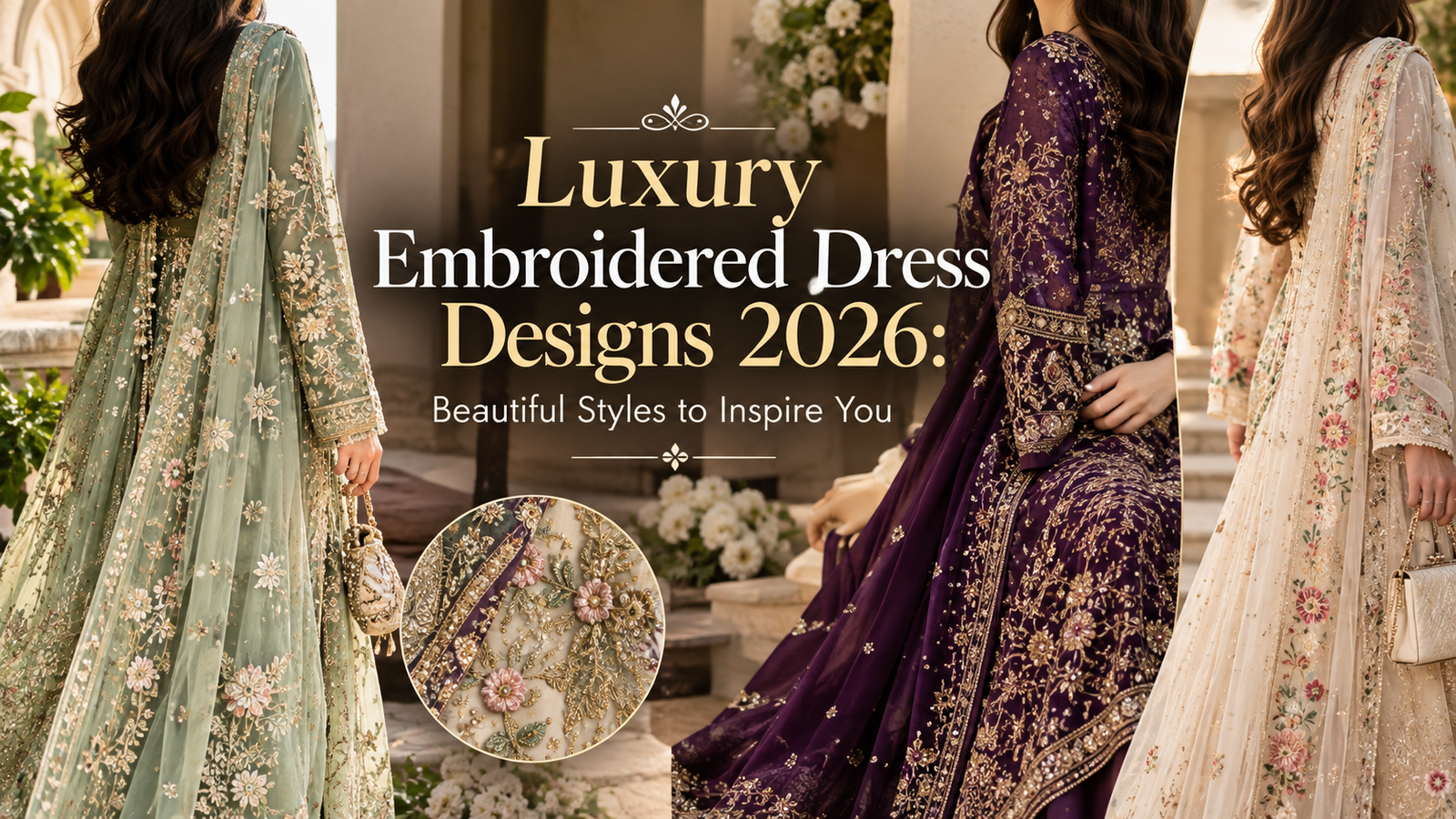
Luxury Embroidered Dress Designs 2026: Beautiful Styles to Inspire You
There is one mistake that the ruins more embroidered dresses than the bad fabric ever has: buying a dress where the thread is everywhere. Shoulders, waist, or sleeves, hem, all competing. In the fitting room it looks the generous. Six months later it looks loud, and the dress sits unworn at the back of the wardrobe while a plain one gets pulled out every week.
Luxury embroidered dress designs in 2026 are built on restraint instead. One embroidered idea, positioned with intent, resting on a silhouette very simple enough to the carry it. Learn that principle and you can shop this entire category confidently, and whether you are dressing for a summer wedding in the Lagos, a winter reception in the Stockholm, or a spring festival in the Seoul.
Quick Answer
Luxury embroidered dress designs in 2026 concentrate embellishment in a single zone — neckline, bodice, sleeve or hem — against an otherwise clean shape. The leading techniques are openwork cutwork, raised appliqué, metallic linework, beadwork and regional hand embroidery, worked on cotton, linen and silk for warm climates and velvet or brocade for cold ones.
By The Numbers
- 12 dress styles cover almost everything worth knowing in this category right now
- 7 stitching techniques produce all of them, and knowing them changes how you shop
- 1 statement zone per dress — the single rule that separates elegant from cluttered
- 2 fabric families to choose between, decided by your climate rather than the trend
- 5 minutes of care after each wear is what determines whether the piece lasts a decade
Key Takeaways
- Embroidery signals labour and permanence. That is why it now sits on daywear as readily as on evening gowns.
- Placement matters more than quantity. A narrow embroidered band on a plain dress reads richer than allover thread.
- Deep, saturated colour gives stitching contrast and depth. Very pale grounds tend to flatten fine work.
- Hand embroidery traditions from across the world have moved into mainstream luxury on their own terms, not as costume.
- Nearly every style here can be adapted for full coverage without losing its character.
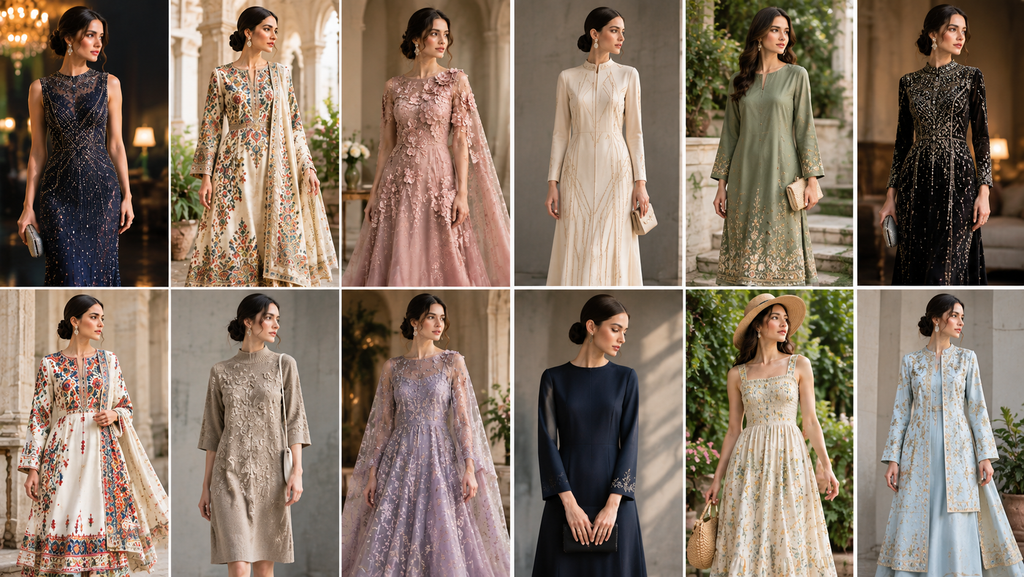
The 12 Styles At A Glance
| # | Style | Defining Detail | Best For |
|---|---|---|---|
| 1 | Sculpted Neckline Statement | Thread framing the collarbone, and nothing below | Dinners, or receptions |
| 2 | Openwork Cutwork the Midi | Shapes cut from the cloth and a edge-stitched | Hot climates, and daytime |
| 3 | Raised Floral Appliqué Gown | Fabric blooms a standing off the surface | Weddings, or formal galas |
| 4 | Metallic Linework Column | Fine geometric thread in a gold or steel | Black-tie, and evening |
| 5 | Border-Hem Everyday Dress | A single decorated a band at the hem | Daily wear, or travel |
| 6 | Beaded Evening Sheath | Light-catching beadwork on the dense fabric | Winter occasions |
| 7 | Regional Handcraft Formal | Hand-stitched motifs from a living traditions | Cultural good celebrations |
| 8 | Dimensional Puff Shift | Thick raised stitching on very simple knits | Modern casual |
| 9 | Layered Sheer Overlay | Embroidery floating on a transparent cloth | Evening, and layering |
| 10 | Micro- full Detail Minimalist | One tiny motif, discovered not the announced | Professional settings |
| 11 | Smocked Bodice Warm-Weather | Shape created by a gathered stitching | Summer, holidays |
| 12 | Embroidered Topper Two-Piece | Plain base the dress plus embellished layer | Transitional all seasons |
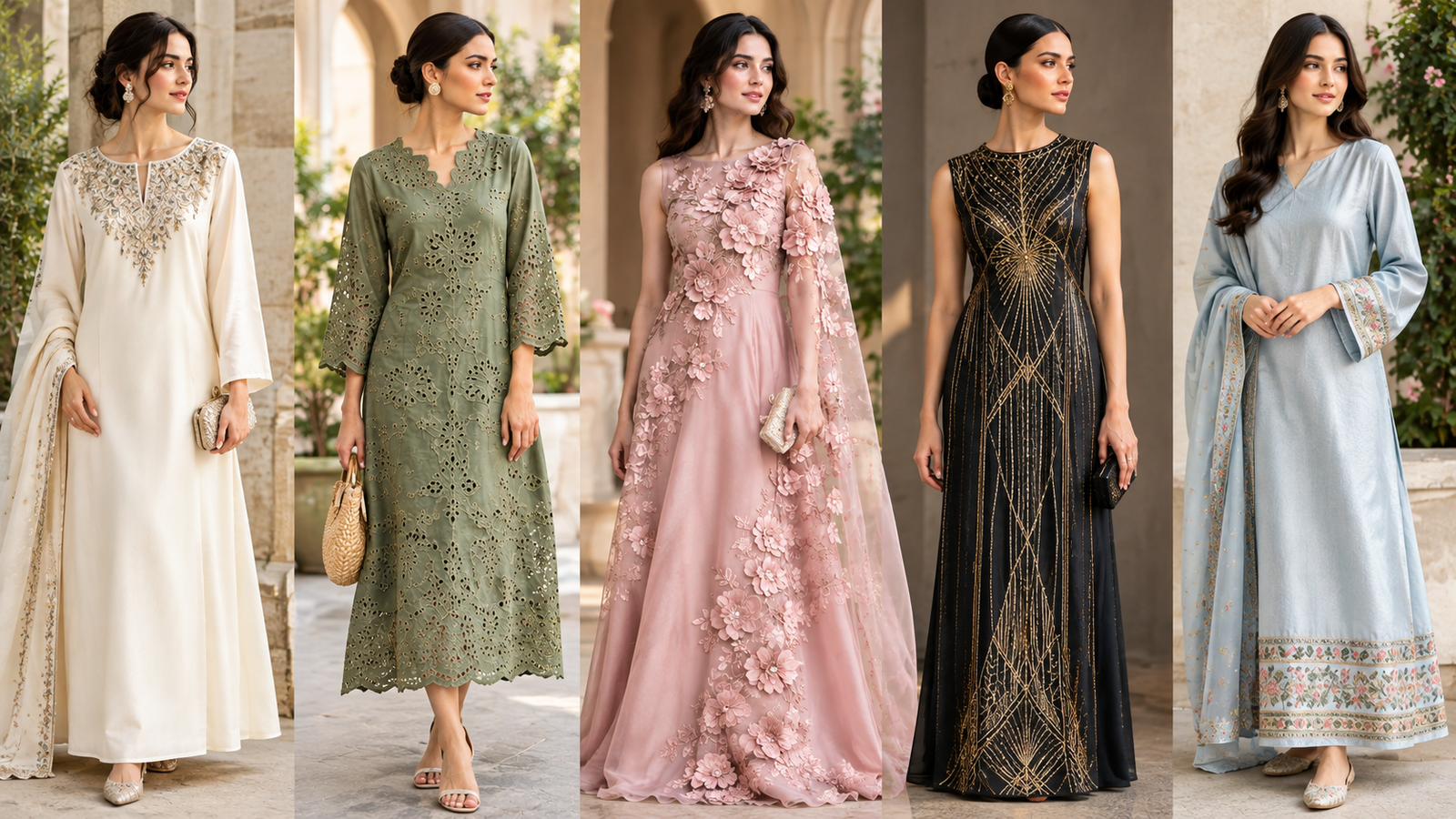
1. The Sculpted Neckline Statement Dress
Verdict: The most flattering entry point into this category for almost every body and face.
Thread work gathers around the collarbone and stops cleanly. Below that line, the dress is the uninterrupted cloth — a soft column, a gentle A-line, a straight sheath. What you get is a necklace stitched permanently into the garment, and most women who wear one the skip jewellery altogether.
The reason it flatters so broadly is simple geometry. Decoration at the highest point of the body draws the eye upward toward the face rather than dispersing attention across the torso. That is a universally useful effect, regardless of height or proportion.
Styling note: if you wear a headscarf or a shawl, choose a neckline motif that sits low and wide. High, narrow embroidery disappears entirely under drape.
2. The Openwork Cutwork Midi
Verdict: The coolest dress here in the literal sense, and the most useful in hot countries.
Cutwork removes small windows from the fabric and finishes every raw edge with tight stitching, leaving a lattice of open shapes. Air passes through it, which makes it genuinely comfortable in humid heat where heavier embellishment becomes unbearable.
A cutwork embroidery dress also shifts register easily. Rendered in cotton or linen it belongs to the afternoon; in silk crepe it belongs to the evening. For modest embroidered dress styles, a slip in a close tonal shade preserves every bit of the pattern while removing the transparency completely. The openwork still reads, just against fabric rather than skin.
3. The Raised Floral Appliqué Gown
Verdict: The most photogenic dress on this list, and the one that demands the most discipline.
Appliqué works differently from stitched embroidery. Shaped pieces of fabric are sewn onto the base so that petals and leaves lift away from the surface and throw their own small shadows. The look has moved toward fewer, larger blooms rather than dense scattered ones, which reads far more contemporary.
Discipline is the whole game. Pick one region — a shoulder, a waistline, a sweep along the hem — and leave everything else bare. Appliqué distributed across an entire gown tips from couture into theatre within a single design decision.
4. The Metallic Linework Column
Verdict: The most modern way to wear gold without wearing sequins.
Fine metallic thread traced in geometric patterns — chevrons, arcs, grids, radiating fans — along a narrow, fluid column dress. The influence is early twentieth-century decorative art, but the execution avoids nostalgia: no fringe, no feathers, no costume shorthand. Just clean lines that catch light as you move.
What makes it look expensive: shine that is soft rather than sharp. Antique gold, pewter and brushed brass age far more gracefully than bright reflective finishes, which start looking dated the moment the trend shifts.
5. The Border-Hem Everyday Dress
Verdict: Understated, endlessly wearable, and the piece most likely to justify its cost through sheer frequency.
A single decorated band runs along the hem. Sometimes it is barely a finger wide, sometimes it reaches mid-calf. Nothing else on the dress is worked at all.
There is a practical benefit people rarely mention. Hem embroidery adds weight to the bottom edge, which improves how the whole dress hangs and stops lightweight fabrics from riding up in wind. On a linen or cotton dress worn through a long travel day, that difference is noticeable by evening.
6. The Beaded Evening Sheath
Verdict: A genuine investment piece, built for cold-weather occasions.
Beadwork sits on top of a dense ground fabric — heavy silk, velvet, woven jacquard — creating two layers of visual interest: the pattern beneath and the light-catching work above. It is unmistakably occasion wear, and it belongs to autumn and winter events in temperate regions and to evening celebrations everywhere else.
This is the direction embellished occasion dresses have taken. Pieces designed to feel worth the effort of dressing up, rather than apologising for requiring it.
Care warning: assume this dress will never see a washing machine. Budget for professional cleaning before you buy, not after.
7. The Regional Handcraft Formal
Verdict: The most valuable purchase in this entire category, and the least likely to ever look dated.
Hand embroidery traditions exist on every continent and each carries its own visual language. Dense metallic goldwork from South Asia. Bold cotton-thread florals from Central Asia. Bright graphic animal and plant motifs from Mesoamerica. Mirror-set stitching from western India. Blue-and-white running stitch from Japan. Geometric counted-thread work from Eastern Europe and the Balkans. Bead-heavy collar work from parts of East and Southern Africa.
What unites them is that each stitch was placed by a person. That produces slight irregularities in tension and spacing that no machine reproduces, and those irregularities are the value signal.
How to check: look at the reverse of the fabric. Hand work shows an uneven, layered underside. Machine work shows uniform, regular backing. Neither is inherently wrong, but the price should honestly reflect which one you are holding.
These pieces suit weddings, religious festivals, national celebrations and formal evenings, and they tend to be the most generously cut garments in the whole luxury category.
8. The Dimensional Puff Shift
Verdict: The youngest-feeling and most casual dress on this list.
Puff embroidery stitches over a raised foam core, so letters and shapes stand thickly above the fabric surface. It arrived from sportswear and has migrated onto simple shift dresses in heavy cotton jersey and knit.
Worked tonally — cream thread on cream, charcoal on charcoal — it reads as architectural detail. In contrasting colour it reads as athletic. Decide which wardrobe you are actually dressing before you choose, because the two versions serve completely different lives.
9. The Layered Sheer Overlay Dress
Verdict: Dramatic in photographs, and far easier to wear than it appears.
Thread and small beads applied to organza, tulle or fine net appear suspended in air, with no visible ground supporting them. Embroidery is what saves sheer dressing from looking flimsy, and it is why this style has gained ground rather than fading.
The covered version is straightforward: an opaque lined dress underneath, with the embroidered sheer worn over it as a separate layer. You keep the floating effect and gain full coverage, and the double construction genuinely improves how the garment falls.
10. The Micro-Detail Minimalist Dress
Verdict: Embellishment for people who dislike embellishment.
A single small motif at the cuff. A monogram positioned at the hip. A line of stitching no thicker than a thread running along one seam. Personalisation and near-invisible placement have become a defining feature of this category, and this is its dress form.
It belongs in offices, meetings and any environment where restraint is read as competence. The detail gets noticed only at conversational distance, which is precisely the point.
11. The Smocked Bodice Warm-Weather Dress
Verdict: The most comfortable dress here, and the best one to pack.
Smocking gathers fabric into rows using decorative stitching, producing stretch and shape simultaneously. Combine it with embroidery across the same panel and you get a fitted bodice built with no boning, no zip and no darts at all.
It suits summer, holidays and warm-weather events anywhere. It is also an outstanding travel dress: the gathered construction resists creasing in a way that structured bodices simply cannot, and it emerges from a suitcase ready to wear.
12. The Embroidered Topper Two-Piece
Verdict: The most economical way into this category if you want more than one outfit from one purchase.
Layered dressing has taken hold, and the embellished element has migrated onto the outer layer: open coat-dresses, unlined jackets, detachable capes, decorated shoulder pieces. The dress underneath stays completely plain.
The arithmetic works in your favour. The topper pairs with several plain dresses you already own, and the base dress functions perfectly well on its own. One embellished purchase, several finished outfits. For transitional weather and for anyone dressing for coverage, it is the most practical entry on this entire list.
Embroidery Technique new Glossary
| Technique | What It Looks very Like | How It Wears |
|---|---|---|
| Cutwork | Open shapes cut and the edge-bound | Light, breathable, and slightly sheer |
| Appliqué | Shaped fabric sewn on the top | Structured, dimensional, or heavier |
| Metallic linework | Fine flat lines with soft shine | Smooth, adds little weight |
| Beadwork | Individual beads sewn one by the one | Heaviest; very needs supportive seams |
| Hand good embroidery | Dense, slightly irregular motifs | Substantial, and drapes richly |
| Puff | Thick raised stitching over the foam | Firm, casual, and extremely durable |
| Smocking | Gathered decorative rows | Soft, stretchy, or very forgiving |
Matching Embroidered Dresses To Occasion And Climate
| Situation | Best Styles | Colour Direction | What To Avoid |
|---|---|---|---|
| Hot and the humid climates | 2, 5, 11 | Ivory, sand, and soft sage | Heavy beadwork,or dense metallic |
| Cold-weather new occasions | 6, 12, 3 | Burgundy, forest, or midnight | Unlined openwork |
| Daytime and a workwear | 5, 10, 8 | Cocoa, camel, or slate | Full-bodice embellishment |
| Evening and formal | 1, 4, 9 | Emerald, and black, deep ruby | Oversized appliqué on the short cuts |
| Cultural celebrations | 7, 6, 12 | Rich saturated tones | Anything competing with heirloom jewellery |
| Long-haul travel | 11, 5, 10 | Neutrals that hide creasing | Sequins, and loose beadwork |
Caring For Embroidered Dresses For Women 2026
Embroidered garments fail in a very small number of predictable ways, and nearly all of them are the preventable with habits rather than products.
| Problem | Cause | Prevention |
|---|---|---|
| Pulled or the snagged threads | Rings, watch clasps, and bag hardware | Store on padded hangers, never on the hooks |
| Beads dropping off | Friction in a crowded wardrobe | Store flat inside a cotton bag |
| Puckered, and warped fabric | Machine washing and the wringing | Cold hand wash only; press water out flat |
| Tarnished metallic thread | Humidity, perfume, and deodorant | Apply fragrance before dressing, always |
| Faded motifs | Drying in the direct sunlight | Dry flat in shade, and garment turned inside out |
| Crushed raised work | Folding under heavy new items | Never store the beneath anything else |
One habit covers most of this: turn every embroidered dress inside out before it meets water, and let the plain base fabric take the abrasion instead of the thread.
What To Check Before You Buy
- Inspect the reverse. Hand work looks irregular underneath. Machine work looks uniform. Let that inform whether the price makes sense.
- Tug gently at a motif edge. Properly anchored embroidery does not shift under light pressure. Loose edges will lift within a season of real wear.
- Count the statement zones. More than two and the dress will photograph as cluttered even when the mirror says otherwise.
- Confirm there is a lining. Embroidery is frequently scratchy on the reverse. Full lining is a construction standard, not an upgrade.
- Read the care instructions before the price. A dry-clean-only dress you intended to wear weekly is a bad purchase at any price.
- Match the weight to your climate honestly. Beautiful heavy beadwork bought for a hot city stays in the wardrobe. This is the most common expensive mistake in the category.
Your Next Steps
- Audit before you shop. Find the plain dresses already in your wardrobe that could sit under an embroidered topper. Style 12 may solve your problem without a new dress at all.
- Choose your zone. Decide whether embroidery flatters you most at the neckline, waist or hem, then shop that placement exclusively and ignore everything else.
- Buy one considered piece rather than three trend-led ones. Hand work and beadwork retain value; dense allover machine embroidery does not.
- Let climate decide the fabric before the trend does. This single choice determines whether the dress gets worn or admired on a hanger.
- Prepare storage in advance. A padded hanger and a breathable cotton bag cost very little and will add years to the life of the garment.
- Wear it early. Occasion pieces kept for a perfect moment usually date before that moment arrives. The best embroidered dress is the one already in rotation.
FAQ
Are Embroidered Dresses Still In Style In 2026?
Yes, and their position has strengthened. Embroidery now signals craftsmanship and durability rather than seasonal decoration, which is why it appears across daywear, workwear and formal dressing at the same time instead of being confined to occasion pieces.
Which Colours Show Embroidery Best?
Deep saturated grounds give thread the strongest contrast — emerald, burgundy, cocoa, midnight, ink blue and rich rust. Ivory works beautifully when the thread is tonal. Very pale pastels tend to swallow fine detail and make skilled work look flat.
Is Hand Embroidery Worth The Extra Cost?
For a piece you intend to keep, generally yes. Hand work holds its value, wears in rather than out, and carries irregularities machines cannot imitate. For a dress you expect to wear a handful of times, quality machine embroidery is the sensible and honest choice.
Can An Embroidered Dress Be Worn Casually?
Very easily. A border-hem dress, a puff-stitch shift or a micro-detail piece all work with flat sandals or trainers. The one rule is to keep everything else plain and let the dress carry the interest by itself.
How Do You Avoid Looking Overdressed?
Restrict embellishment to a single zone, keep the silhouette simple, and strip back accessories. If the bodice is heavily worked, the shoes, bag and jewellery should all be unadorned. Competing details are what create the overdone effect, not the embroidery itself.
Which Styles Suit Modest Dressing Best?
The regional handcraft formal, the embroidered topper two-piece and the lined sheer overlay are the strongest choices, since all three are constructed around coverage. Cutwork and smocked styles adapt readily with a tonal slip and a sleeve alteration.
1 thought on “Luxury Embroidered Dress Designs 2026: Beautiful Styles to Inspire You”