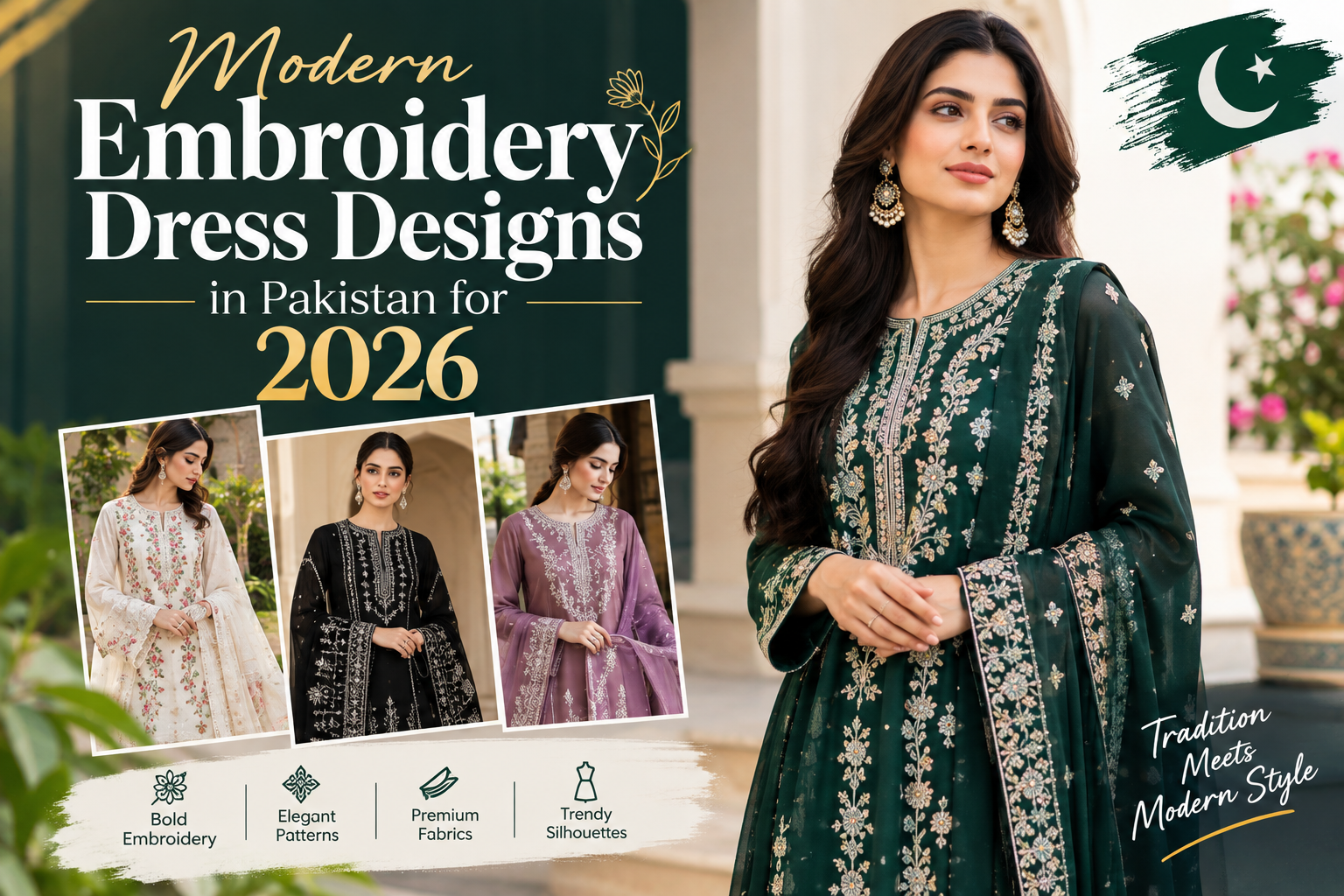
Modern Embroidery Dress Designs in Pakistan for 2026
Almost everyone starts in the wrong place. They find the dress first — a photograph, a shop window, a friend’s outfit at a dinner — and only afterwards ask how long it will take to make. By then the answer is usually a number they do not want to hear.
Embroidery is not a finish applied at the end. It is the slowest part of the garment, and the everything else waits for it. Understand that and the rest of this article becomes a calendar rather than a wish list.
Quick answer: Modern Embroidery Dress Designs in the Pakistan for 2026 have moved away from all-over surface work toward deliberate placement — thread matched tonally to the base cloth, raised floral work built up in layers, and a fine metallic wire scattered rather than massed. Handwork of any depth needs months, not weeks, so the design you can have depends largely on the date you are working toward.
What Has Actually Changed This Year
The card: Coverage is out. Precision is in. The confident choice in 2026 is less embroidery, better placed.
For years, formality was measured by how much of a garment was covered. A heavily worked shirt read as expensive because the labour was visible from across a room. That equation has quietly inverted. What signals quality now is restraint — a single motif that sits exactly right, a border that stops where it should, a bodice that carries its detail and then leaves the rest of the cloth alone.
Three directions define the year, and they are worth separating because they behave very differently in the hand.
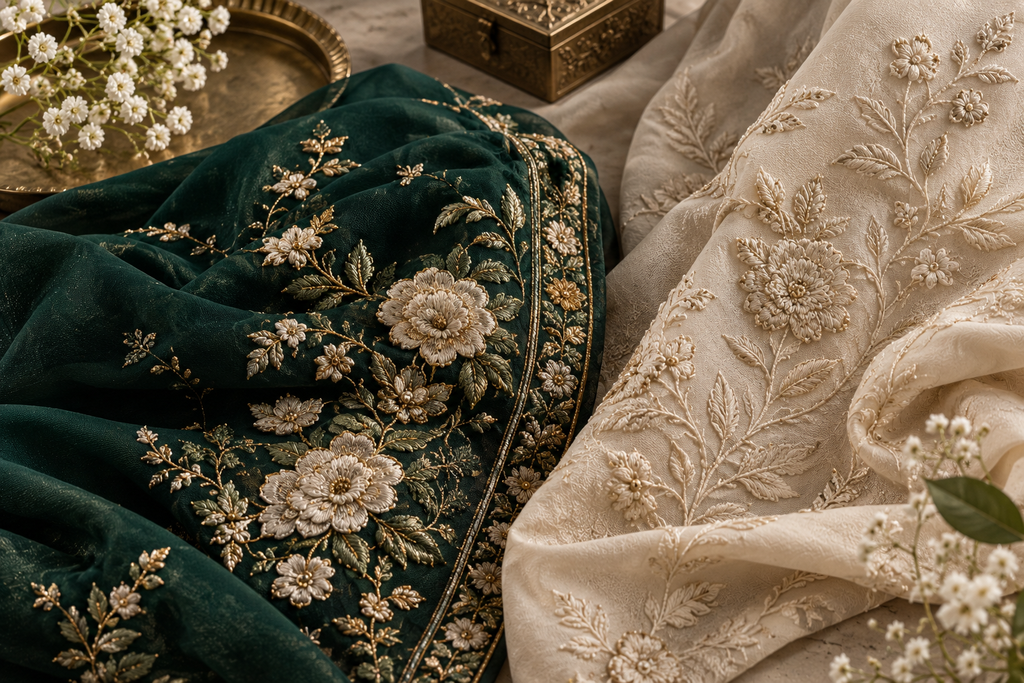
Tonal work. Thread in the same family as the fabric beneath it. Cream on cream, olive on sage, terracotta on rust. From a distance the eye registers texture rather than pattern; up close the detail arrives. This is the most forgiving direction in the year because it flatters at every price point and it does not date. A tonal piece made in 2026 will still look considered in 2031.
Raised floral work. Petals constructed in layers so the flower stands off the surface rather than lying flat against it. It is the most photogenic of the three, because dimension means shadow and shadow means depth in a picture. It is also the heaviest, the slowest, and the most fragile.
Fine metallic detail. Very thin flattened wire, worked into scattered dots or small linked patterns. The whole point of this family of techniques is shimmer without mass — light on the cloth without weight on the shoulders. It suits warm climates, long daytime events and anyone who has ever taken off a formal outfit early because the sheer heft of it became unbearable.
Colour has followed the same instinct. Softer neutrals — bone, oat, champagne, or pale clay — carry the light work, while the darker end has moved from bright primaries into a wine, ink, moss and burnt copper. The loud saturated palette has not disappeared, and but it now reads as a deliberate choice rather than a default.
[https://emanembroidery.store/modern-embroidery-ideas-2026-fresh-designs-for-every-style/]
Modern Embroidery Dress Designs In Pakistan For 2026: The Ordering Timeline
The card: Choose the method that fits your calendar, then choose the design inside that method. Never the reverse.
Everything below assumes you are commissioning rather than buying finished. Add shipping time if you are ordering across borders, and add more of it than you think you need.
| What you want | Working lead time | Cross-border buyers should add |
|---|---|---|
| Deep handwork across a full outfit | 4–6 months | 2–4 weeks shipping and customs |
| Semi-custom: existing base, added placement work | 8–10 weeks | 2–3 weeks |
| Tonal thread detail on a plain garment | 5–6 weeks | 2–3 weeks |
| Scattered metallic accents only | 3–4 weeks | 2 weeks |
| Stitching a pre-embroidered length of cloth | 2–3 weeks, longer in peak season | 2 weeks |
| Finished garment, altered locally | 7–10 days | none |
Two things make these numbers slip. The first is season — every workshop on earth is slower when everybody wants the same thing at the same time. The second is indecision. A week spent changing your mind about a neckline is a week the artisan cannot spend stitching it.
Right Now: Secure The Maker Before You Settle The Design
The card: In September, availability is scarcer than inspiration.
If you take one action this week, make it this: find out who has capacity and when their books close. You can decide on motifs later. You cannot conjure a skilled pair of hands in November.
Ask three questions and listen carefully to the answers.
What is in your queue right now? A vague answer is itself an answer.
What is the last date you will accept new handwork for a December event? Any maker who will not name a date is not managing a schedule.
What have you finished recently in the technique I want? Skill is not transferable across methods. Someone who does beautiful flat thread work may have no experience building raised florals, and the gap will show.
Measurement practice tells you a great deal too. A garment that fits properly through the shoulder, bust and the upper arm needs a proper set of measurements taken on the body, not a size guessed from an a old outfit. If the new process takes four minutes, expect a four-minute result.
Book with a written date and a receipt. Verbal arrangements evaporate the moment somebody with a bigger order walks in.
By The End Of September: Pick The Method, Not The Motif
The card: The method decides weight, cost, drape and delivery. The motif is decoration on top of that decision.
It helps to the know roughly what you are choosing between, because the vocabulary can be intimidating and the very differences are real.
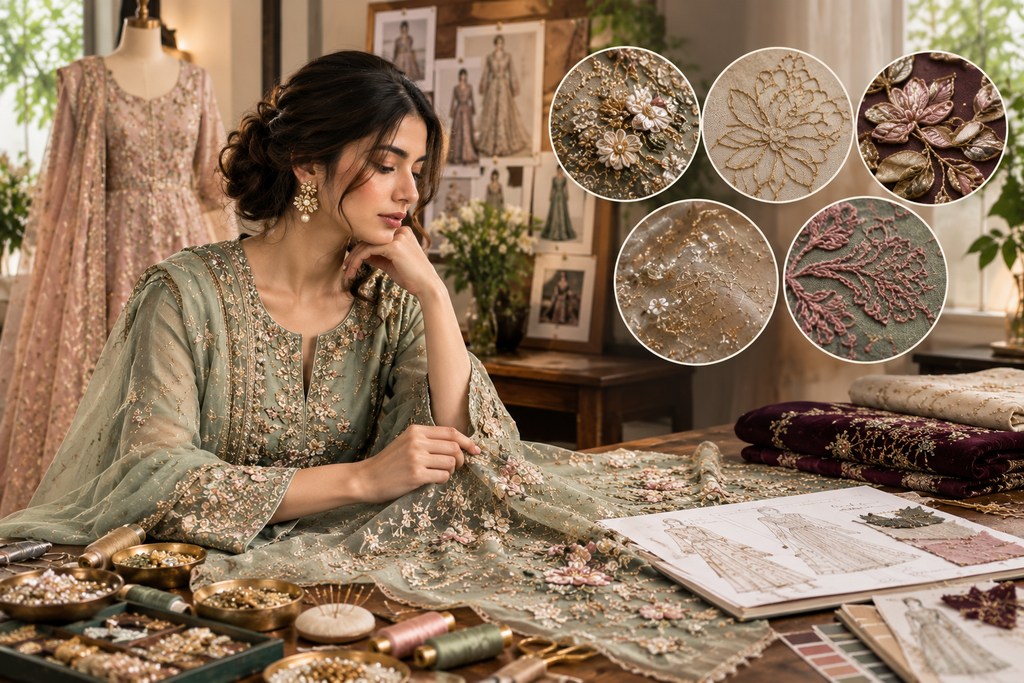
Frame-based handwork. Cloth stretched taut over a wooden frame so several techniques can be layered with precision — raised metallic coils, flat thread fills, small mirrors, tiny beads, all built into one composition. This is the deepest and slowest family of work and the reason bridal pieces take months.
Outline work. The pattern is drawn in stitched line rather than filled in. Quiet, architectural, surprisingly modern, and considerably faster than fill work because the artisan is covering a fraction of the surface area.
Ribbon appliqué. Narrow metallic ribbon folded and stitched down into shapes — leaves, petals, geometric borders. Festive, bold, and quick, which makes it the practical friend of anyone working to a short deadline.
Fine wire work. The lightweight metallic family described earlier. Best on chiffon, organza, fine cotton and anything you intend to wear in heat.
Chain-stitch hook work. Made with a hooked needle rather than a straight one, which lets an experienced artisan cover ground fast in flowing continuous line. It offers the best ratio of visual impact to hours spent, and it is badly underrated.
For a December event decided today, ribbon appliqué, wire work and hook work are all comfortably achievable. Deep frame-based handwork is not, and you should be wary of anyone who tells you otherwise.
[https://emanembroidery.store/modern-embroidery-ideas-2026-fresh-designs-for-every-style/]
Through October: Placement, Cloth And Coverage
The card: This is the last month in which changes cost you nothing.
Placement. Decide it on paper. Ask for a flat sketch of the garment with the embroidery positions marked — how far the neckline detail extends, where the sleeve work stops, whether the hem border runs all the way around or breaks at the side seams. Look at the sketch sitting down, not just standing, because a border placed on the natural hipline behaves very differently once you fold. Every ambiguity you resolve here is an argument you avoid later.
Cloth. Fine transparent fabrics carry light wire work and delicate thread beautifully but will pucker under anything heavy. Structured silks hold their shape and suit sculpted evening pieces. Velvet has real presence in cold weather but tends to absorb metallic shimmer rather than reflect it, so pair it with matte thread or accept the muting. Whatever you choose, ask for a small stitched sample on the actual fabric before full production begins. A technique that looks perfect on a showroom swatch can behave completely differently on your cloth.
Coverage. Full sleeves, a long hem, a high or draped neckline and a wide outer layer are not compromises in 2026 — they are the prevailing silhouette. A structured overlapping-front tunic with wide trousers and a generous draped stole covers thoroughly while reading as entirely current. If modest styling matters to you, this is a good year: you will not have to fight the trend to get it.
One practical instruction that saves grief: ask what lining will sit behind any sheer embroidered panel, and see it. Discovering a see-through bodice at the fitting stage is a two-week problem in a two-day window.
Six Weeks Out: The Fitting You Cannot Skip
The card: One honest fitting now removes the panic later.
By around late October for a December event, you should be standing inside a partly finished garment rather than looking at photographs of one. Test it properly, and say what you find out loud rather than hoping it settles.
- Can you sit comfortably, or does a stiff embroidered band land exactly where your body folds?
- Can you raise both arms fully? Worked sleeve caps and heavy shoulder detail restrict movement more than people expect.
- Does anything scratch? Raised metallic work and dimensional florals catch on skin at the underarm and inner elbow, and an hour in is too late to discover it.
- Does the outer drape hang or slide? Anything heavily worked usually needs weighting or a stitched-in edge to stay where you place it.
Every one of those is a free correction at week six and a costly favour at week two.
Two Weeks Out: Finish, Do Not Redesign
The card: From here the only sensible changes are small ones.
Fastenings, hems, pressing, linings lying flat, a secure edge on the drape. That is the entire acceptable list. Resist the urge to add one more motif; late additions are where good garments get ruined.
Wear the finished piece at home for twenty minutes before the event. Sit, stand, climb stairs, reach up, eat something. A garment behaves differently on a body than on a hanger, and you want that discovery to happen in your own room.
Finally, ask for your leftover cloth and matching thread back. Embroidered pieces snag on chair backs and car doors, and an invisible repair months later is only possible if the exact thread still exists.
If You Have Already Run Out Of Time
The card: Finished clothing is not a consolation prize this year. It is one of the genuine trends.
The market has shifted decisively toward complete, ready-made formal pieces, and the reason is simply that most people’s lives no longer accommodate a six-month commissioning process. There is no shame in this route and, done well, no visible difference.
Buy finished and alter. Allow ten days. Choose a size up rather than down — taking a garment in is straightforward, letting it out through embroidered panels usually is not.
Buy pre-embroidered cloth and keep the cut simple. The slow work is already done at source; you are only paying for a clean, well-fitted construction. Choose a straight silhouette rather than a panelled or gathered one, because panels mean cutting through the pattern and matching it again.
Rent. For a single event you will never repeat, particularly a heavy piece that would otherwise live in a box, renting is the rational answer. It is now normal in most major cities worldwide.
[https://emanembroidery.store/modern-embroidery-ideas-2026-fresh-designs-for-every-style/]
Planning Beyond December
The card: Three different peaks sit ahead of you, and they demand different lead times.
Readers are spread across very different calendars, and the smart move is to work backwards from whichever peak is yours.
Late 2026 into February 2027 is the dense wedding stretch across South Asia and the Gulf, when cooler weather makes large outdoor functions possible. Workshops are at maximum load; assume every quoted timeline stretches.
Early March 2027 brings Eid al-Fitr, following a Ramadan that begins in early February — exact dates depend on moon sighting, so treat these as approximate and confirm locally. Demand climbs steeply in the final ten days of Ramadan, which is precisely when you do not want to be ordering.
June through August 2027 is peak wedding season across much of Europe, North America and Australia, when families travelling internationally concentrate celebrations into the summer. If that is your event, you are in the comfortable position of being able to commission deep handwork now, at off-peak attention and, often, off-peak prices.
Key Takeaways
- The year favours precision over coverage: tonal thread, raised florals and fine metallic detail, all deliberately placed.
- Lead time is the binding constraint. Deep handwork wants four to six months; lighter methods can be done in weeks.
- Secure a maker before you finalise a design, and get placement marked on a sketch.
- The six-week fitting is where every fixable problem gets caught.
- Ready-made and rental are legitimate 2026 choices, not fallbacks.
- If your event is next summer, order now while workshops are calm.
What To Do This Week
- Fix your event date and count backwards using the lead-time table above.
- Contact two makers and ask each for their last intake date for that period. Compare honestly.
- Choose your method from what the calendar allows, then choose the design within it.
- Confirm the booking in writing, with a date, a deposit receipt and a sketch showing embroidery placement.
- Put the six-week fitting in your calendar today and hold everyone to it.
None of that takes more than a day. All of it becomes impossible in about four weeks.
FAQ
Does hand embroidery add much to the price of a garment?
Considerably, and the variation is enormous. Outline and scattered wire work sit at the affordable end; ribbon appliqué in the middle; layered frame-based handwork at the top, and where the embroidery can cost several times the garment beneath it. Ask for the pricing broken down per panel or per motif rather than as a single figure, and so you can see what you are actually buying and adjust the design to fit a budget.
Is machine embroidery ever acceptable?
Yes, and pretending otherwise is snobbery. Good machine work on a well-cut garment beats poor handwork every time. The honest difference is in irregularity — hand stitching carries small variations that catch light unevenly, which is what people are really responding to when they say a piece looks rich. For everyday formals, machine work is sensible. For a once-in-a-decade piece, handwork earns its cost.
Can tonal embroidery work on dark colours?
It works particularly well. Wine thread on wine cloth or antique gold on deep brown gives texture at close range and a clean, uninterrupted silhouette from across a room. The whole effect depends on the sheen difference between thread and fabric, so insist on seeing a stitched sample in daylight rather than under shop lighting.
Which embroidery survives repeated wear best?
Flat techniques outlast raised ones. Work that lies close to the surface takes friction, folding and storage far better than anything built up in layers. Heavy dimensional florals and coiled metallic work are beautiful and genuinely fragile — plan for a handful of outings, store them flat rather than hanging, and never let anyone press directly over the work.
How do I order embroidered clothing from another country without disaster?
Send measurements taken by someone else, on your body, in centimetres, alongside a photograph of a garment that currently fits you well. Ask for progress pictures at the halfway point. Confirm who pays import duties before anything ships. And build in a fortnight of slack, because customs delays are the single most common reason a garment misses its event.
Is it too late to commission something for January?
For lighter methods, no — that is a workable window. For deep handwork on a major piece, it is very tight, and a workshop that agrees enthusiastically is either unusually quiet or not being straight with you.